
Bids for 900MHz licences among world’s most costly


Play
INTENSE AUCTION FOR 4G CELLULAR SERVICE SET TO ENTER ITS FIFTH DAY
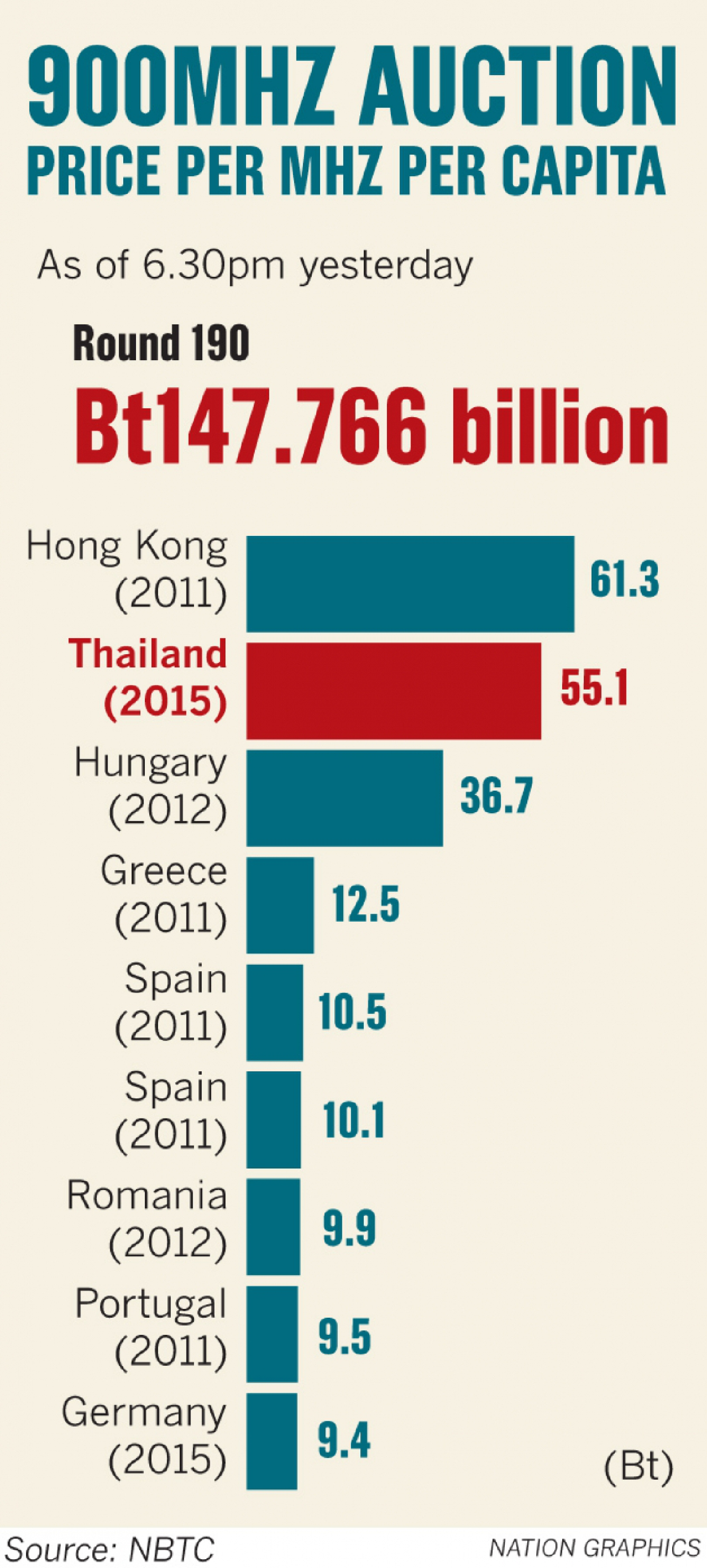
THE AUCTION for two fourth-generation telecom licences on the 900MHz spectrum has entered the fourth day, with the combined price surging beyond Bt147.7 billion and placing them among the world’s most expensive permits.
The latest bid makes the two licences the world’s second most expensive at around Bt55.10 per megahertz per capita, compared with Hong Kong’s Bt61.30, while Hungary’s Bt36.70 was the world’s third most expensive.
The Hong Kong price was based on its spectrum auction in 2011, while the Hungarian price was set in 2012.
Of the four bidders for Thailand’s two 900MHz licences, one unnamed contestant yesterday reportedly dropped out as of press time when the combined price for the two licenses rose to Bt147.766 billion.
The minimum starting bid for the two licences was Bt12.680 billion.
The bid for the first licence block is Bt73.078 billion, while that for the second block is Bt74.688 billion. The |total of bids for the two licences dwarfed final total price of the two 1,800MHz licences auctioned last month, which |was Bt80.788 billion.
At the start of the auction the four bidders were Advanced Wireless Network (AWN) of Advanced Info Service (AIS), DTAC TriNet of Total Access Communication (DTAC), True Move H Universal Communication (TUC) of True Corp, and Jas Mobile Broadband of Jasmine International.
A telecom analyst said that if both AWN and DTAC TriNet won a licence for Bt70 billion each, their spectrum depreciation cost per year would be Bt4.7 billion.
Their funding costs would gradually rise from Bt440 million in the first year to Bt3.9 billion in the fourth year, the analyst said. These two costs combined could cut into DTAC’s 2016 earnings by between 20 and 30 per cent.
The impact on AIS’s profit would be below 10 per cent, the analyst said.
Information and Communications Technology Minister Uttama Savanayana inspected the auction at the National Broadcasting and Telecommunications Commission. He said that as far as he knew TOT’s board had no plan to take legal action against the auction of the bandwidth it held on 900MHz under the former concession regime.
TOT had granted the concession to AIS to provide cellular services. After AIS’s concession expired in September this year, the NBTC reclaimed the 900MHz spectrum for the auction.
The TOT’s labour union believes that TOT is entitled to hold the spectrum until its licence ends in 2025.
Uttama said Prime Minister General Prayut Chan-o-cha thanked all parties involved in the auction for bringing benefit to the country, given the licence upfront payments would be transferred to the state. The government will spend the money on social and economic developments, Uttama said.
AIS’s share price fell 3.02 per cent to close at Bt193 yesterday, while DTAC’s dipped 10.06 per cent to Bt38, True fell 1.36 per cent to Bt7.25, and Jas remained unchanged at Bt4.78.
The NBTC said there were conditions that would prevent the eventual winners of the licences from overcharging consumers, some of whom were concerned that the high prices garnered by the auctions would lead to expensive 4G services.
Some analysts have said the high prices reflected transparency in the auction process, allowing maximum competition among all the companies wanting to secure the licences, which would be crucial to their competitiveness in the country’s lucrative cellular-phone sector.
