
The waves never stopped
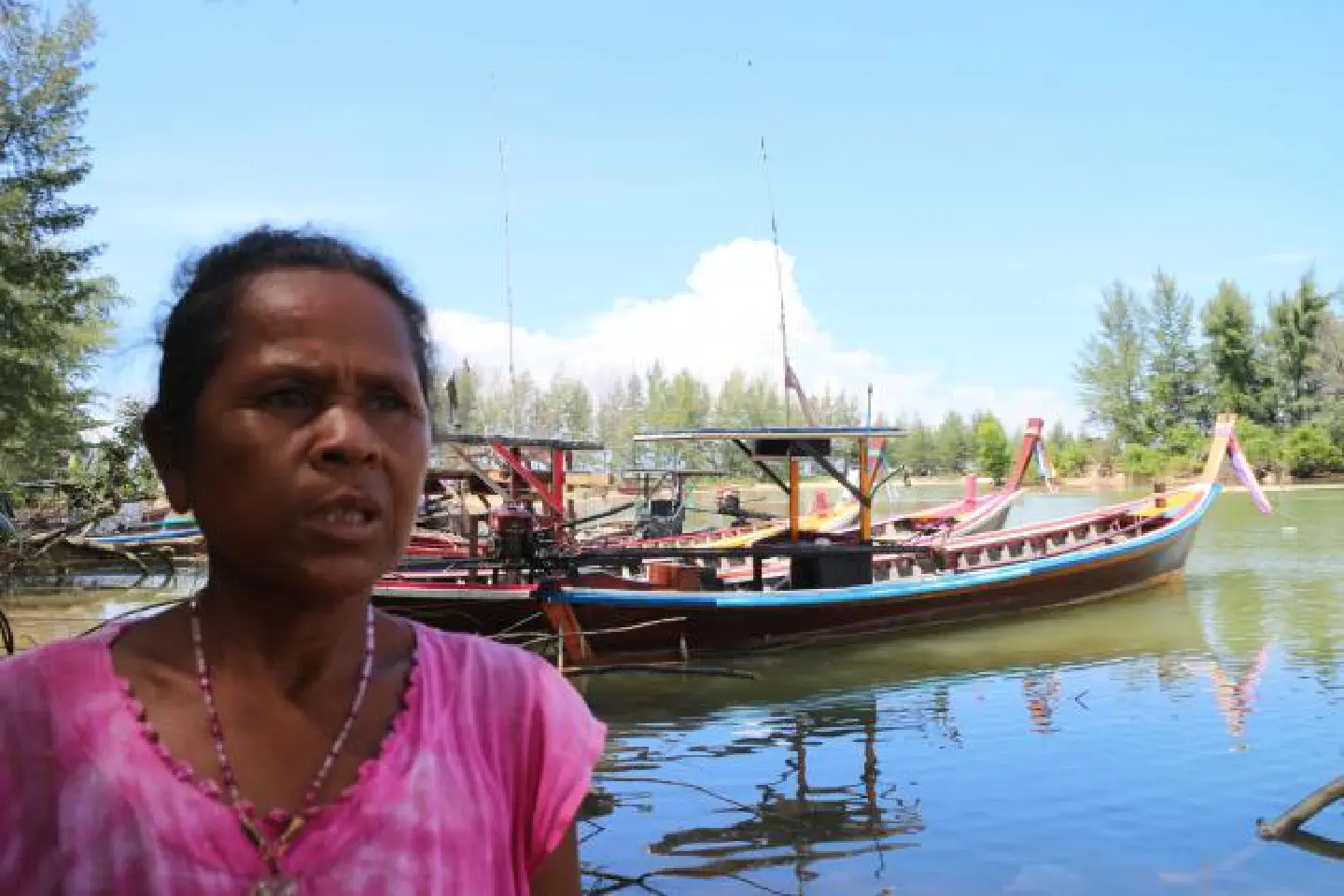


Sea gypsy losing hope in decade-long fight to keep ancestral land
WHEN GIANT WAVES swept through a sea-gypsy community in Phang Nga’s Takua Pa district in late 2004, locals lost not just their houses but also land plots where their ancestors had lived for generations.
“My grandparents and my parents lived and died here on this plot of land. It’s mine. I can’t understand why after the tsunami hit, someone else tried to take it away from me,” Larp Harnthalay said with a glitter of desperation in her eyes.
The 55-year-old sea gypsy, who is from a Moken tribe, is the last resident to continue the decade-long battle against an investor who has produced title deeds to claim 24 rai (3.85 hectares) of land in Tap Tawan community.
Larp admitted that she had been confident that she would win when the investor first showed up in early 2005. By law, people can claim ownership of a property that they have openly occupied for at least 10 years without being challenged.
“Why would the court listen to a city resident and her single document? We have lived here for generations. Locals here know each other,” she said.
She added that the graves of their ancestors and coconut trees grown by them should be solid proof that they have the right to all the plots in Tap Tawan community.
But as the 10th anniversary of the tsunami approaches, Larp now bitterly reckons that she might have engaged in a battle she could not win.
Other locals have already given up hope, agreeing to accept whatever the title-deed holder offers. They have accepted smaller land plots than they used to have in exchange for the right to get a proper title deed that the investor agreed to provide.
Rampa Kulwanich has produced evidence that she owns 33 rai of land in the Tap Tawan community, including the one Larp had been living in. Her evidence comes in the form of Nor Sor 3 Kor title deed, which was issued in 1972. Though the land previously belonged to other people, Rampa said she has evidence that she legally bought the plot from the original owner.
Tian Harntalay, 47, said he agreed to compromise with Rampa only because he did not think his family could win a legal battle against the investor.
“We don’t have money to fight the case,” he said. “When we contacted our district office to check land maps, we were told to contact the lands office instead. It’s complicated.”
Tian accepted the investor’s offer in 2009, and got the title deed the following year.
Larp, however, was determined to fight on, as she said she needed to protect the land that belonged to her ancestors and pass them on to her descendants.
“I won’t bow down. I will fight until the day I die. My family has lived here for hundreds of years,” she said.
Today, she continues to reside on the plot of land where she has lived since her birth. But things are far different from what they used to be before the devastating tsunami hit her community on December 26, 2004.
All her neighbours have about half the land area they used to own, and Larp has been living with deep fear that her child and grandchild will not have a place to build a home in the end.
Larp is the only resident in the Tap Tawan Community who does not have a title deed.
“I started learning the Thai standard language after the tsunami hit. That’s because I need to contact various authorities in a bid to protect my ancestors’ land plots,” said Larp, who has only a Prathom 4 education and used to speak only the local dialect.
Her voice shook with emotion every time she mentioned what she saw as an injustice.
“Before the tsunami, we never faced such problems,” she said.
Tian said he also felt deeply frustrated, sad and enraged to see how investors had even encroached on the Moken graveyard zone.
He said Pakveep Graveyard had long provided the last shelter to the bodies of Moken people from three local communities including Tap Tawan. It used to span well over 60 rai.
“But you know, the graveyard zone how has just 6 rai only,” Tian said. “There’s now a hotel going up on the graveyard of our ancestors.”
The Moken are an Austronesian ethnic group colloquially known as sea gypsies; their Thai name is chao le, which translates as “sea people”. It is estimated that there are more than 10,000 sea gypsies in 41 communities across Thailand’s Andaman provinces.
Fifteen of these communities have reported land problems. There have been problems at seven sea-gypsy graveyards too.
Larp said her struggle to cling to her ancestral land had also made it harder for her to earn a living.
“I used to pan for tin, but this is not possible any more. Hotels have mushroomed and there are no mines in my neighbourhood any more. Hotels have beautiful landscapes. They won’t allow me to pile anything in their zones,” she said.
She said an old woman like her faced a tougher situation than the young.
“Young people can find jobs at the hotels. My last resort is to find squid in the sea,” said the sea gypsy.
