
Waste not, want not


Play
Designers and manufacturers join up for the third edition of "The Cooperation" project
IN A WORLD that seems to be drowning in its own waste – more than 1.2 trillion kilograms of it according to current annual estimates – it is both refreshing and reassuring to see designers and manufacturers working together to find new uses for commercial and industrial leftovers that would otherwise find their way to the dump or junkyard.
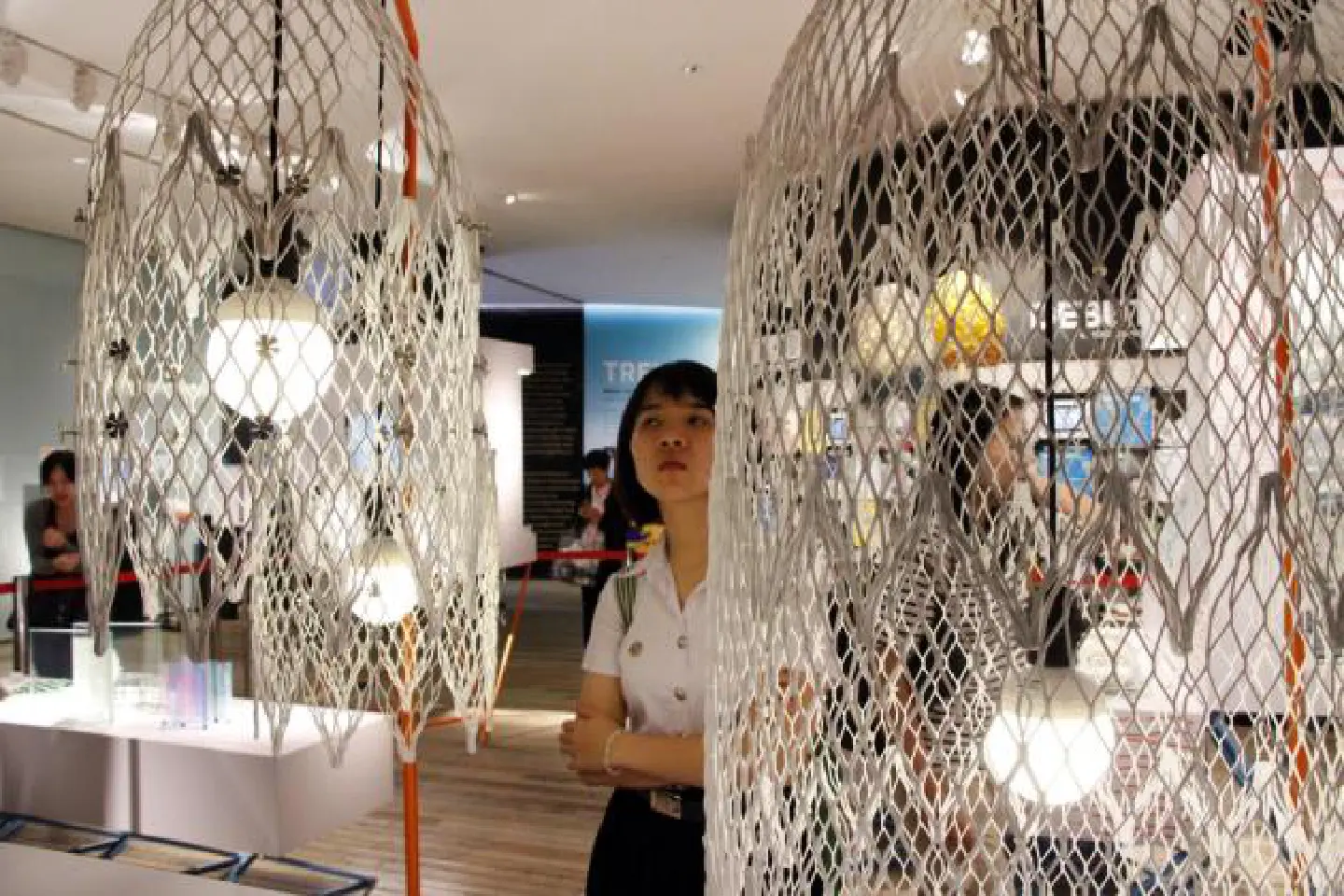
The fruits of their collaboration are currently on show in “The Cooperation 3” in the lobby of the Thailand Creative and Design Centre (TCDC) and feature a range of interesting designs made from such semi-finished materials as mawata, as the waste from silk yarn production is known, bioplastics, bamboo strips, laminated glass and expanded metal sheets.
The mawata, often pressed into sheets as filling for duvets, becomes a star in its own right as a beautiful lampshade while bioplastics morph into a salad lunchbox for health-conscious consumers.
Organised annually by Material Connexion Bangkok – a global library of advanced, innovative and sustainable materials – these and the other prototypes on show were given life during a nine-month project that asked five pairs of manufacturers and designers to develop a product with commercial potential, viability for industrial production and that was easy to make.
Phetchabun-based Chul Thai Silk has been producing silk yarn for more than 50 years and has amassed an excess of mawata that it freely admits is not being put to good use. To maximise its potential, the company worked with textile designer Arisara Dangprapai to create prototype products using mawata while preserving all its outstanding properties.
“Mawata is the delicate inner part of a silk cocoon. While it has a glossy texture, its structure is too soft and too easily spoiled to hold its form. So we normally use it to produce spun silk or press it into sheets for stuffing duvets. Once spun, mawata loses its outstanding shine and is usually not durable enough to withstand multiple washes,” says Radachaya Cunvong of Chul Thai Silk.
Arisara experimented with several techniques to try to strengthen the material and discovered early on that it could be made into thin sheets, which could be sewn together using an adhesive fabric interlining. That made it durable enough to hold its form and even allowed for dry-cleaning. Batik-dyed colour was applied directly to the sheet with paintbrushes to give a natural watercolour effect.
To test how the material could be developed for lifestyle products, the mawata sheet was sewn together in a freeform pleated texture to create a lampshade, and also folded into thick layers and wrinkled for a blanket.
“Although it’s not the best option to strengthen the material, this combination of techniques is a good option to highlight mawata’s unique qualities. After several experiments, we found that mawata couldn’t be melted with sulphuric acid and left to dry in a solid form. And when we tried to dye it, both with heat and non-heat technique, the colour was uneven and the mawata sheet was spoiled,” Arisara says.
Jiratt Leowkijsiri of Thai Techno Glass Co is well aware that his large sheets of glass require complex transport logistics and expert installation, making them unsuitable for use by ordinary customers. He teamed up with Rachaporn Choochuey and Sorawit Klaimark from the design firm all(zone) to come up with a piece of glass that can be easily transported and installed.
“We agreed to focus on an architectural scale but to stick to a free-standing piece that requires no expertise for installation. It should not be too heavy either, so that it can easily be moved and carried by one person.” says Rachaporn.
“We started by developing a free-standing curved glass wall that could function as a partition but during the development process, we discovered limitations with the glass tempering so had to set aside this idea.”
The duo then turned their attention to easy-to-install and foldable laminated glass that is still free standing. The glass is integrated with a strong and tensile fabric that acts as a foldable joint and adds both a transparency and a pattern. With time marching on, they eventually produced a hanging, foldable, laminated glass screen, which can be adapted to fit any interior space.
Although Reangwa Standard Industry produces a wide variety of plastic products, it was challenging for Decha Archjananun and Ploypan Theerachai, the founders of Thinkk Studio, to come up with a product that best presents the potential of bioplastic as a non-toxic eco-friendly material.
They eventually decided on a stacked salad lunchbox inspired by the form of a traditional tiffin. The colours are inspired by fruits and vegetables such as tomato red, cabbage purple, and corn yellow.
“Salad requires careful storage otherwise it goes limp. Our portable lunchbox has different compartments to keep vegetables, meats, crunchy toppings and salad dressings. The lower level is a vegetable section with a strainer and the lid is a gel pack that keeps vegetables fresher for longer,” says Decha.
“While petroleum-based plastic takes hundreds of years to decompose, bioplastic made from agricultural by-products takes only three months to two years. The salad lunch box consists of many components, but the production process is not complicated and the box can go immediately into production. It’s a niche market anyway,” adds Paiboon Palajin, product manager for Reangwa Standard Industry.
Designer Suppapong Sonsang joined with Kasien Phaovanij of Thai Metal Perforation to explore the potential for developing the firm’s expanded metal sheets for heavy industry into consumer products.
Suppapong redesigned the industrial sheets as a modular product. The sheets were reshaped into a more curvaceous form so that they could be made into larger 3D figures and the ends were attached together, forming a leaf-like shape that is expandable.
“This extended metal module can also be used for various design functions,” says Suppapong. “For a visual presentation, the metal sheets are joined to form a hanging lamp that uses a minimal amount of metal and can be reshaped into different sizes.”
Initially Kornpak Meesitita of Fasttechno Co, a wooden furniture and interior decoration material manufacturer, asked designer Ratthee Phaisanchotsiri for ideas on how to transform bamboo waste from the assembly line into DIY furniture.
What Ratthee presented to Fasttechno was not an end product – a piece of furniture – but a new method of working with the waste that increases its production potential. The semi-finished products can also be adapted for use in other products.
Compressed bamboo strips 1 to 2 mm thick are woven into desired patterns before being moulded into 3D shapes with heat. This approach not only enables mass production but also saves time. Furthermore, it does not require skilled workers, thus easing labour problems.
DIFFERENT DESIGNS
“The Cooperation 3” runs until November 15 at the Thailand Creative and Design Centre on the fifth floor of the Emporium mall.
It’s open daily except Monday from 10.30am to 9pm. Admission is free. Call (02) 664 8448, or visit www.TCDC.or.th.
