
Dualities emerge


Play
Somtow Sucharitkul’s epic Buddhist “challenge to Wagner” creates a buzz, but “Das-Jati” is shaping up to be quite different
AS OPERA FANS around the world are learning, Somtow Sucharitkul is composing a cycle of 10 operas based on the final incarnations of the Buddha.
The story of those lives is known in Thai as the Tosachat. Somtow uses the Sanskrit transliteration “Das-Jati”, which causes a momentary dissonance for Thai readers but makes the title more comprehensible to Buddhists elsewhere in the world, both Mahayana and Theravada.
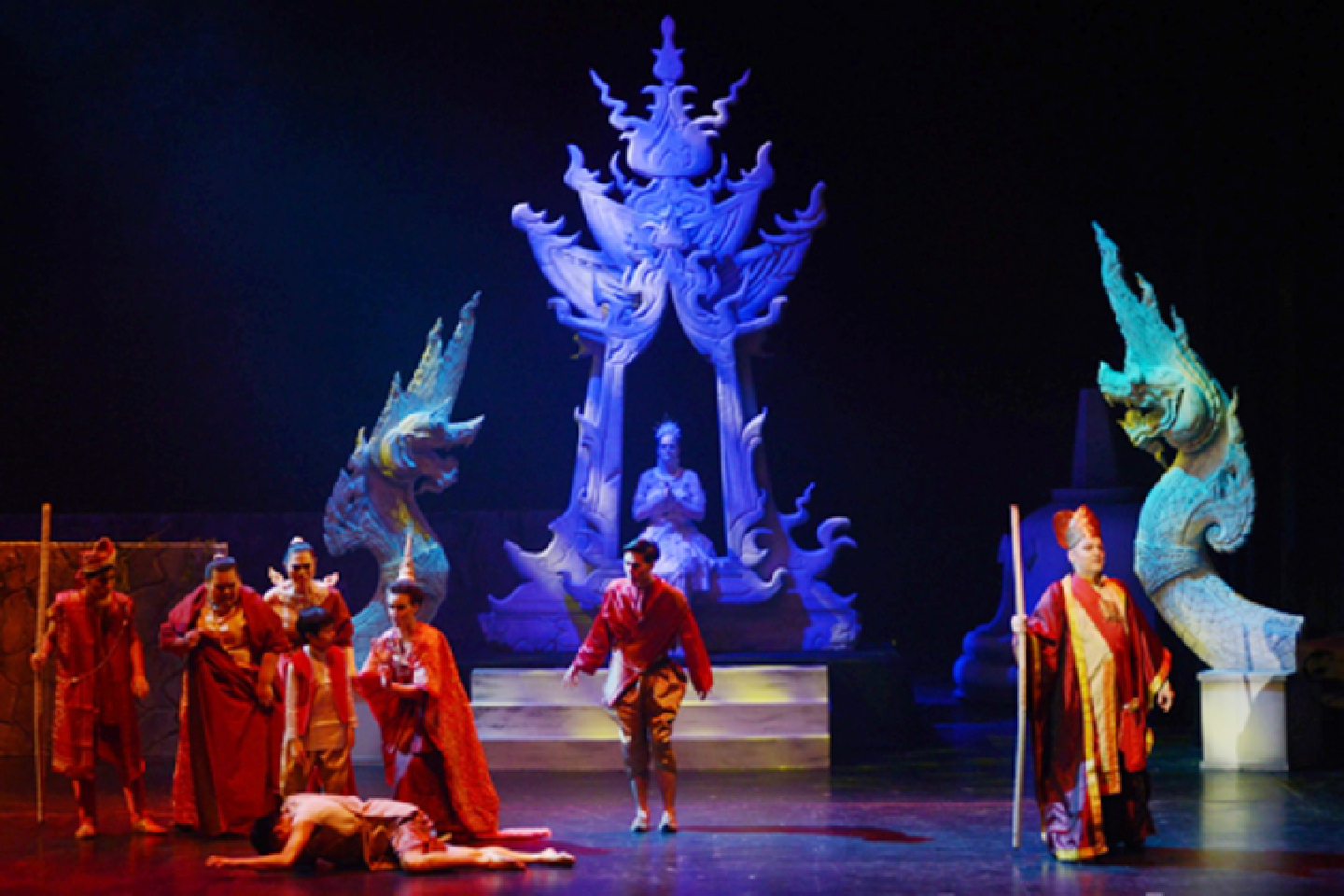
In “Suwana Sama – The Faithful Son”, the fourth instalment presented earlier this month at the Suryadhep Music Sala – the magnificent new theatre in Rangsit – Somtow inched a little closer to challenging the world domination of Wagner’s “Ring Cycle”.
Although “Das-Jati” and “The Ring” have the same, almost hubristic vision in common, there’s very little in common between them. The latter plays out over huge spans of time – literally – with a 30-minute love duet in “Siegfried” and a 20-minute suicide aria in “Gotterdammerung”. To enjoy “The Ring”, you really have to set the whole world aside and get into “religious experience” mode.
Although the subject matter of “Das-Jati” is religious, its component episodes are created much more for today’s shorter attention spans. Like the three previous offerings, “Suwana Sama” squeezes complex storytelling, philosophy and characterisation into much smaller packages.
The plot is less spectacular than the three already produced. It’s an intimate family drama, mostly set in the sacred forest of Himavant, whose non-singing inhabitants – the Kinnaree, Garuda and other magical creatures – are played by dancers, their movements intricately choreographed by Puwarate Wongatichat.
Though smaller in scale, this work is in some ways the most emotionally affecting thus far.
Inventively scored for two small chamber orchestras, one on either side of the conductor, the opera is of a piece with the exotic, multihued “Das-Jati” world. It is equal parts Indian, Thai, Balinese and neo-romantic. With the odd sprinkle of atonality, it has a sound that Somtow has made uniquely his own, instantly recognisable among modern composers.
A statue of a yakkhini named Bahusodari dominated the set. At the show’s climax, the statue came to life and sang a sensational aria. Houston-based soprano Cassandra Black, as the statue, remained motionless for 70 minutes, so that the audience had pretty much accepted her as part of the set, and her coming to life produced audible gasps. It was an idea more effective than any hi-tech gimmick and Black carried it off to perfection.
The effective performances of Damien Whitely as both the good king and the evil king, of Kaleigh Rae Gamache as both the messenger of the gods and the very lusty Queen of Kashi, brought home the point that the opera is about opposites.
It is in fact two orchestras. The plot concerns the citizens of two villages who seek to become one, and are thwarted when their two beloved scions refuse to be married because they’ve taken a vow of perpetual chastity.
It’s two worlds as well. There are the brash city-dwellers of Kashi, with their eccentric king, and the peaceful magical forest, fuelling a confrontation between man and nature that somehow echoes contemporary environmental concerns (not to mention making an oblique reference to Bambi with a scene of a wounded stag).
Heaven and earth, life and death – it’s an opera that plays with dualities, and with the ambiguities that make them not so opposite after all.
Somtow recently stated that, of the 10 “Das-Jati” tales, this one is most similar to the Christmas story. “It’s got a virgin birth and an incarnated god who is slain by an unfeeling tyrant and is resurrected through the power of love,” he said. “The hero is shown as an exemplary human being, living a life of gentleness and goodness. In the end, murderers are forgiven and the blind are healed. I don’t know whether the Christmas story travelled east or west, but I don’t think these parallels are accidental.”
The “challenge to Wagner” angle has been good for the international buzz over “Das-Jati”, but the series is shaping up to be something quite different. It has a lighter touch, a bit of whimsy and, when all 10 are staged in 2020, it will apparently, literally, have the proverbial “cast of thousands”. It is no less moving than Wagner – it merely moves at a more contemporary pace!
Stan Gayuski is a member of the International Mahler Society and often writes about classical music for international media.
