
Outlasting the years


Play
A new exhibition at the Thailand Creative and Design Centre proves that you are only as old as you feel
MUCH HAS BEEN written about the greying population and how longer life expectancy combined with low fertility rates is likely to turn Thailand into an ageing society well before the middle of this century.
But who will care for these elderly people? Will their children or even grandchildren shoulder the care as part of the long-cherished but rapidly disappearing extended family, will it fall to the government to assume responsibility or will the advent of new technology allow them to look after themselves?
The exhibition “New Aged Citizens: New Definitions, New Opportunity and New Challenges” currently showing at the Thailand Creative and Design Centre attempts to answer these and other related questions.
Asked “who will be responsible for your care when you get old”, a 20 year-old student had no hesitation in placing her black sticker – the colour denoting Generation Z – on the wall marked “government”, ignoring such other choices as family, self, not sure and others.
Faced with a different set of questions, a 45-year-old office worker with a green sticker representing Generation X opted for “loneliness” rather than health, transportation, savings and technology, when asked what he felt was the biggest issue facing older Thais.
The exhibition hopes to discover the attitudes and feelings of the different generations – defined as Gen Z (six-21 years old), Gen Y (22-35), Gen X (36-51), Baby Boomers (52-70) and Silent Gen (over 71). And while their answers do reveal differences in attitudes, most immediately pair physical condition with old age, and are unanimous in their view that Thailand is not ready to handle the aged society in the next five years when 20 per cent of the country’s population will be 60 or older.
“In just 34 years, the world will become an aged society with one in five people over the age of 60, according to the United Nations’ 2015 World Population Prospect,” says senior curator Nunnaree Panichkul.
“But age is just a number. From the questions we’ve posed to participants, we’ve learnt that several 20-year-olds feel older than their age while most 60-year-olds feel younger than their years and believe they might well live to 110. Year of birth is no longer an indicator. We need to look at social profiles, behaviour, lifestyle and other fluid factors. This exhibition aims to create understanding and disseminate knowledge, opportunity and challenges that will come with our aged society.”
The low fertility rate and high life expectancy are demonstrated graphically in a population pyramid that covers the period 1950 to 2050 and is divided into gender and age group. Visitors are invited to select a specific year and the left side will show a graph of Thailand’s population. From the right, they can choose the pyramids for the World, Singapore, Japan, India, the US and Sweden. In Thailand, the 0-4 age group contained the largest number of people in 1960 with the numbers thereafter declining steadily as the ages increased. Compared to 2020, the bulge extends much further, covering the age groups 30-64.
Another part of the show reveals that advanced medical technology coupled with 3D-bioprinting technology will make it possible to produce better and more affordable replacement organs for all. This could mean that babies born in 2015 will live to the ripe old age of 142, as suggested by Time magazine. And then there’s the exVive3D Liver model produced by Organovo, which mimics the macro and micro 3-D structure of the human liver and a suite of the organ’s cell types and offers preclinical in vitro testing services that could help medical researchers and pharmaceutical companies predict the toxicity drugs have to the human liver.
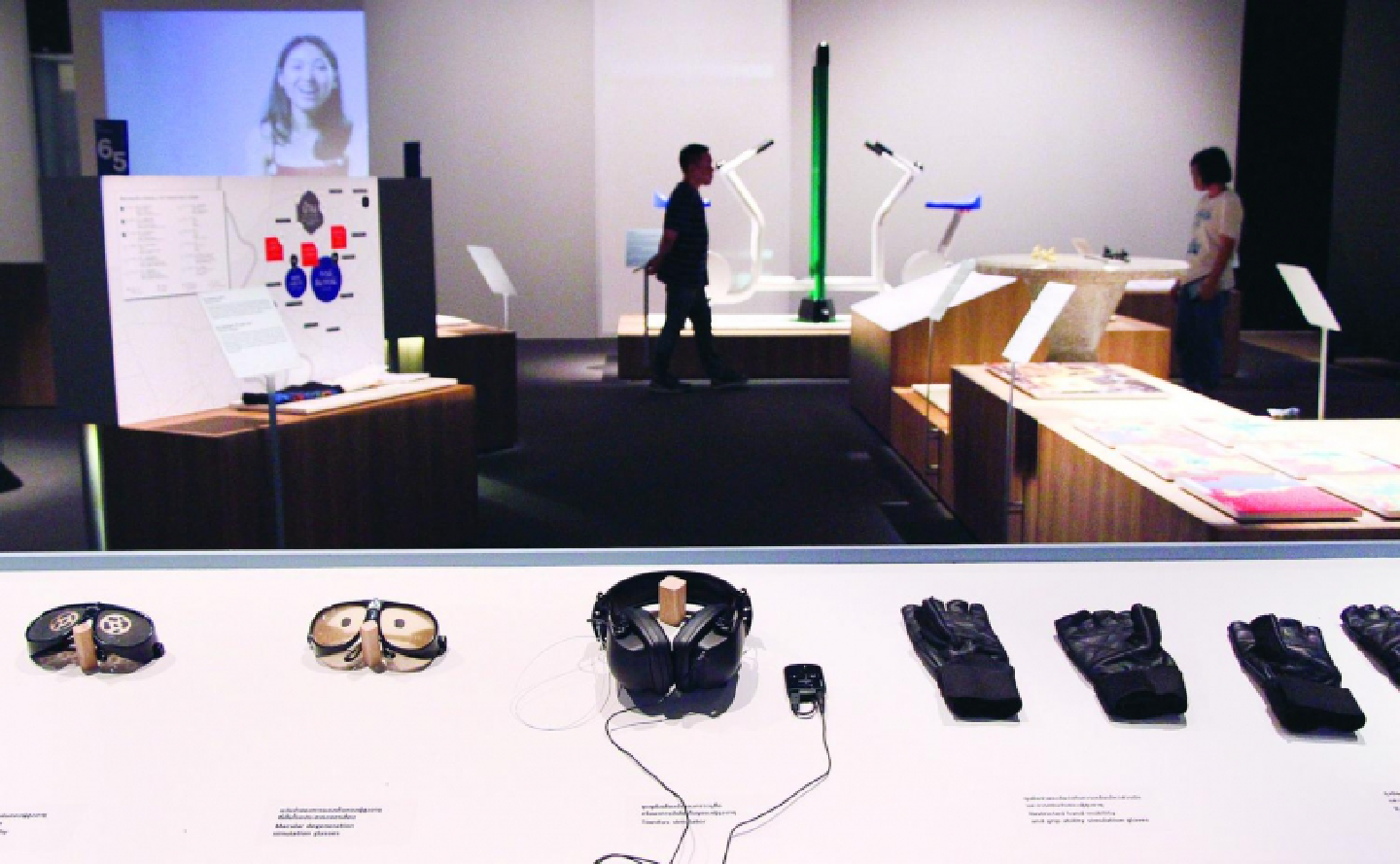
Adjacent is a showcase of wearable gadgets that can track steps, calories, distance travelled, caloric intake, heart rate and sleep. While the fitness tracker is individually tailored and records the user’s personal physical data, it’s still too early to say whether it can be clinically validated to perform at the same standard for reliability as a medical-grade device. But in the near future, who knows?
The age simulation suit called Gert from Produkt+Projekt Wofgang Moll allows younger people to experience the impairments faced by older people in terms of opacity of the eye lens, narrowing of the visual field, hearing loss, head mobility restrictions, joint stiffness and reduced coordination skills. Viewers can also try restricted hand mobility and grip ability simulation gloves, a tinnitus simulator, and simulation glasses to experience the sight of elderly who suffer from diabetic retinopathy, macular degeneration, cataract, and glaucoma.
“Product designers are increasingly turning their attention to developing basic tools and mobility aids based on detailed insights to meet the diverse lifestyles of the elderly,” adds the exhibition’s curator Piyaporn Aroonkriengkrai.
“Using the Asimo robot technology, Honda has developed its Uni-Cub Beta – a lightweight and compact electric scooter or personal mobility device steered by weight shift control,” she explains
Danish brand Sabi, meanwhile, has revolutionised the walking cane and offers a range of options from sporty to chic to classic. All are engineered for comfort and safety, and come in a variety of bright colours. A rubber pad on the side allows the cane to lean against a wall without falling. A rubber foot improves stability and reduces the noise of the stick hitting the floor – a reminder of old age – and there’s even a clip-on LED light to facilitate walking in the dark.
In Thailand, Cotto brand’s design research team was among the pioneers in developing a sanitary-ware series to meet the needs and wishes of the elderly. Their study of senior patient behaviour at Sirindhorn National Rehabilitation Centre, clearly showed that older people want to be self-reliant despite their limited mobility. But using the bathroom alone can be dangerous for the elderly; who can suffer cuts to the thigh from the toilet seat. The Forall toilet series has a seat made of soft plastic, a special hygiene chute for patients and a height of 450 centimetres over the usual 380 cm to accommodate wheelchair transfers.
In Japan, Prof Hiroshi Kobayashi of the Tokyo University of Science has developed the muscle suit – a wearable robot that provides muscular support for heavy lifting and which has been gratefully welcomed by manual workers and farmers. It is also targeted at the personnel of care homes and hospitals to assist in lifting people in and out of bed. The exoskeleton, weighing around 5.5 kilograms, helps support the muscles in the waist and upper thigh areas, allowing the wearer to easily lift 30 kilograms with the help of pneumatic artificial muscles.
And sometimes just a little common sense can replace smart technology in helping the elderly remove a twist-off jar lid or turn a doorknob.
“If you find it hard to grip, you should replace doorknobs with a lever-style handle or sliding door. A single-handled faucet control is easier to use for someone with limited mobility,” says Piyaporn.
“In 2014, the city of Vancouver officially imposed a ban on doorknobs in all new buildings and lever handles must be put in their place.”
Retiring at 60 will soon be a thing of the past too. Short video interviews of five inspiring and energetic people aged 56 to 87 are being screened to inspire the younger generation. They are the 87-year-old owner of Nara bookstore Nara Boontong; DJ and VJ Roj Kwantham, now a sprightly 65; historian Anake Nawigamune, 63, founder of the House of the Museum; coffee business owner Wullop Pasananon, 58; and Praphaiphan Daengchai, 56, founder of the indigo clothing brand Mae Teeta.
Before leaving the exhibition, visitors are invited to write down what they would like to leave the world in the next 34 years. Each sheet of paper is rolled in a glass tube and placed on a wall of the gallery.
You can also estimate the age at which you will stop to work. Just snap your picture at the provided screen and press the age you prefer. Your picture and the age you select will appear on the large screen at the entrance of the exhibition and is bound to pique the curiosity of new visitors.
SIXTY YEARS YOUNG
“New Aged Citizens: New Definitions, New Opportunity and New Challenges” continues until May 1 at Thailand Creative and Design Centre on the fifth floor of the Emporium.
The centre is open daily except Monday from 10.30am to 9pm. Call (02) 664 8448 extension 213 or 214 or visit www.TCDC.or.th.
