
A matter of conscience
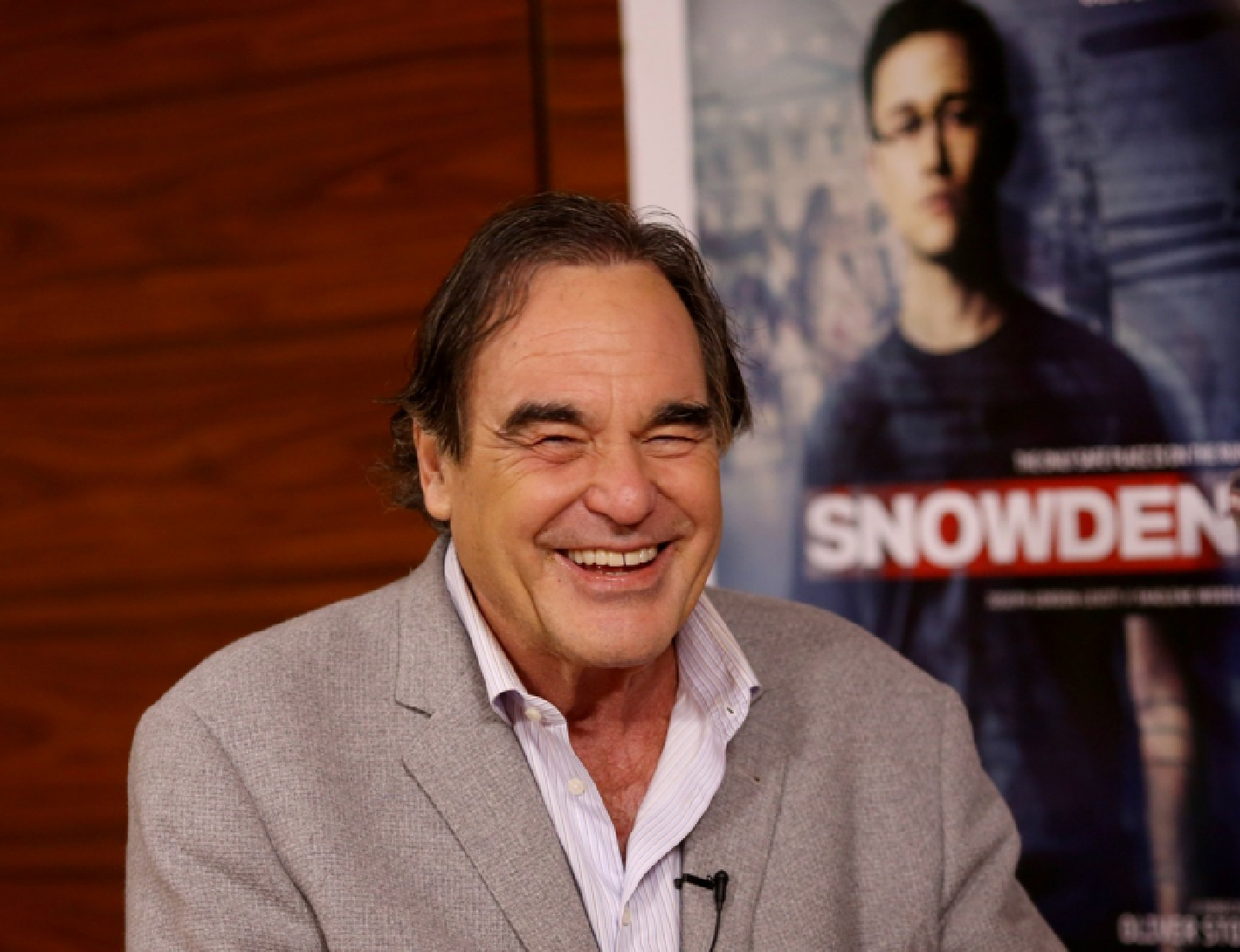


Oliver Stone talks about his latest film, a biopic of US whistleblower Edward Snowden
Oscar-winning director Oliver Stone had been feeling a little off colour in recent days but that small inconvenience certainly didn’t stop him from promoting his latest film “Snowden” in Bangkok on Monday.
Indeed, he seemed happy to give media interviews and looked on for the movie premiere at Paragon Cineplex, which was attended not only by the press but also diplomats from many countries including Russia and the United States, the two nations who play starring roles in Edward Snowden’s story.
Stone is no stranger to Thailand, having used the landscapes of the south as Vietnam’s paddy fields for his 1993 film “Heaven and Earth” and also for “Alexandre” in 2004. According to the New York Times, he was all set to come to Thailand to shoot “Pinkville”, a film about the massacre at My Lai during the Vietnam war, but the project was cancelled when the economy collapsed in 2008.
And Thailand certainly holds Stone in high regard. The director is being honoured with the Lotus Award in recognition of his lifetime achievements in the film industry at the upcoming World Film Festival of Bangkok, which runs from November 4 to 13 at SF World Cinema.
Speaking to Nation Multimedia Group’s adviser to the Editorial board Suthichai Yoon in an interview for the “Timeline” programme, Stone reveals that at first he didn’t want to make the film about Snowden. “I don’t want to chase news that keeps changing all the time,” he explains.
The change of heart came after he was invited to Moscow by Snowden’s Russian lawyer Anatoly Kucherena, author of “Time of the Octopus”, one of the two books used for reference in the film. The other is “The Snowden Files” by Luke Harding. The chance to meet the real Snowden and discuss the project reversed his earlier decision and he travelled between the US and Moscow nine times until the film is done.
“He is a straight arrow, a boy scout. He is a square who believes in the constitution of the United States,” the 70-year-old director says of Snowden.
Snowden was initially reluctant to agree to the project, saying he didn’t want to be a story, Stone explains, adding that even though he only vaguely knew of Stone, he came to realise that a film about him would be made, with or without his consent, and it was therefore better to seize the chance to portray his version of the facts.
“The movie is his story as far as his possible. I did warn him that if it became really boring, we would have to figure out how to tell his story another way. He made very positive suggestions. He outlined a path and that was very important for me, because I’m a stickler for dialogue and really want the dialogue to be accurate. I wanted to portray the National Security Agency people exactly like how they talk in real life,” he says.
“I also told him that if there was something wrong in the story, he had to tell me immediately. I didn’t want to embarrass him or myself. He did the best he could,” Stone continues, adding that he gave Snowden the script twice as well as two versions of edited film to check. “If the story had contained any exaggerations, it would have undermined the film. I was very conscious of my responsibility because he is alive. It’s not like most biopics. Most of the characters are already dead when the films are made.
“Snowden” joins other Stone films like “JFK”, “Born on the Fourth of July” and “Platoon” that criticise the workings of the American government through the story of a man’s life.
Starring Joseph Gordon-Levitt as the 29-year-old NSA whistleblower, the film starts nine years earlier when Snowden enrols in the military. It covers his work as a CIA computer analyst and his job for the contracting company to the NSA. A genius with computers, his career prospects have never looked better. But his work is affecting his personal life and his relationship with his girlfriend Lindsay (Shailene Woodley), leading to his decision to expose the government’s mass surveillance project. He meets journalists Glenn Greenwald (Zachary Quinto) and Ewan MacAskill (Tom Wilkinson) and documentary filmmaker Laura Poitras (Melissa Leo) in Hong Kong and passes along the data.
While “Citizenfour”, the Oscar-winning documentary by Poitras, covers their meeting in Hong Kong, “Snowden” shows how the young man came to do something that would label him as a traitor and force him to live in exile in Russia.
“‘Snowden’ is a dramatisation of nine years of his life while Citizenfour is just a slice – 45 days in Hong Kong,” explains the director. Stone adds that the documentary made him understand what was going on but didn’t tell him what the mass surveillance was about or how the NSA functioned in the world. His film, he says, fills out the documentary and also shows Swowden’s relationship with his girlfriend, who was the catalyst in driving Snowden to take his decision.
“The problem is that the information is complicated. It’s difficult for people to really get their heads around what mass surveillance means and we try to help them with that in the movie,” he explains.
Thus the film tries to show how mass surveillance affects peoples’ lives even when those same people think they have nothing to hide.
Fear of terrorism has been high since the 9/11 attacks and it is that fear that gave birth to the NSA’s mass surveillance programme. The documents leaked by Snowden show how the agency worked with leading companies to monitor peoples’ lives through private email, computers and communications without their consent.
Stone says that he tries to stay true to the real-life Snowden, who he sees as a super-intelligent young man who was able to advance through the ranks of the NSA to become a major cyber warfare operator on the offensive and defensive against China.
“In the movie you see that he gets more and more access. He doesn’t like what he’s seeing at all. He’s seeing a criminal world. He’s seeing that the USA is deploying a massive global surveillance system without democratic consent. That was his point in leaking the documents,” he says.
Stone is adamant that Snowden received no money in exchange for the information and in the end only allowed the documentary and film to be made on the condition that they would not affect any of his former colleagues.
Stone chose Gordon-Levitt for the title role for his ability to adopt Snowden’s character and personality.
“I didn’t know him at all. I’d seen him in a few films and knew he was smart. On the social media he comes across as a kind of a democratic liberal and, of course, he also looks like Edward,” Stone explains.
While the film has so far received mixed reviews, it has done very well in a Cinemascore survey. “They interviewed thousands of people and they gave the movie an ‘A’, which is the best score I’ve ever had,” he says.
In Thailand, the film is distributed by newcomer The Digital Content Factory. The company, which is run by former Airports of Thailand president Chotisak Asapaviriya, bought the distribution rights two years ago in Cannes. “The film should be watched by Thais,” Chotisak says. “The issues are very much part of our life today.”
Truthful tale
“Snowden” is now showing at cinemas all over Thailand..
The interview with Oliver Stone will be aired on Timeline Suthichai Yoon tomorrow night at 10.30 on NationTV Channel 22.
