
Eleven magnitude 7 earthquakes heighten focus on Thai preparedness


Thailand is promoting earthquake and tsunami readiness after 11 magnitude 7.0 or stronger events were recorded worldwide by August 15, 2026.
- Eleven earthquakes of magnitude 7.0 or higher were recorded globally in 2026, prompting Thai research organizations to raise public awareness about earthquake safety.
- While these events do not predict an imminent earthquake in Thailand, authorities highlight that the country has 16 active fault groups, making preparedness essential.
- Recommendations for Thai residents include learning the "Drop, Cover and Hold On" safety drill, preparing a 72-hour emergency kit, securing homes, and recognizing natural tsunami warnings on the Andaman coast.
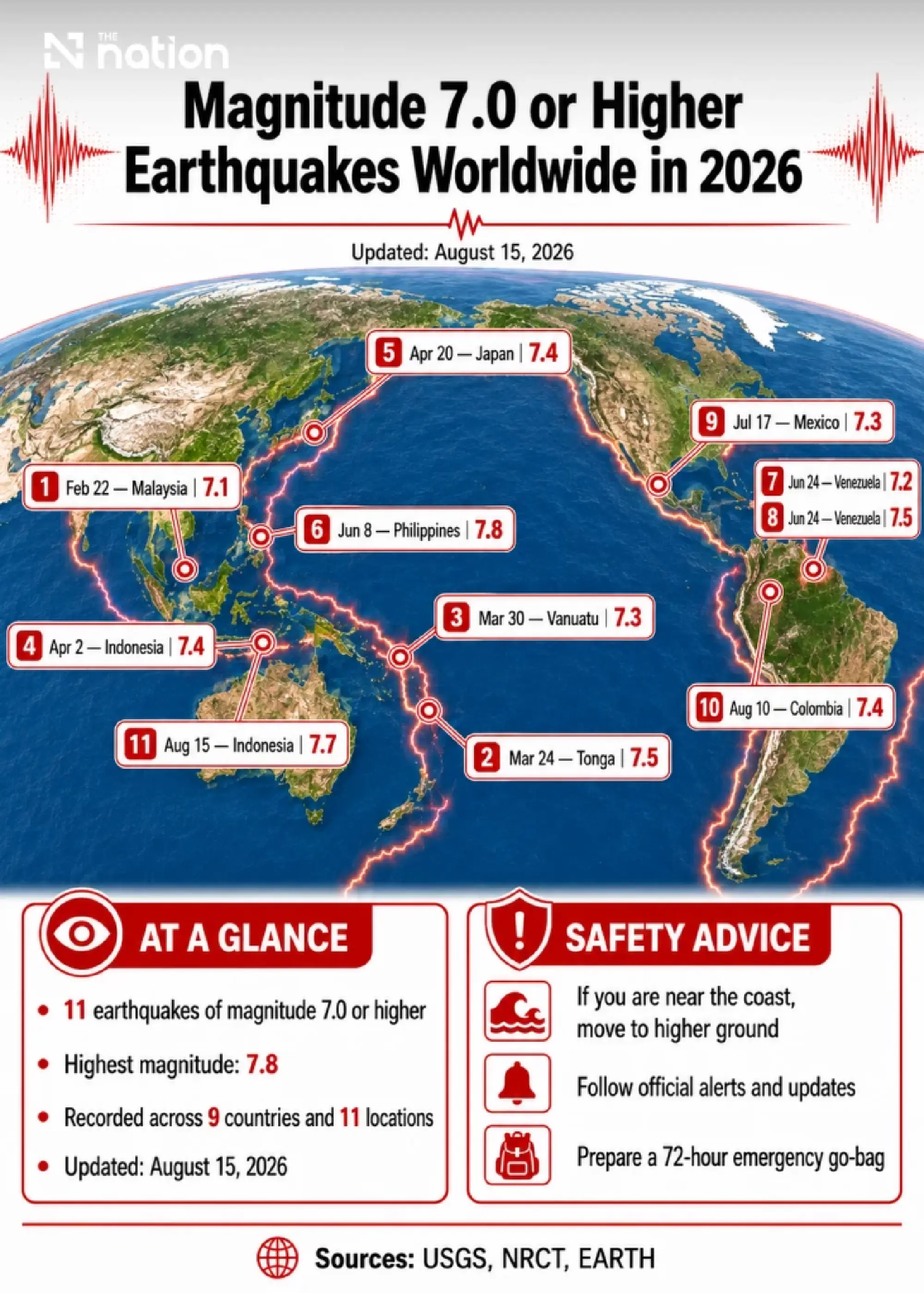
In 2026, 11 earthquakes of magnitude 7.0 or higher were recorded across nine countries and areas, most of them around the Pacific Ring of Fire, according to Thailand’s National Research Council (NRCT) and the Earthquake Research Centre of Thailand (EARTH).
The two organisations released an overview of major earthquakes recorded worldwide up to August 15, aiming to improve public understanding, raise awareness and promote proper preparedness without causing unnecessary alarm.
The strongest was a magnitude 7.8 earthquake in the Philippines on June 8 local time, while the latest struck near Flores, Indonesia, at 4.58am on August 15.
Indonesia’s Meteorology, Climatology and Geophysics Agency, or BMKG, revised its estimate for the Flores earthquake to magnitude 7.7 at a depth of 15 kilometres. The US Geological Survey reported the same magnitude but placed the depth at 10 kilometres.
Eleven magnitude 7 earthquakes recorded in 2026
The 11 earthquakes of magnitude 7.0 or higher recorded up to August 15 were:
- February 22: Malaysia, magnitude 7.1
- March 24: Tonga, magnitude 7.5
- March 30: Vanuatu, magnitude 7.3
- April 2: Indonesia, magnitude 7.4
- April 20: Japan, magnitude 7.4
- June 8: Philippines, magnitude 7.8
- June 24: Venezuela, magnitude 7.2
- June 24: Venezuela, magnitude 7.5
- July 17: Mexico, magnitude 7.3
- August 10: Colombia, magnitude 7.4
- August 15: Indonesia, magnitude 7.7
Major earthquakes cluster near tectonic boundaries
The figures show that major earthquakes are not confined to one part of the world. However, many are concentrated along tectonic plate boundaries, particularly around the Pacific Ring of Fire.
In these areas, tectonic plates collide, move beneath one another, pull apart or slide past each other. The accumulation and release of energy along faults make earthquakes and volcanic activity more likely there than within the interiors of tectonic plates.
Thailand has 16 active fault groups
Thailand has 16 groups of active faults, according to the Department of Mineral Resources. They include the Mae Chan, Mae Lao, Mae Ing, Mae Hong Son, Ranong, Khlong Marui and Si Sawat fault groups, among others.
Communities near active faults should maintain continuous preparedness. Local ground conditions and building characteristics also influence how shaking is experienced.
People in high-rise buildings may sometimes feel prolonged swaying from a distant earthquake more clearly because tall buildings can respond strongly to long-period seismic waves.
What people in Thailand should watch for and prepare for
1. Do not treat global earthquakes as a prediction for Thailand
A series of major earthquakes around the world does not indicate that a powerful earthquake is about to strike Thailand.
Global earthquake information is used to monitor and assess risks, not to make precise predictions. It is currently impossible to forecast an earthquake’s exact date, time, location and magnitude accurately in advance.
People should follow information from relevant public agencies, particularly the Thai Meteorological Department, the Department of Disaster Prevention and Mitigation, the National Disaster Warning Centre and local authorities.
2. Follow “Drop, Cover and Hold On”
When shaking begins, drop to the floor, protect the head and neck, take cover beneath a sturdy table or another strong shelter, and hold on.
Stay away from windows, glass, cupboards, shelves and other objects that could fall. People should not rush towards staircases or use lifts while a building is shaking.
Once the movement has stopped, occupants should leave the building calmly and follow instructions from officials.
3. Be cautious in high-rise buildings
People in tall buildings should remain calm and avoid judging the level of danger solely from how strongly the structure appears to sway.
High-rise buildings can respond to long-period earthquake waves and may continue moving even when the earthquake source is far away.
Occupants should keep clear of windows and hanging objects and wait until the shaking has stopped before checking the building and its systems for damage. Where serious damage is found, nobody should re-enter until the structure has been examined by qualified experts.
4. Recognise natural tsunami warnings on the Andaman coast
Residents and tourists along Thailand’s Andaman coast should learn the natural warning signs of a tsunami.
These include strong or prolonged earthquake shaking, an unusual rise or retreat of the sea, and an abnormal sound coming from the ocean. Anyone noticing these signs should move to higher ground or farther inland as soon as it is safe to do so.
People should not wait for an official warning when natural signs are clear. A tsunami generated close to the coast can arrive quickly, and the first wave may not be the largest.
5. Prepare a go-bag for at least 72 hours
Every household should keep an emergency go-bag containing drinking water, ready-to-eat food, regular medicines, a first-aid kit, a torch, a whistle, a radio or mobile phone with a power bank, and copies of important documents.
Families should also prepare essential supplies for children, older people, people with disabilities and pets. A meeting point and agreed methods of contacting family members should be arranged in advance.
6. Prepare homes and workplaces before an emergency
Cupboards, shelves, electrical appliances and other heavy objects should be secured to walls. Heavy items should not be placed above beds or near exits.
People should check evacuation routes and participate regularly in earthquake drills at home, school, work, hospitals and within their communities.
Preparedness matters more than prediction
The 11 earthquakes of magnitude 7.0 or higher recorded worldwide in 2026 provide important information for risk monitoring. Their number should not, however, be interpreted as a forecast that a major earthquake will soon occur in Thailand.
The priorities are to follow information from official agencies, understand how to respond when shaking begins and maintain preparedness at household, building and community levels.
