
Thailand plans 18-month smart weir trial to curb Sai River arsenic
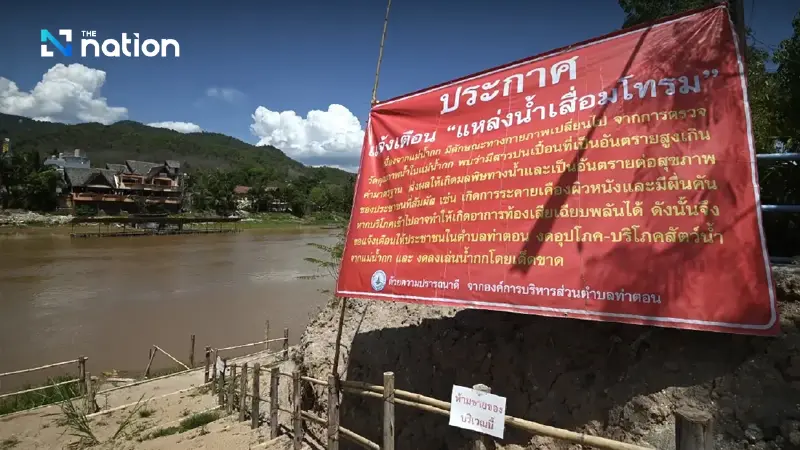


Thailand plans an 18-month smart weir trial on the Sai River in Mae Sai. Simulations suggest it could reduce arsenic by up to 94.6% and help protect 27,000 rai of farmland.
- Thailand is launching an 18-month pilot project in Mae Sai district for an AI-powered smart weir to combat arsenic contamination in the Sai River.
- The system uses sensors to detect high turbidity, automatically diverting contaminated water into treatment ponds where arsenic-carrying sediment is removed.
- Simulations suggest the technology could reduce arsenic levels by up to 94.6 per cent, protecting approximately 27,000 rai of agricultural land.
- The trial is scheduled to run at the Mae Sai irrigation headworks and will cover the 2027 rainy season to assess the system's effectiveness under real conditions.
An 18-month pilot project in Mae Sai aims to test the system's effectiveness, with simulations suggesting it could reduce arsenic levels by up to 94.6% and help protect 27,000 rai of farmland.
The government is preparing to test an AI-powered sediment-trapping system in Mae Sai district, Chiang Rai, as part of a broader effort to tackle arsenic contamination in the Kok and Sai rivers in northern Thailand. The 18-month pilot will be accompanied by measures to secure clean water supplies, strengthen environmental monitoring and protect agricultural areas.
Captain Patdarasm Thongsaluaykorn, deputy government spokesperson, outlined the plan on November 22, explaining that Thailand would also present scientific findings on possible sources of contamination during talks with Myanmar and China beginning on November 24.
Smart sediment-trapping weir to undergo 18-month pilot in Mae Sai
The Ministry of Higher Education, Science, Research and Innovation (MHESI) has proposed the smart sediment-trapping weir as a technology-based solution to capture fine sediment that can carry arsenic through river systems.
The technology was jointly developed through research involving Thailand Science Research and Innovation (TSRI), Naresuan University and DHI. Researchers used local data in a digital twin simulation covering 523 days of river conditions to design a system to divert turbid water into treatment ponds along riverbanks.
The system combines automated controls and artificial intelligence (AI) to assess water quality and regulate water diversion in real time. The process works as follows:
- Trapping and sediment settling: When sensors detect turbidity levels above a set threshold, the system diverts water into holding ponds. Specialised coagulants are added when necessary to separate suspended sediment from the water.
- Sediment removal and dewatering: Contaminated sediment is extracted, dewatered, weighed and assigned a unique identification code for traceability before being sent for disposal in accordance with environmental safety standards.
- Returning treated water: The treated water undergoes further arsenic testing before being released back into the river. Water-quality results are also reported in real time for monitoring by authorities and the public.
Simulation results indicate that installing three units along a stretch of the Sai River between kilometres 95 and 99 could reduce arsenic levels by up to 94.6%. The model suggests river water could meet the required water-quality standards on 476 out of 523 days.
This could help the Mae Sai waterworks maintain daily operations by reducing the need to suspend production during periods of high contamination.
To assess the system under actual conditions, an 18-month pilot project has been approved under a controlled trial scheme at the Mae Sai irrigation headworks. The trial will cover the 2027 rainy season. Government projections suggest the project could reduce arsenic entering rice-growing areas by approximately 94% and help protect around 27,000 rai (4,320 hectares) of agricultural land, benefiting more than 3,356 water users.
The Royal Irrigation Department and TSRI are preparing to survey potential construction sites for integrated sediment-trapping and treatment facilities at Ban Mueang Daeng in Mae Sai district and near Chiang Rai Weir.
Nanotechnology deployed to provide clean water to communities
While the smart weir is being prepared for its pilot trial, the government is also deploying nanotechnology to address immediate concerns over drinking and household water supplies.
The National Nanotechnology Centre (NANOTEC), under the National Science and Technology Development Agency (NSTDA), has introduced two technologies in affected areas.
- The M-Sense rapid arsenic testing kit allows officials and local communities to screen water for arsenic and obtain results within three to five minutes. All 30 samples tested, including bottled drinking water, ice, school water supplies and water from Mae Sai Hospital, met the reported safety standards.
- The Nano-Biochar filtration system can remove up to 99% of arsenic from water. It has already been installed at four sites in Chiang Rai. Tests in Ban Rim Kok, Mueang Chiang Rai district, found that arsenic concentrations in raw water fell from 0.069 milligrams per litre to 0.0035 milligrams per litre, a reduction of nearly 95%. Treatment costs less than two baht per 1,000 litres of water.
The government plans to expand filtration systems and monitoring points to Tha Ton subdistrict in Mae Ai district, Chiang Mai, and additional areas in Mueang Chiang Rai district. More than 100,000 litres of clean water have already been delivered to residents in Tha Ton.
Meanwhile, the Royal Irrigation Department has earmarked more than 22.5 million cubic metres of water from three major reservoirs for Fang and Mae Ai districts. These reserves are intended to provide an alternative supply if the use of potentially contaminated natural water sources needs to be restricted.
Groundwater systems and expanded piped water supply planned
To strengthen long-term water security, the government has divided its infrastructure plans into two phases.
- Medium-term plan: The Department of Groundwater Resources is preparing to construct 14 community groundwater supply systems in two subdistricts of Mae Sai district, where residents have previously experienced interruptions to their water supply. The broader plan would expand the network to 22 systems at a proposed cost of 165 million baht, subject to approval of central government funding. The project is expected to benefit approximately 17,600 people.
- Long-term plan: The Provincial Waterworks Authority (PWA) is preparing to expand its piped water supply network to cover Fang, Mae Ai and Chai Prakan districts. The plan involves sourcing raw water from Mae Thalop Reservoir to reduce dependence on potentially contaminated water from the main rivers.

Tighter mineral controls and Agri-Map planned to protect farmers
To address pollution at its source, the Ministry of Industry is preparing regulations specifying the types and conditions of minerals that require import and export permits. The measures aim to ensure minerals can be traced back to their origins throughout the supply chain. The ministry is also coordinating with security agencies to patrol border areas and prevent the illegal movement of minerals.
Meanwhile, the government plans to collect crop, soil and water samples at 50 sites in Mae Ai district, Chiang Mai, to develop an Agri-Map for proactive agricultural management. The map will divide areas into three colour-coded zones: green, yellow and red. It is scheduled for official release on December 15.
The zoning system aims to identify areas where agricultural production meets safety standards and prevent concerns about contamination from affecting produce prices across the province.
Produce from green zones will be supported in seeking Good Agricultural Practices (GAP) certification to increase its market value. Produce from areas where contamination exceeds safety limits will be subject to government purchase and safe disposal under established procedures.
A centralised data platform is also being developed to provide public access to verified information from relevant agencies on water and soil quality, as well as other environmental impacts.
Thailand to present scientific evidence at cross-border talks
The Thai delegation is preparing to present domestic water-quality monitoring results, together with isotope-analysis findings described as an "arsenic fingerprint", at a trilateral working group meeting involving Thailand, Myanmar and China, scheduled for November 24–26.
According to the government, the scientific evidence could help identify the sources of arsenic contamination and provide a factual basis for cross-border discussions, supporting concrete efforts to tackle the pollution at its source.
