
PM2.5 pollution returns as Thailand’s Clean Air Bill faces crucial November 25 vote
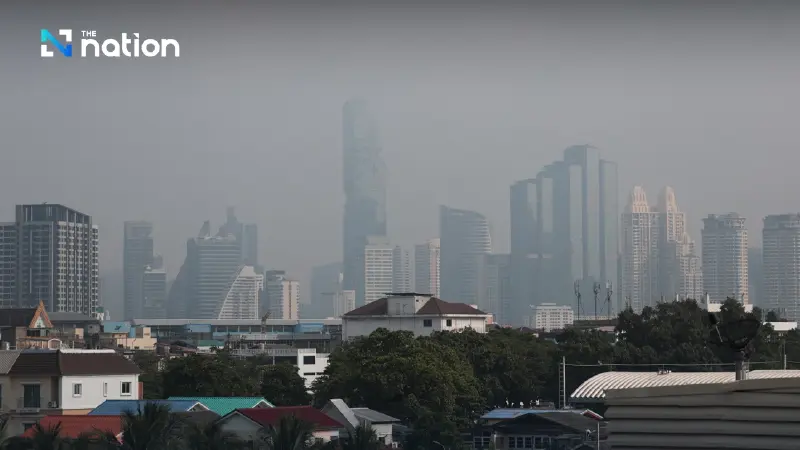


Thailand’s long-awaited Clean Air Bill heads to the House on November 25 after seven years of advocacy, as PM2.5 levels exceed safety standards in several areas.
Thailand’s long-awaited Clean Air Management Bill is approaching a decisive parliamentary hurdle on Wednesday (November 25, 2026), as rising levels of PM2.5 pollution renew concerns over public health ahead of the annual haze season.
After seven years of advocacy and legislative deliberations, a joint parliamentary committee has reached agreement on all provisions of the draft legislation, paving the way for its consideration by the House of Representatives.
The bill seeks to protect the public’s right to clean air, tackle pollution at its source and introduce economic instruments based on the “polluter pays” principle.
PM2.5 levels exceed standards at six monitoring stations
Data from the Pollution Control Department’s Air4Thai platform showed that six of the 173 monitoring stations reporting readings nationwide recorded PM2.5 concentrations above Thailand’s 24-hour standard of 37.5 microgrammes per cubic metre (µg/m³) as of 8am on Tuesday (November 24).
The highest readings were recorded at:
- Samut Sakhon: Samut Sakhon Wittayalai School – 47.5 µg/m³
- Bangkok: Bang Khun Thian district office – 42.5 µg/m³
- Phitsanulok: Chom Nan Chaloem Phra Kiat Park – 41.1 µg/m³
- Nakhon Pathom: Waterworks reservoir – 40.6 µg/m³
The return of unhealthy air quality comes as Parliament prepares to consider legislation designed to establish a comprehensive framework for managing air pollution.

Clean Air Bill nears final parliamentary approval
Chakrapol Tangsutthitham, a Pheu Thai MP and deputy chairman of the joint parliamentary committee reviewing the Clean Air Management Bill, said the panel had resolved all outstanding differences between the House and Senate at its 11th meeting on November 17.
The committee had reviewed the Senate’s amendments section by section to ensure consistency across the legislation and establish practical measures for controlling air pollution.
Chakrapol said the committee had sought to balance public health protection, effective law enforcement and the potential impact on businesses and other stakeholders.
The revised bill is expected to be considered by the House on November 25 before being forwarded to the Senate, which aims to complete its consideration by November 30.
If approved by both chambers, the legislation will be submitted for royal assent before being published in the Royal Gazette.
Chakrapol said the bill would establish an important legal mechanism to protect people’s right to breathe clean air, extending that protection even to unborn children.
Joint committee outlines five priorities for effective enforcement
Karndee Leopairote, a Democrat Party MP and spokeswoman for the joint committee, said the panel had also drawn up five recommendations to support the interpretation and implementation of the legislation.
1. Strengthen local authorities’ capabilities
Provide training for local government personnel to improve their understanding of the law and equip them to tackle air pollution effectively within their jurisdictions.
2. Broaden private-sector participation
Ensure that private-sector representatives on relevant committees reflect the interests of diverse stakeholders, including small and medium-sized enterprises (SMEs) and social enterprises, rather than solely major corporations.
3. Improve transparency through pollution reporting
Integrate the Pollutant Release and Transfer Register (PRTR) system with relevant legislation to improve the collection, disclosure and monitoring of information on pollution sources.
The system would help authorities identify polluters and develop more targeted control measures.
4. Strengthen efforts to combat transboundary pollution
Assign the Ministry of Foreign Affairs a leading role in co-ordinating with neighbouring countries, working alongside the Ministry of Natural Resources and Environment to address cross-border haze.
5. Introduce practical economic instruments
Design pollution-related fees, fines and other financial measures to encourage emissions reductions without imposing unnecessary burdens on businesses or undermining the competitiveness of Thai industries.
The legislation incorporates the “polluter pays” principle, under which those responsible for pollution would bear the associated costs of addressing environmental and public health impacts.
Seven years in the making
Efforts to introduce comprehensive clean air legislation began in Parliament in 2019, when worsening PM2.5 pollution emerged as a major national concern.
However, early proposals encountered fiscal and administrative obstacles, particularly over the potential budgetary burden of establishing new agencies and a dedicated Clean Air Fund.
The legislative process gained momentum in 2023 after the Cabinet endorsed a draft proposed by the Ministry of Natural Resources and Environment.
On January 17, 2024, the House unanimously accepted the principles of seven draft clean air bills by 443 votes.
The proposals comprised five drafts from political parties, one from the Cabinet and one citizen-led draft backed by more than 22,000 signatures.
A special House committee subsequently spent approximately one year and seven months consolidating the proposals, consulting government agencies, businesses, academics, civil society organisations and members of the public.
Discussions covered pollution management structures, controls on emission sources, economic incentives, legal liability and penalties.
On October 21, 2025, the House passed the consolidated bill in its third reading with 309 votes.
However, the dissolution of the House on December 12, 2025, under Prime Minister Anutin Charnvirakul interrupted the legislative process, requiring the incoming government to revive the bill.
Further amendments by the Senate subsequently led to disagreements between the two chambers.
On September 3, 2026, the House voted 414 to two against the Senate’s amended version, prompting the formation of a 20-member joint parliamentary committee to reconcile their differences.
The committee finally reached agreement on all sections of the legislation on November 17, clearing the way for its return to the House.
Clean air legislation faces decisive test
The forthcoming parliamentary deliberations represent a significant milestone in Thailand’s efforts to shift from short-term responses to seasonal haze towards a more systematic approach to pollution prevention.
The proposed legislation would provide a legal framework for controlling pollution at its source, strengthening accountability and improving co-operation between government agencies, businesses and neighbouring countries.
However, the effectiveness of the law will ultimately depend on its enforcement, the development of supporting regulations and the ability of authorities to monitor and control major pollution sources.
With PM2.5 concentrations once again exceeding national standards in several areas, the November 25 parliamentary deliberations will be closely watched by environmental campaigners, businesses and members of the public who have waited years for comprehensive clean air legislation.
Source: Thansettakij
