
Five US trade proposals test Thailand’s negotiating red lines


The commerce minister expects US reciprocal tariffs of no more than 19%, while an independent analyst questions the cost to Thai farmers and businesses.
- The US is proposing that Thailand reduce non-tariff barriers on agricultural exports, including meat with growth-promoting substances, which challenges Thailand's stated "red line" on public health.
- Proposals on digital trade and telecommunications test Thailand's "red lines" on national security and investment by asking it to forgo a digital services tax, allow free data flow, and ease foreign ownership limits for services like SpaceX's Starlink.
- Other key US demands include strengthening labour rights, such as the right to organise and bargain collectively, and improving enforcement against intellectual property infringements.
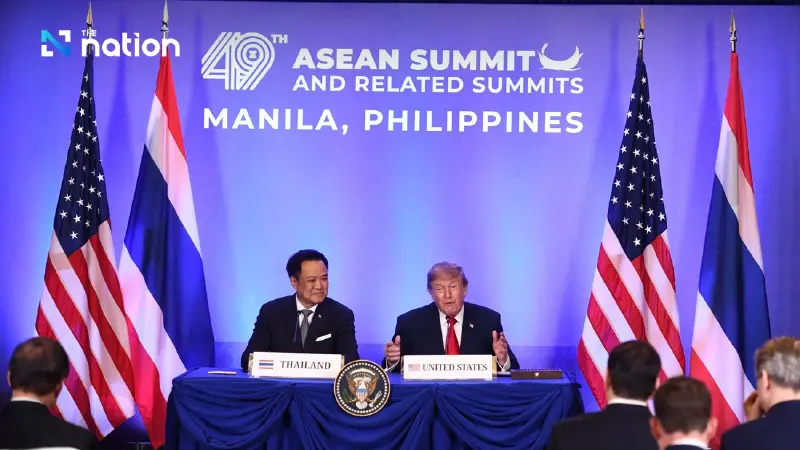
Thai Prime Minister Anutin Charnvirakul and US President Donald Trump signed a non-binding joint statement in Manila on Tuesday (November 17, 2026), marking progress towards an Agreement on Reciprocal Trade.
Thailand aims to finalise the legal text and submit it to Parliament for approval within two months.
According to independent analyst Kritsada Boonruang, Commerce Minister Suphajee Suthumpun described the deal as a “positive signal” for Thailand’s efforts to protect its largest export market, worth THB2.37 trillion and linked to employment for more than 1.25 million people.
She said work could begin immediately on reducing a US tariff linked to forced labour from 12.5% to 10%.
The US reportedly put forward proposals in five areas.
On agriculture, it wants Thailand to reduce non-tariff barriers to US food and agricultural exports, including meat and poultry.
The proposal could extend to restrictions on the use of substances that promote lean growth in livestock.

Suphajee had previously identified public health as a red line, citing imports of pork containing such substances.
She said Thailand would open its market only to goods it already admitted from other countries or could not produce in sufficient quantities.
The labour proposals cover workers’ rights to organise and bargain collectively, child labour and controls on imports of goods made with forced labour in third countries.
The US has also pressed Thailand to tackle intellectual property infringements.
The negotiating framework calls for both sides to make further commitments on geographical indications, which add value to Thai farm produce and goods made by local communities.
On digital trade, the US wants Thailand to forgo a digital services tax, prevent discrimination against US digital products, allow data to flow freely across borders under trusted conditions and rule out quotas on foreign film screenings.
The US also wants Thailand to ease foreign ownership limits in telecoms.

Its request for market access for Starlink, SpaceX’s satellite internet service, had already drawn public attention.
Suphajee had identified national security and investment as Thailand’s other red lines, citing US interest in full ownership in sectors such as telecoms.
In his November 18 assessment, Kritsada questioned the balance of the proposed deal.
He said the Office of the United States Trade Representative had told Americans that Thailand would eliminate tariffs on 99% of US goods.
Thai exports, meanwhile, could still face US reciprocal tariffs of up to 19%, the ceiling Suphajee expected.
Kritsada saw a short-term case for concluding the agreement quickly to avoid losing ground to Thailand’s Southeast Asian trade rivals.
He argued that presenting the deal as a “perfect shield” while keeping the concessions confidential could leave Thai farmers and businesses unprepared for fiercer competition and further US tariffs.
He also saw risks from potential trade policy disputes between the Trump administration and the incoming Democratic majorities in both chambers of Congress.

