
Indonesia begins domestic construction of first Scorpene submarine
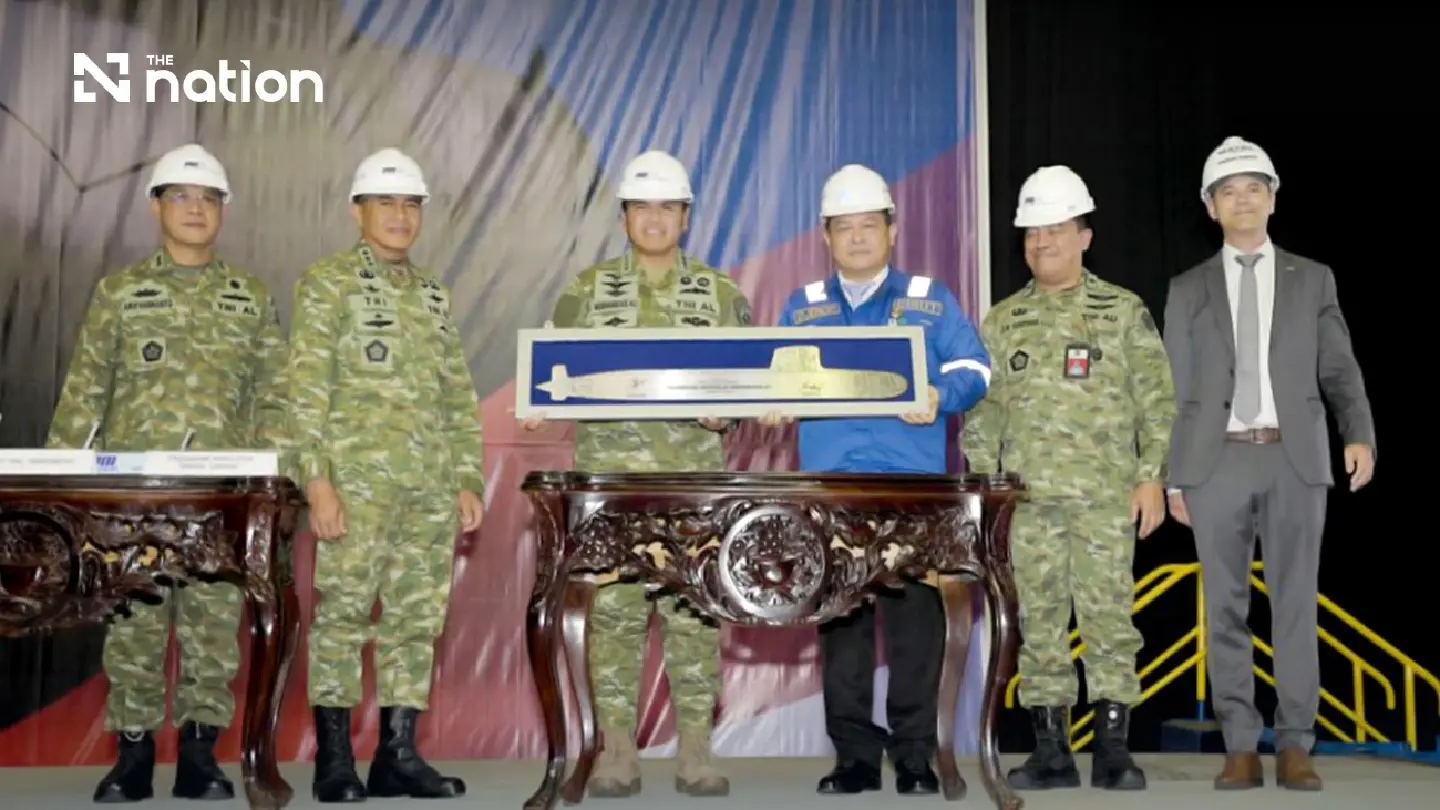


The steel-cutting ceremony marks a major step in Indonesia’s drive for greater naval self-reliance, with two vessels targeted for completion within seven to eight years.
- Indonesia has begun the domestic construction of its first of two Scorpene Evolved submarines with a steel-cutting ceremony at the PT PAL shipyard in Surabaya.
- The project marks the first time Indonesia has built a submarine domestically from its initial stage, a step that could make it the first ASEAN country to achieve this.
- The submarine is being built by Indonesia's PT PAL in collaboration with France's Naval Group, which is providing the design, engineering assistance, and technology transfer.
- This national strategic project aims to strengthen the Indonesian Navy's capabilities while simultaneously developing the country's domestic defense-industrial ecosystem and engineering skills.
Indonesia began physical construction of the first of two Scorpene Evolved submarines on Friday with a steel-cutting ceremony at PT PAL Indonesia’s shipyard in Surabaya.
Officials described the occasion as a historic step that could make the country the first ASEAN member to construct a submarine domestically from the outset.
Indonesian Navy chief of staff Admiral Muhammad Ali presided over the ceremony at the fabrication shop of the state-owned shipbuilder’s surface-ship division.
Designed by French shipbuilder Naval Group, the Scorpene for the Republic of Indonesia (SRI) programme is a national strategic project intended to strengthen the Indonesian Navy’s operational readiness while supporting the development of the country’s defence-industrial ecosystem.
PT PAL president director Kaharuddin Djenod described the event as an important milestone in Indonesia’s effort to strengthen its defence capabilities.
He said it was “not just about the start of a submarine’s construction”, but also an opportunity to demonstrate that Indonesia could develop strategic national capabilities sustainably.
The programme would build not only a defence platform but also the skills of Indonesian engineers, technological expertise and an industrial foundation for future generations of submarines.
Ali said this was the first time Indonesia had built a submarine domestically from its initial stage.
He added that Indonesia was “perhaps the first” ASEAN country to do so and called for the capability to be developed further.
Greater self-reliance, he explained, would allow the national naval industry to construct surface ships, submarines and other major weapons systems.
In a joint statement, Naval Group and PT PAL said their consortium brought together the complementary expertise and responsibilities of both companies.
PT PAL will construct the hull, integrate the equipment, conduct testing and final assembly, and deliver the vessels to the Indonesian Navy.
Naval Group will supply the submarine design, engineering assistance, industrial capability transfer and continuing technical support through a dedicated team of specialists permanently based in Surabaya.
PT PAL production director Diana Rosa expressed confidence that her team could meet the required construction milestones.
She said the company had both the capabilities and facilities needed for the programme.
All experts sent to France had passed their assessments, with the results recognised by Naval Group.
Diana contrasted their performance with that of specialists from Brazil and India, which also build Scorpene submarines.
She said bringing the first steel-cutting date forward from October to August demonstrated that PT PAL could complete its work on schedule.
Although the company would seek to move ahead of schedule where possible, Diana described a submarine as “handmade” and warned that construction could not be rushed because even a slight decline in quality would be extremely dangerous for an underwater vessel.
The work would therefore not proceed as quickly as surface-ship construction.
PT PAL pledged to protect quality standards at every construction milestone despite efforts to accelerate the programme.
Diana also confirmed that the supply chain for both submarines had been secured.
The two vessels are targeted for completion within seven to eight years.
The fully locally produced Scorpene Evolved submarines fall within the medium-weight, ocean-going category and will have a submerged displacement of 2,800 tonnes.
They will be capable of travelling underwater at more than 20 knots, or about 37 kilometres per hour, and remaining at sea for 80 days on a single voyage.
Their operational range will extend to 12,000 nautical miles, or 22,224 kilometres, at economical speed.
The diesel-electric attack submarines will require crews of about 31 and are designed for high stealth with low acoustic signatures.
They will be armed with 18 Black Shark heavyweight torpedoes, SM39 Exocet anti-ship missiles, A3SM (MICA) anti-air missiles and naval mines, all of which can be launched through six 533-millimetre torpedo tubes.
While awaiting completion of the Scorpene submarines, Ali said the navy would optimise its four existing vessels to maintain Indonesia’s underwater security.
The service will continue modifying and equipping the submarines while carrying out refurbishment and modernisation work to keep them operational.
Indonesia’s current fleet comprises one German-built U209-type submarine, KRI Cakra, and three South Korean-built improved Chang Bogo-class vessels: KRI Nagapasa, KRI Ardadedali and KRI Alugoro.
Asked whether Indonesia would acquire additional submarines as an interim measure, Ali confirmed that such a plan existed but declined to disclose the type or number being considered.
“The interim submarines will come later,” he said, adding that the Defence Ministry was best placed to determine the details.
Several submarine types have been offered for the interim role, including second-hand and newly built vessels.
China, for example, has offered three second-hand S26T submarines, the export version of the Type 039A, or Yuan class.
Indonesia is also holding talks with Japan over the possible acquisition of decommissioned Japanese submarines.
The options include the older Oyashio class and the newer Soryu class, which is equipped with air-independent propulsion.
Candidates for newly built submarines include the Italian U212 NFS and the Turkish-built Reis class, a variant of the German-made U-214 fitted with Turkish subsystems and weapons.
Acquiring any of these new submarines would require redirecting vessels already on the production line for the supplier country’s navy.
Indonesia previously adopted this approach when it purchased two multipurpose combat ships from Italian shipbuilder Fincantieri.
Source: The Jakarta Post
