
BR-V: a good 'regional' model from Honda


Play
KINGSLEY WIJAYASINHA THE NATION
Apart from global models,automakers usually also offer regional models to suit varying tastes
in different parts of the world.Large markets like the US,Europe, China and Japan normally
enjoy specially tailored models. For example, in the US you will find a Honda pickup called the Ridgeline,an exclusive model for NorthAmerica.
Well, southern Asia, comprising the Indian subcontinent and Asean, is also becoming an important market globally. And we also get our own regional cars from several automakers.
Honda is one of the major players that likes to build regional vehicles (just like its arch rival Toyota)with models such as the Brio and Mobilio gaining customers in this part of the world.
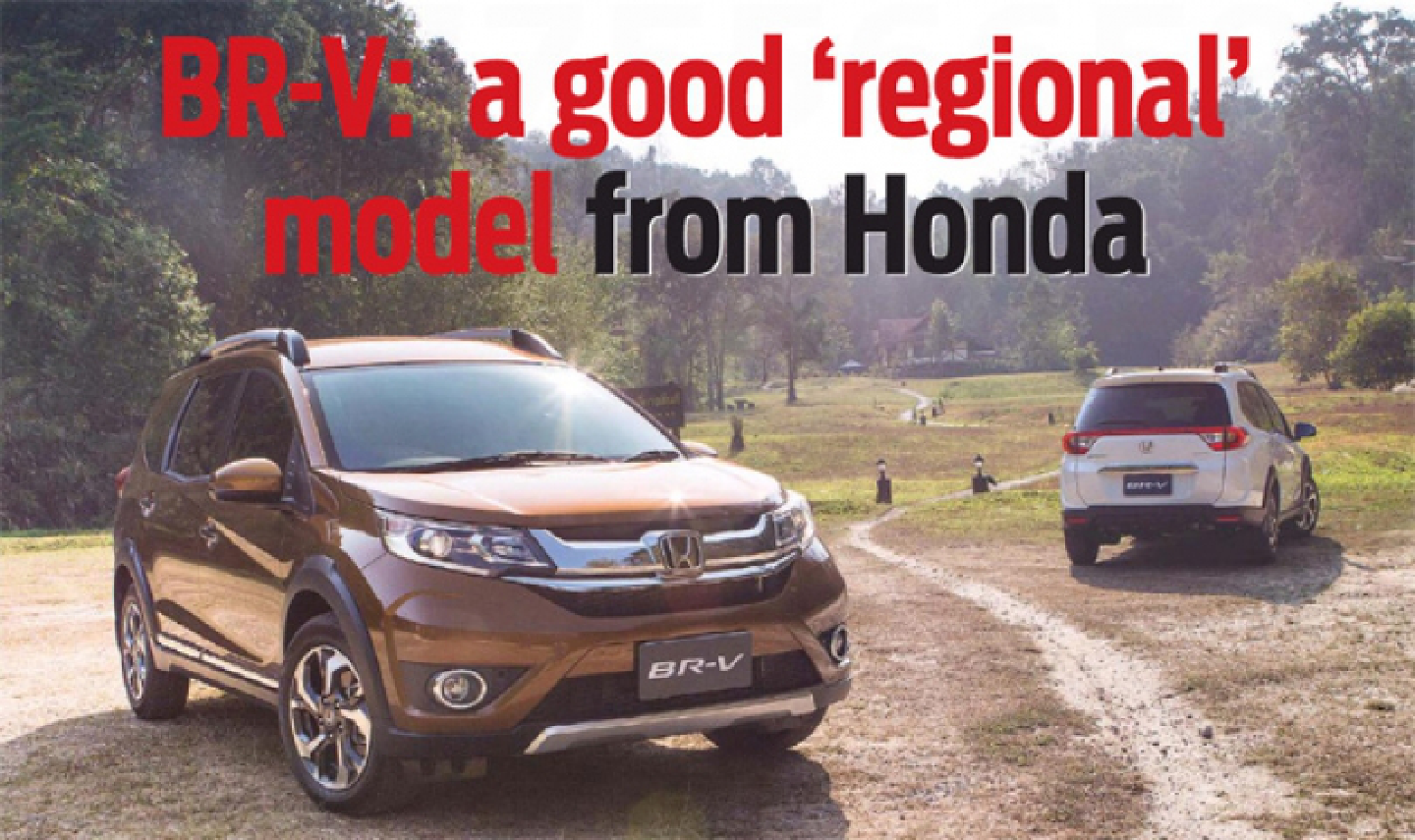
The latest regional model from Honda is the BR-V and it also hails from the Brio/Mobilio family.
The BR-V is available in two trim levels – V (Bt750,000) and SV (Bt820,000) – and competes against the Ford Ecosport, Nissan Juke and the baseline model of the Mazda CX-3.
Judging from the competition comprised of global models, this isn’t a piece of cake for Honda, especially with a regional model, which is usually understood by insiders to have lower quality but generate higher profits for the manufacturer.
But Honda is confident with the new model. While sales of its elder brother the Mobilio, a strange-looking 7-seater mini MPV, were just 6,000 units last year, the BR-V is expected to generate sales of 15,000 units in 2016.
In terms of seating arrangement, the tradition continues as the BR-V is also available with 7 seats (SV model). However, the newcomer is larger in every dimension, while the front and rear track has been widened significantly (28mm in front and 25mm at the rear).
The design of the BR-V has been improved dramatically as well, shedding the Asean look of the
Mobilio for a more global front-end design. Strangely, the funny rear window design from the Mobilio is still there, but the good thing is that it is large and offers good visibility.
Roof rails are offered as standard equipment in both trim levels,stressing the go-about character ofthe BR-V.
The tailgate opens wide and has a low loading height, making it easy to load and unload things.
The interior design is similar to the other family members, with but with a steering wheel upgrade for added sportiness. What you’ll notice is the large amount of space available and while the seats aren’t on the luxury side, they do the job properly as you’d expect. The second-and third- row seats in the SV are adjustable for backrest recline,and are also split-foldable to increase luggage space. Passengers in every row also enjoy air-con vents.
For the V trim, the second-row seats provide the same functions, and there are two special storage compartments under it. The luggage area also features waterproof flooring.
Although there are only seven seats in the BR-V, there are 11 cupholders located around the cabin (I can imagine a lot of drinking in the car) and there are two cabin lights.
In terms of safety, you get dual front airbags, Vehicle Stability Assist and Hill Start Assist, in addition to Isofix child seat anchors. However, it would also be good if Honda would consider offering side airbags as well as window airbags that extend all the way to the third row seats since the BR-V will be carrying lots of families with children.
The BR-V is powered by the same 1.5-litre VTEC engine as the Jazz subcompact, a single-cam (whatever happened to twin-cam VTEC engines, I wonder), 16-valve motor capable of producing 117 horsepower and 146Nm. This engine is E85-compatible, which is good for both the environment and the buyer thanks to the lower excise tax rate.
Transmission is an “Earth Dreams” CVT that contributes to fuel economy.According to figures from its own Eco Sticker, the BR-V has an average fuel economy of 16.4km/l, while its CO2
emission is 144g/km.
Honda doesn’t like the media to drive their cars long distances so the test drive event in Chiang Mai for the BR-V was just a little more than 100 kilometres for two drivers, and was completed in a jiffy.
On the highways heading back into the city, the BR-V performed better than expected, which is something I first experienced with the more upmarket HR-V. Unlike other Honda models that are usually sloppy when it comes to cornering, the BR-V (and HR-V) cuts through curves with much more authority. In the BR-V’s case, thanks go to the wider track and stiffer springs,including additional shock absorber damping rate tuning.
The 1.5-litre engine and efficient CVT has enough torque to get the 1.25-tonne BR-V going uphill without sweat, but the large amount of engine noise that enters the cabin during heavy acceleration is highly irritating.
It’s such a pity, because the BR-V turned out to be a pretty good “regional” model from Honda that comes with good standards.
Honda BR-V specs
Engine: SOHC 16-valve VTEC
Displacement: 1,497cc
Bore and stroke: 73x89.4mm
Compression ratio: 10.3:1
Max power: 117ps/6,000rpm
Max torque: 146Nm/4,700rpm
Transmission: CVT
Ratios: 3.484-0.562
CO2 emission: 144g/km
0-100km/h: n/a
Top speed: n/a
Fuel economy
Average: 6.1 l/100km (16.4km/l)
City: 7.5 l/100km
Highway: 5.3 l/100km
Suspension (f/r): McPherson strut,
stabiliser/torsion beam
Steering: powered rack and pinion
Turning circle: 10/6 metres
Brakes (f/r): vented disc/drum
Dimensions (mm)
Length: 4.456
Width: 1,735
Height: 1,666
Wheelbase: 2,655
Track (f/r): 1,500/1,500
Ground clearance: 201
Weight: 1,241kg
Wheels: 16-in alloys
Tyres: 195/60R16
Fuel tank capacity: 48.5 litres
Price: Bt820,000
Distributor:
Honda Automobile (Thailand)
