
AI layoff trap raises wider risks for workers, firms and demand
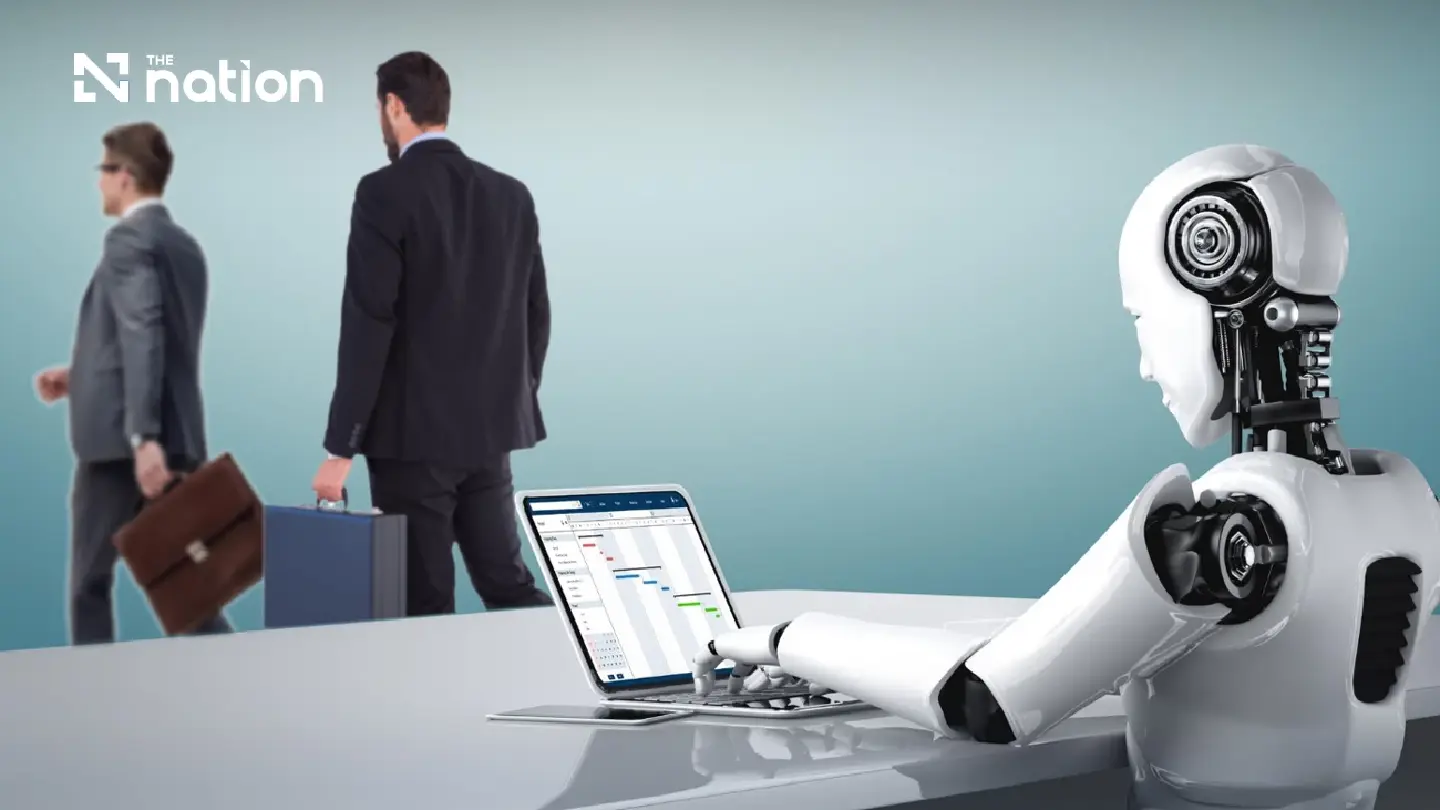


A study warns that replacing workers with AI may cut costs for individual firms while weakening consumer spending across the wider economy.
- Companies are caught in an "AI layoff trap," where they are individually incentivized by competition to replace workers with AI to reduce costs, creating a negative cycle.
- While this strategy benefits individual firms, widespread layoffs lead to a decline in overall consumer purchasing power, which in turn reduces demand and hurts sales across the entire economy.
- This creates a "race to the cliff" where each company's rational choice is to cut staff, as the immediate cost savings outweigh its individual share of the collective economic damage from lost demand.
- The article highlights a study proposing an "automation tax" on each job replaced by AI to make companies financially accountable for the broader economic harm caused by reduced employment.
Artificial intelligence, or AI, is sending another tremor through the economy as organisations around the world continue to cut jobs and adopt AI to replace workers and reduce costs.
But when workers are laid off and lose income, consumer purchasing power also falls, affecting sales of goods and services across the wider economy.
The study, The AI Layoff Trap, or the “AI layoff trap”, indicates that while AI can raise productivity and reduce costs for businesses, broad labour replacement may cause people’s income and purchasing power to decline, creating a new risk that affects not only workers but also businesses and the economy as a whole.
Since the launch of ChatGPT in late 2025, technology companies around the world have poured huge budgets into developing AI models, while businesses have begun experimenting with AI across many areas of work, from customer service, marketing, and data analysis to programming and administrative tasks.
Early discussions about AI tended to focus on improving efficiency. Many organisations presented AI as an “assistant” that would help employees work faster and produce more output.
But as the technology has continued to develop, the question has begun to shift from “how can AI help workers?” to “how far can AI replace people?”
Many technology companies are restructuring their organisations alongside AI investment.
Some executives have said certain types of jobs no longer require additional hiring, while some organisations have begun testing automated systems to perform work in place of employees.
This has raised concern in labour markets around the world that the AI revolution is changing the relationship between technology and labour.
The problem is not AI but business incentives
The study, The AI Layoff Trap, or the “AI layoff trap”, by Brett Hemenway Falk of the University of Pennsylvania and Gerry Tsoukalas of Boston University, points to a structural problem hidden in the AI-era economy: competition between companies may create an incentive for excessive layoffs beyond what is good for the economy as a whole, ultimately affecting both workers and the companies themselves.
The researchers ask why, if every company knows broad layoffs could reduce consumer purchasing power and hurt the economy in the long term, no one is willing to slow the use of AI.
The study cites the example of Jack Dorsey’s company Block, which announced large workforce reductions and said AI made some roles unnecessary.
US data also show that in 2025, there were more than one million layoffs, with about 55,000 positions directly linked to the adoption of AI.
Employees are not just costs but part of the economic engine
Throughout history, technology has often replaced some types of work, but at the same time, it has created new jobs to take their place, allowing labour markets to adjust in the long term.
However, in the AI era, no one knows for certain whether the creation of new jobs will happen quickly enough to compensate for the disappearance of old ones.
Several studies have found that labour replacement is likely to happen faster, while job creation has not increased.
The researchers explain that, from the perspective of each company, using AI to replace labour is a rational decision because it helps reduce costs and increase competitiveness.
But the impact of reduced employment does not stop inside the organisation.
When employees lose income, consumer purchasing power falls, affecting sales of goods and services across the wider economy.
For example, if one company cuts several thousand employees, the company may see lower costs.
But those employees were consumers who spent money in retail, real estate, tourism and various services.
When their income disappears, their spending also falls, and the impact spreads to other businesses across the system.
The key point the study tries to show is that companies cutting staff gain the full benefit of lower costs, while the damage from lost purchasing power is spread across other players in the market.
Companies see profit but not system-wide costs
For this reason, even if executives recognise that layoffs could cause long-term damage, competitive pressure still pushes every company to keep using AI to reduce costs, because no one wants to be at a disadvantage against rivals.
For the executive of one company, laying off 1,000 employees may reduce costs substantially.
But the lost purchasing power of those 1,000 people is spread across thousands of other businesses, so the effect that returns to the original company is small.
The study demonstrates mathematically that using AI to replace employees is “always the best strategy”.
In game theory, this is called a Dominant Strategy.
If Company A wants to restrain itself by not using AI, but all its competitors use AI, Company A will still suffer from the decline in purchasing power, while not saving even 1 baht in costs.
Conversely, if Company A uses AI, it saves costs while bearing only part of the damage.
Therefore, whatever the situation, using AI is always better than not using it at the level of an individual company.
The researchers call this situation a “Race to the Cliff”, or a race in which all sides know the destination may create problems, but no one can stop themselves because any company that slows its use of AI while competitors press ahead could immediately face a cost disadvantage.
Researchers propose a tax on automation
The researchers also tested several counterarguments often proposed in public policy forums, such as reskilling workers, giving employees company shares, providing a universal basic income (UBI), taxing capital income, and even allowing companies to negotiate among themselves.
The result was that these measures could ease the problem in part, but could not address the basic incentive pushing each company to accelerate the use of AI.
The proposal the researchers see as most direct is an “automation tax”, similar to taxes used to deal with economic externalities, or a “Pigouvian tax”, named after British economist Arthur Cecil Pigou.
The idea is that the state would levy a tax for each employee replaced by AI, at a rate equal to the harm the company causes to others in the market but does not bear itself.
This would make companies responsible for the indirect damage caused by reducing employment.
Tax revenue could be used to support reskilling or help affected workers, increasing their chances of returning to the labour market and reducing the long-term impact on purchasing power.
The researchers view the tax as possibly only a temporary measure that gradually declines as the economy adjusts.
The researchers also note that Dario Amodei, chief executive of Anthropic, warned that replacing labour with AI would be “more disruptive than usual”, broader and faster than past technological change.
The study concludes that the debate on AI should not be limited to the question of how displaced workers should be helped.
It should also ask whether the current structure of competition in the economy is creating incentives for companies to use AI faster than the economic system can absorb.
If consumer purchasing power continues to decline, a problem that begins in the labour market may ultimately return to affect the business sector itself.
US tech firms have cut more than 150,000 jobs
Meanwhile, layoffs in the US technology sector in 2026 are continuing, with the total now above 150,000 positions.
Although the latest May employment report was strong, the “technology sector” has continued to reduce staff significantly.
Challenger, Gray & Christmas said technology companies laid off 38,242 people in May, the largest job reduction in nearly two years.
Since the beginning of this year, more than 123,000 technology jobs have already disappeared, while a report by TrueUp put the figure higher, at 150,526 positions.
Events in May included Meta beginning the 8,000 job cuts it had previously announced, while Intuit laid off about 3,000 employees.
There were also major layoffs at Wix, Cisco, LinkedIn and GM.
In April, nearly 12,000 employees were laid off, including at Disney, Amazon and Snap.
March recorded the highest figure, with nearly 50,000 people affected.
Many companies have cited increased investment in AI as a key reason for layoffs.
TrueUp said layoffs appeared to be happening at a “faster than last year” pace, with more than 245,000 technology employees laid off throughout 2025.
Oracle and Meta lead layoffs
The technology sector announcements of staff reductions this year cover software makers, online platforms, cloud service providers and major gaming companies.
Many have said they are restructuring to prepare for increased AI investment.
Oracle cut a large number of staff in March amid reports that the company faced rapidly rising AI infrastructure costs.
Meta began gradually laying off about 8,000 employees in May and also cancelled 6,000 open positions to make way for more AI investment.
Cisco announced layoffs of nearly 4,000 employees and said it would redirect resources into chips, networking, cybersecurity and internal AI use.
LinkedIn is preparing to cut 5% of its workforce, or about 875 people, while Coinbase, Cloudflare, ClickUp and Wix have all announced workforce reductions and clearly signalled adaptation to the AI era.
Salesforce, one of the world’s major software companies, has begun layoffs in several divisions related to AI products and cloud systems.
Layoffs are not limited to technology
The wave of workforce reductions is not confined to the technology sector but has spread to many industries worldwide, from consumer goods, finance, retail and manufacturing to logistics.
Estée Lauder, a major global cosmetics company, raised its workforce reduction target to 9,000-10,000 positions from a previous plan of no more than 7,000.
Heineken, one of the world’s leading beer producers, said it was cutting up to 6,000 employees amid a sluggish beer market and the closure of some production plants outside Europe.
UPS, a major US transport and logistics company, plans to cut a further 30,000 operational employees this year after already laying off 48,000 employees in 2025, bringing cumulative workforce reductions over two years to 78,000.
Nike also announced a second round of layoffs this year, affecting 1,400 employees, mostly in technology roles, after previously cutting 775 employees, mostly in distribution operations.
