
AOT posts 19.3 billion baht profit as higher airport fees offset falling duty-free revenue
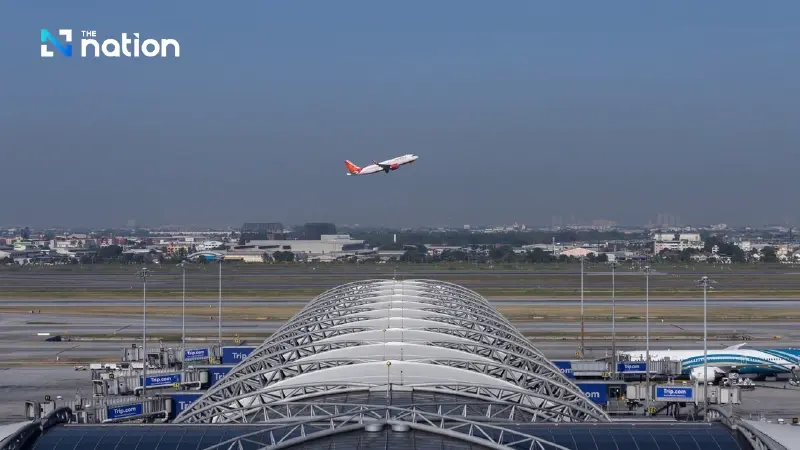


Airports of Thailand reports a 6.53% rise in FY2026 net profit to 19.3 billion baht, driven by higher international passenger fees despite weaker duty-free revenue.
Airports of Thailand (AOT) reported a 6.53% increase in net profit to 19.31 billion baht for fiscal year 2026, driven by higher international passenger service charges and modest growth in passenger numbers, despite declining revenue from duty-free operations.
According to financial results released on Monday (November 23), the state-controlled airport operator recorded a net profit attributable to shareholders of 19.31 billion baht for the financial year ending September 30, up 1.18 billion baht from 18.13 billion baht a year earlier.
Total revenue rose 1.36% year on year to 69.52 billion baht, while revenue from sales and services increased 1.49% to 67.67 billion baht.
The improvement was primarily driven by stronger aeronautical revenue following an increase in the passenger service charge (PSC) for international departures.

Higher passenger fees boost aviation revenue
AOT reported aeronautical revenue of 36.22 billion baht, an increase of 9.60% from the previous year.
The main contributor was revenue from passenger service charges, which climbed 11.24% to 29.27 billion baht.
The increase followed AOT's decision to raise the international departure PSC from 730 baht to 1,120 baht per passenger, effective June 20, 2026.
The revised charge, representing an increase of 390 baht per international departing passenger, helped strengthen aviation-related earnings during the final months of the financial year.
Revenue from airport service charges also increased by 2.68%, providing further support to the company's aeronautical business.
The higher passenger fees helped AOT improve its overall profitability despite relatively modest growth in passenger traffic.
Duty-free revenue falls 10.73%
In contrast, AOT's non-aeronautical revenue declined by 6.47% year on year to 31.45 billion baht.
The decline was largely attributed to a 10.73% reduction in concession revenue, particularly from duty-free retail operations.
The weaker contribution from duty-free businesses offset part of the gains generated by higher passenger service charges.
Nevertheless, rental income from offices and other properties increased by 4.56%, providing some support to non-aeronautical earnings.
AOT's total expenses reached 42.75 billion baht, edging up just 0.04% from the previous year.
The company attributed the slight increase mainly to higher repair and maintenance costs, employee benefit expenses and impairment losses on assets.
With expenses remaining largely stable, operating profit increased by 3.54% to 26.77 billion baht.

Passenger traffic reaches 126.85 million
Passenger traffic across AOT's six airports continued to recover gradually during fiscal 2026.
The airports handled a combined 126.85 million passengers, representing a 0.69% increase from the previous financial year.
International passengers accounted for 77.08 million, while domestic travellers totalled 49.77 million.
However, aircraft movements declined slightly, with the six airports handling 786,879 flights, down 0.15% year on year.
Of these, 441,669 were international flights and 345,210 were domestic services.
The figures indicate that passenger volumes continued to grow despite a marginal reduction in the total number of flights.
Travel demand was supported by international tourism, particularly visitors from India, Russia and China.
The continued recovery in international travel helped sustain passenger throughput and supported AOT's revenue from airport services.
AOT assets rise as liabilities decline
AOT also reported an improvement in its financial position at the end of fiscal 2026.
Total assets increased by 1.35% to 212.77 billion baht, while total liabilities fell by 6.82% to 71.83 billion baht.
Shareholders' equity rose by 6.09% to 140.94 billion baht.
The results highlight the importance of passenger-related revenue to AOT's profitability, particularly as income from commercial concessions remains under pressure.
Although passenger traffic grew by less than 1%, the increase in international departure charges provided a substantial boost to aeronautical revenue.
AOT's latest financial performance reflects a combination of stronger aviation earnings, controlled operating expenses and weaker contributions from duty-free retail operations.
The results underline the company's continued reliance on international passenger traffic and airport charges as key drivers of its financial performance.
