
Five Thai policies under US scrutiny as USTR proposes 18% tariff ceiling
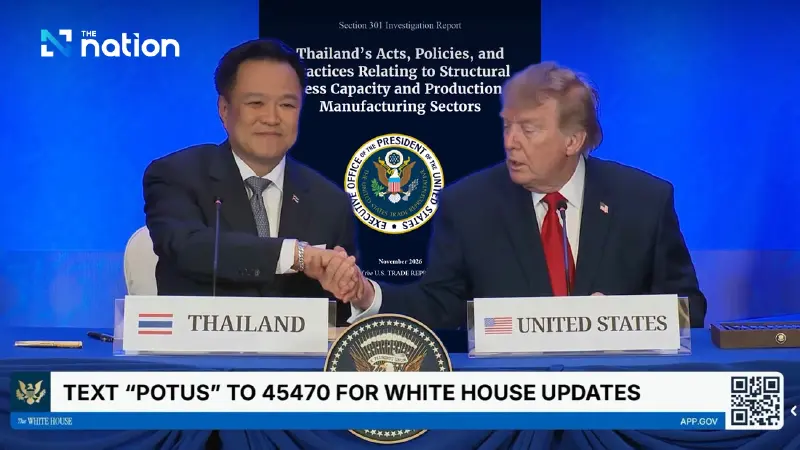


A 171-page USTR report identifies five Thai policies behind proposed US tariffs of up to 18%, citing industrial subsidies, Chinese investment and excess manufacturing capacity.
- The U.S. Trade Representative (USTR) has proposed a tariff ceiling of up to 18% on Thai goods following an investigation that found certain policies distort trade and create excess manufacturing capacity.
- The five Thai policy areas under scrutiny are government-led industrial development, market access barriers, industrial subsidies, inadequate labor protections, and growing economic links with China.
- A key U.S. concern is that Thailand is acting as a channel for China's excess industrial production, evidenced by Thailand's increased reliance on Chinese imports and a doubling of its trade surplus with the U.S. since 2021.
- The investigation specifically highlights Thailand's electric vehicle (EV) subsidy schemes (EV 3.0 and EV 3.5) and support for battery manufacturing as potential contributors to industrial overcapacity.
The United States has identified five Thai government policies and practices that it claims distort international trade and contribute to excess manufacturing capacity, laying the groundwork for proposed tariffs of up to 18% on Thai goods.
The Office of the United States Trade Representative (USTR) released its findings on Wednesday (November 25, 2026), following an investigation under Section 301 of the US Trade Act of 1974.
The 171-page report examines Thailand’s industrial development strategies, government subsidies, import restrictions, labour protections and growing economic links with China.
US Trade Representative Jamieson Greer determined that the policies and practices of 14 economies, including Thailand, placed an unfair burden on US commerce and warranted consideration of retaliatory measures.
A key concern raised in the report is Washington’s assessment that Thailand has become a channel through which China redirects its excess manufacturing capacity towards the US market.

Thailand’s trade surplus with US more than doubles
According to the USTR report, Thailand’s bilateral goods trade surplus with the United States increased from US$34.5 billion in 2021 to $71.2 billion in 2025, more than doubling over five years.
The increase contrasted with Thailand’s overall trade position, which recorded annual deficits of approximately $11–12 billion between 2023 and 2025.
Manufacturing accounted for an average of 25.4% of Thailand’s gross domestic product (GDP) between 2021 and 2025, compared with 9.9% in the United States and an OECD average of 12.8%.
However, Thailand’s manufacturing capacity utilisation rate has averaged 60% or below since 2023.
The USTR cited the combination of relatively large manufacturing capacity, low factory utilisation and rising bilateral trade surpluses as evidence supporting its findings on structural excess capacity.
Growing dependence on Chinese imports and investment
The investigation also highlighted Thailand’s increasing reliance on Chinese goods and investment.
Between 2017 and 2025, Thailand recorded substantial increases in three categories of imports from China:
- Intermediate goods: Up 155%, or $39 billion, including electronic components, chemicals and steel used in manufacturing.
- Capital goods: Up 119%, including machinery and production equipment.
- Finished consumer goods: Up 137%.
Accumulated Chinese foreign direct investment (FDI) in Thailand reached approximately $22.5 billion, with significant investment in automotive manufacturing, basic materials, financial services and other business activities.
The USTR argued that access to Chinese production inputs and capital, combined with Thailand’s industrial promotion policies, had strengthened the competitiveness of Thai-manufactured goods while allowing Chinese industrial capacity to expand overseas.
The report characterised Thailand as a channel for redirecting Chinese excess production towards the US market.
Five Thai policies identified by USTR
The investigation identified five broad areas of government policy that Washington considers to be contributing to excess manufacturing capacity and distorting competition.
1. Government-led industrial development
Thailand’s industrial and economic development strategies, including Thailand 4.0, have prioritised manufacturing expansion, technological upgrading and export growth.
The USTR questioned the extent to which government intervention had encouraged production beyond market-driven demand.
2. Barriers to market access
The report criticised import prohibitions, licensing requirements and other restrictions that it said limited commercial opportunities for foreign producers seeking access to the Thai market.
3. Industrial subsidies and preferential financing
Government financial assistance, preferential loans, tax incentives and other industrial support measures were identified as factors that could give manufacturers operating in Thailand an advantage over overseas competitors.
The automotive and electric vehicle (EV) industries received particular attention.
4. Inadequate labour protections
The USTR alleged that weaknesses in labour protections contributed to lower wages and manufacturing costs, affecting competition with US producers.
It also linked relatively low labour compensation to weaker domestic purchasing power and greater dependence on exports.
5. Chinese investment and manufacturing inputs
The report argued that Thailand had failed to adequately address the effects of industrial overcapacity originating in China and other economies that Washington considers to be non-market economies.
The USTR said growing imports of Chinese manufacturing inputs and inflows of Chinese investment had contributed to the expansion of Thailand’s export-oriented industries.
EV 3.0 and EV 3.5 subsidies come under scrutiny
Thailand’s electric vehicle industry emerged as a particular focus of the investigation, with the USTR examining incentives introduced under the EV 3.0 and EV 3.5 schemes.
The measures include consumer subsidies, reduced import duties and excise taxes, alongside requirements for participating manufacturers to establish local production to compensate for previously imported vehicles.
Under the original EV 3.5 framework, manufacturers were required to meet the following domestic production commitments:
- 2026: Two locally manufactured vehicles for every imported vehicle.
- 2027: Three locally manufactured vehicles for every imported vehicle.
Thailand subsequently introduced greater flexibility by allowing each EV manufactured for export to count as 1.5 vehicles towards manufacturers’ local production obligations.
The USTR also highlighted a 24-billion-baht subsidy for domestic battery cell manufacturers announced in 2023, which it said could cover up to 50% of factory construction costs.
While Thailand has introduced these measures to develop its EV supply chain and support the transition towards cleaner transport, Washington considers them potential contributors to excess industrial capacity.
Electronics, automotive and machinery sectors in spotlight
The report identified several categories of Thai exports that compete directly with US manufacturers, including computers, printers, telecommunications equipment, automotive components, power supply equipment, semiconductors and machinery parts.
Washington also raised economic security concerns over the concentration of global hard disk drive (HDD) manufacturing in Thailand.
The USTR argued that natural disasters or other major disruptions to Thai manufacturing facilities could expose vulnerabilities in global technology supply chains.
The report further estimated that Chinese inputs accounted for 10.7% of the value added in Thailand’s manufactured exports in 2024, highlighting what Washington considers a growing dependence on Chinese supply chains.
Thailand rejects allegations of unfair industrial subsidies
Deputy Prime Minister and Commerce Minister Suphajee Suthumpun said on Thursday (November 26) that Thai government agencies and private-sector representatives had consistently presented evidence to US trade officials throughout the investigation.
Thailand maintains that it does not provide subsidies specifically designed to encourage excess manufacturing capacity and that its investment promotion policies comply with World Trade Organisation (WTO) obligations.
Suphajee said the proposed tariff ceiling of 18% was consistent with Thailand’s previous discussions with Washington and placed Thai exporters in the same category as Malaysia, Indonesia and Cambodia.
The government will continue presenting evidence to US authorities while accelerating efforts to finalise the Thailand–US Agreement on Reciprocal Trade (ART).
Proposed 18% tariff not yet in force
The USTR’s findings provide a legal basis for trade measures under Section 301, which allows Washington to respond to foreign government practices deemed detrimental to US commerce.
However, the proposed 18% tariff represents a ceiling rather than a confirmed rate and takes into account existing Section 301 duties, with exemptions proposed for certain products.
The USTR will accept written submissions until January 5, 2027, before holding public hearings beginning on January 25.
Thailand intends to use the consultation process to challenge the findings and seek the lowest possible final tariff rate.
With the United States remaining Thailand’s largest export market, the outcome of the investigation and ongoing reciprocal trade negotiations will be important in determining the competitiveness of Thai manufacturers in the years ahead.
Source: USTR
