
Art that really pops


Play
American 3D artist Tracy Lee Stum adds believable dimension to sidewalk chalk drawings
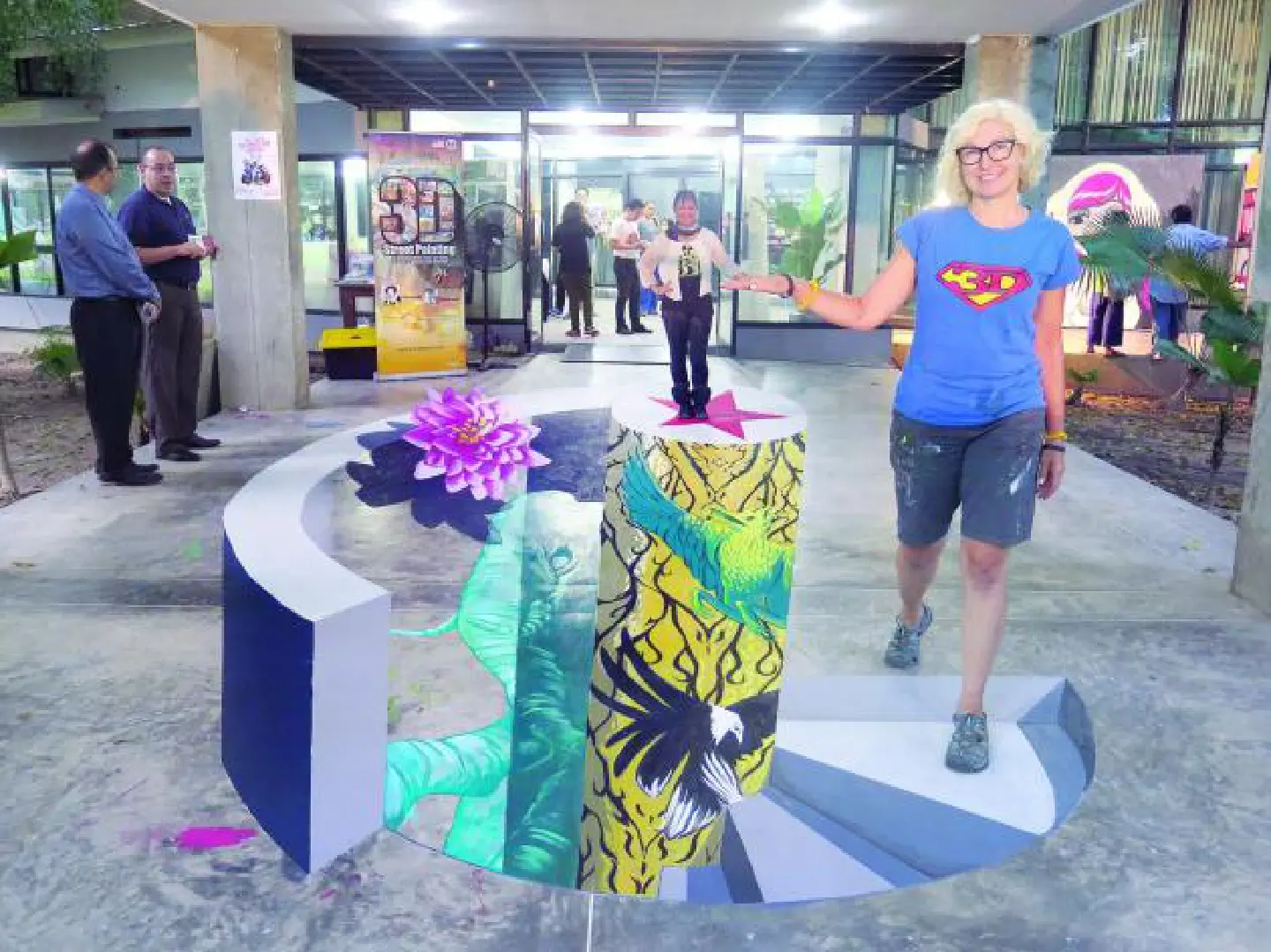
FOR MORE THAN 20 years, American artist Tracy Lee Stum has been using the pavement as her canvas to create fun, interactive 3D paintings.
Using simple pastel-coloured chalk, Stum has created a shark rising from the ocean, a monster emerging from the underworld and all sorts of optical illusions that showcase her impeccable skills, finesse and playful sense of humour.
As one of the leading street painting artists today, Stum in 2006 held the Guinness World Record for the Largest Chalk Painting by an Individual with a reproduction of Leonardo da Vinci’s “The Last Supper” that spanned a massive 55 square metres.
Stum was in Thailand last week on a trip that took her to Bangkok, Chiang Mai and Khon Kaen to host 3D painting workshops for young students as part of the US State Department’s Arts Envoys Programme.
We caught up with her after her workshop at Santichon Islamic School in Bangkok.
HOW DID 3D STREET PAINTING START?
It was invented in 1984 by an American artist called Kurt Wenner. He was the first one to put optical illusions on the ground. But it didn’t really kick in until the Internet came along, when images started going viral online around early 2000s.
WHY DOES IT APPEAL TO YOU SO MUCH?
I like a challenge. When I first started street painting, I copied some of the works from the masters, which was a good way to learn very quickly, but I wasn’t learning anything artistic. I was thinking about something morphing or transforming, like MC Escher’s style of drawing, so I started playing around with those. Back then it was quite difficult because we didn’t have any books, so you had to figure it out by yourself. For me it’s like a challenge, psychologically and mentally, as far as “how am I going to make this work? How do I make it believable?” 3D painting has always engaged me that way, and I have no interests in doing flat, 2D images anymore.
WHAT IS YOUR BACKGROUND?
Prior to 3D street painting I was a mural painter, specialising in Italian decorative art painting which employs a lot of illusionistic techniques. My clients were big casinos in Las Vegas and hotels, and they required me to paint murals that were reproductions of villas in Italy with architecture that looks like it’s coming out but is actually flat. When I discovered that I could do it on the ground, I was blown away. The first 3D street painting I did was an illusionistic twist of an image morphing out of something else.
DO YOU HAVE A FAVOURITE OBJECT OR SCENE TO DRAW?
I don’t really have a specific theme or style. I like to have a broader parameter to work within, which is usually informed by location and who I am drawing for. I like to add lightness to my drawing, and some humour. I don’t like my paintings to be too serious or heavy because there’s enough of that going on in the world.
DO YOU SEE YOURSELF MORE OF A PERFORMANCE OR A VISUAL ARTIST?
We’re more performance artists than we are visual artists. We just use the visual art format. It’s like musicians. They play music and then it’s gone. I’m not attached to the work at all. I’m more interested in the process and the interaction with the public. There are some street painters who don’t do anything in public. They do all their work in studios and bring it down and put it down. But for me that defeats the purpose, which is to have an exchange with the public. The public provides the energy and inspiration for us. We’re educating and delighting them. Most street painters that I know love performing in front of people.
WHAT PROJECTS ARE YOU WORKING ON?
I’m working on one right now, and it has a very different viewing point placement. There are guys around the US who are doing parkour, where they run on walls and do flipping and all of that. I have designed a piece where it should look like there are people running up walls. And the viewpoint would be completely different. I haven’t had the opportunity to paint one yet. It would require about a week and quite a lot of setting up.
I’m always pushing myself to come up with new ideas and new ways to incorporate the 3D format. After doing this for many years, people expect you to draw a hole in the ground. I’ve done enough of those, and I won’t do any of those anymore. I’m looking for ways to incorporate different viewing points, different ways for people to stand and interact with the painting.
YOU SEEM TO USE ALL KINDS OF PAINT. WHAT’S YOUR FAVOURITE?
My favourite way of practising is with chalk pastel because it gives such a rich, beautiful look and you can get so much texture from the drawing. There’s something about pastel on pavement; it’s vibrant and it pops off, drawing people in. But we usually use stuff that’s not expensive at all, like house paint or acrylic paint. You don’t need fancy paint or tools to do this. But you need a camera because the 3D effect is best seen through camera lens. It’s because the way our eyes see and pick up peripheral where we tend to flatten things out when we see an illusion on the ground.
HOW BIG IS THE 3D STREET ART SCENE NOW?
It’s huge right now. When I first started drawing in 1997-98, there were about two festivals in the US a year. Now there are hundreds of festivals around the world, and there’re so many artists practising 3D now. Younger artists can now make a living out of it but that didn’t exist 15 years ago. Nowadays there’s a market for it and ways to practice.
WHAT ADVICE WOULD YOU GIVE TO SOMEONE WHO WOULD LIKE TO TRY?
Don’t be afraid to try. You can’t really make mistakes with chalk; you can just wipe it all away and start over! Look at other artists’ works that you like, and there are tons of videos online. Have a go and start with something simple – like a hole in the ground. Take some art classes, because it certainly helps if you know how to render things and how colours work. And have fun with it.
On the Web:
TracyLeeStum.com
