
Why Thailand's Courtroom Devil Conquered Netflix in a Single Night



Five years of legal research, a moral universe built on shades of grey, and a public-private production pipeline that de-risks ambitious storytelling — the overnight triumph of The Evil Lawyer is no accident
- The series abandoned traditional good-versus-evil narratives for a morally complex "shades of grey" framework, exploring the gap between law and justice which resonated deeply with audiences.
- Its success was built on high production quality, stemming from five years of intensive legal research, compelling performances that embodied the show's ambiguity, and innovative directing.
- A unique public-private partnership enabled its creation, with a government agency's Content Lab program de-risking the ambitious project before it was developed by Netflix for global distribution.
Five years of legal research, a moral universe built on shades of grey, and a public-private production pipeline that de-risks ambitious storytelling — the overnight triumph of The Evil Lawyer is no accident.
It took less than twenty-four hours. On June 11, 2026, Netflix Thailand released The Evil Lawyer and by the following morning social media feeds across Bangkok had transformed into an impromptu law school seminar.
The series had seized the number-one spot on the platform's Thai charts, and the conversation – about justice, morality, and the monsters in white clothes – had escaped every algorithm and colonised dinner tables, university corridors, and office group chats.
For a legal drama set in the often rigidly conservative universe of Thai courtroom procedure, this was not the expected outcome. Yet it was, on reflection, the entirely logical one.
The speed of the ascent invites scrutiny. What does it mean when a prestige drama sells not just entertainment but a philosophical framework and finds an audience apparently starved of exactly that?
The answer lies in the convergence of narrative risk-taking, institutional infrastructure, and performances that challenged viewers to question their own assumptions about guilt, innocence, and the systems designed to adjudicate between them.
The Grey-Space Strategy
Thai television has, for most of its modern history, operated in a binary moral universe: heroes shine, villains scheme, and the audience is never left in genuine doubt about who deserves their sympathy. The Evil Lawyer dismantles this architecture in its very first episode and never rebuilds it.

The series centres its drama on the "Devil's Path" — a philosophical framework in which characters deploy morally illegitimate means to combat systemic evil.
The premiere episode's centrepiece is the "Luk Krok" case — a plotline built around a localised superstition involving infant remains and sorcery, submitted to the cold forensic scrutiny of statutory definition.
The defence's strategy hinges on whether the infant cried at birth, which determines its legal classification as a "human life" or merely "remains".
This forces the audience to simultaneously recoil at the human horror of the case and acknowledge, with uncomfortable clarity, that the law itself has made space for this horror to exist.
The gap between what is legal and what is moral is exposed not with a lecture but with a verdict.
The series maps three distinct layers of conflict — legal versus moral, visible versus invisible power, and human versus system — with the discipline of a production that has spent years thinking about what it wants to say. The result is drama that functions as both entertainment and interrogation.
The Characters Doing The Work
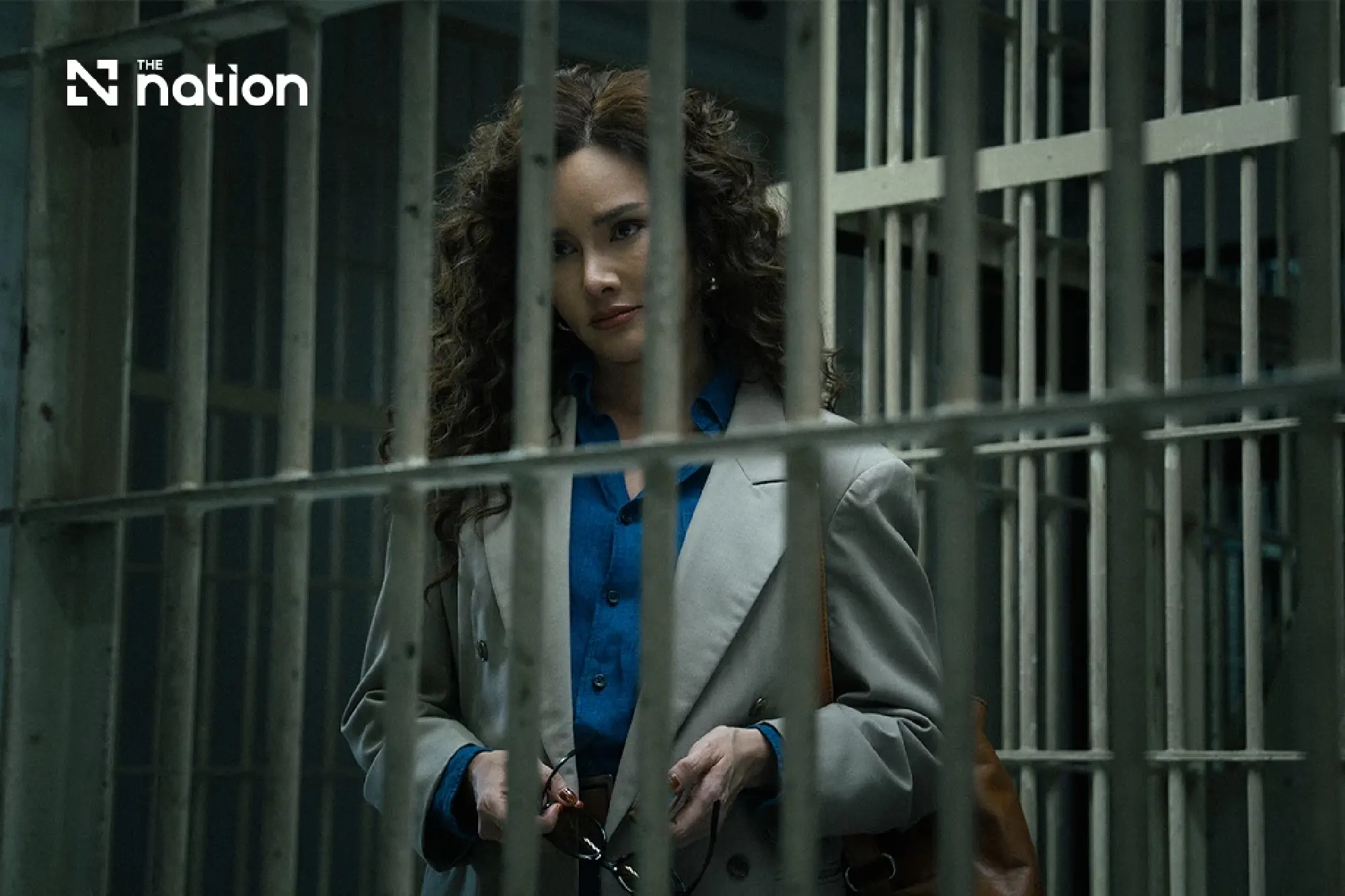
No philosophical framework survives bad casting. Ying Rhatha as Jittri – the "Grey Lawyer" – carries the series' central moral paradox across multiple simultaneous registers: the cold, the sharp, and the sardonic.
Jittri is a survivor who has weaponised the system's own flaws; blackmail and procedural theatre are her instruments. Taking her first leading role, Rhatha plays the character without allowing any single note to dominate long enough to resolve the ambiguity the show depends upon.

Against her, Nat Kitcharit plays Mek, the idealist framed for the murder of the son of the powerful "Big Anant", portrayed by Songsit Rungnophakhunsri. His trajectory — from white-suited idealism to the grey pragmatism of the Devil's Path — mirrors the audience's own forced reappraisal of what justice requires.
A standout supporting turn comes from Ta Phatsakorn as Seya, a migrant worker portrayed with such precision in manner and language that viewers initially believed the actor was actually Burmese – the show's commitment to realism made physical.
Five Years in The Research Room
The Evil Lawyer benefited from a five-year research period during which the creative team consulted legal professionals across multiple specialisations.
Director and co-writer Nottapon Boonprakob — whose previous global breakthrough, Mad Unicorn, established his credentials for technically demanding storytelling — solved the core challenge of legal drama through a directorial device: camera movements that physically bridge the courtroom with the crime scenes under discussion, collapsing the abstract procedural into visceral narrative.
Co-created by Jakkarin Thepvong and Songphon Jantharasom, the series has the feel of a production in which everyone understood precisely what they were making and why.

The Institutional Engine
To understand why The Evil Lawyer exists at this level of quality, one must look beyond the production to the infrastructure behind it.
The series was incubated through the Content Lab programme managed by Thailand's Creative Economy Agency (CEA), the 2023 edition of which provided a structured development environment before connecting projects with streaming buyers.
Netflix identified the project through this mechanism and developed it for global distribution — a public-private pipeline that de-risks ambitious content before it ever reaches a commissioning table.
The macroeconomic context makes the strategic logic clear.
According to PwC's Global Entertainment & Media Outlook 2025–2029, Thailand's entertainment and media industry is projected to surpass 700 billion baht in 2025, up 4% from the previous year, and is forecast to reach 788 billion baht by 2029 at a compound annual growth rate of approximately 3% (PwC Thailand, August 2025).
OTT video services are among the fastest-growing segments, expected to expand 21% year-on-year to 33.8 billion baht in 2025. Netflix has backed this trajectory with a $200 million investment in Thai content between 2021 and 2024, supported by 750 million global viewing hours — numbers that transform cultural production into economic policy.
A Critical Accounting
The series' achievement is real, but it is not purely the product of creative genius. It is also the product of an institutional system built, with public money, to produce exactly this kind of outcome.
The Content Lab framework rewards projects that combine local authenticity with global commercial viability; stories that are too formally experimental or too politically uncomfortable, may find this pipeline less hospitable. That is a structural tension worth naming even as the results speak for themselves.
There is also the matter of the "grey spaces" the series so confidently inhabits. The Evil Lawyer is sophisticated in its refusal of moral binaries, but this sophistication is itself a highly marketable quality in 2026's prestige television landscape.
Global streaming audiences have been trained by years of "complex antihero" drama to read moral ambiguity as a marker of quality. The series meets this expectation with skill — but whether it genuinely challenges that expectation or simply satisfies it is a question worth holding open.
These are not arguments against the series. They are invitations to take it seriously as a cultural phenomenon shaped by forces larger than any individual creative vision.
On June 12, the morning after the night everyone watched it, the conversation had already moved from "did you watch it?" to "what do you think it's saying?" That transition — from viewing event to cultural reference point — is the real measure of impact.
The Evil Lawyer has, in a single day, made the Thai courtroom a space where questions about justice and power feel urgent and alive. The achievement worth examining is not simply that it reached number one, but that it made its audience want to keep arguing about what it means to win.
