
Phimai Temple: the Thai sanctuary that came before Angkor Wat
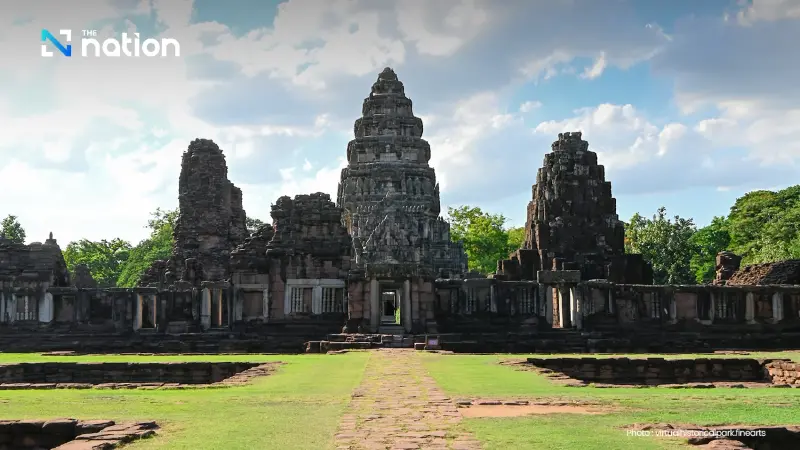


Phimai Temple in Nakhon Ratchasima is Thailand’s largest sandstone sanctuary. Explore its Mahayana Buddhist roots, south-facing design and possible links to Angkor Wat.
- Phimai Temple, located in north-eastern Thailand, is the country's largest ancient sandstone sanctuary and predates Cambodia's Angkor Wat by approximately 30-50 years.
- Historians suggest Phimai may have served as an architectural inspiration for Angkor Wat, sharing features such as bud-shaped towers and narrative sandstone carvings which appeared at Phimai first.
- Unlike many Hindu Khmer temples, Phimai was a significant centre for Mahayana Buddhism and is uniquely oriented to face south, likely to align with an ancient royal road from Angkor.
- The temple's scale and sophistication establish the region not as a remote frontier, but as a flourishing centre of Khmer civilisation with a shared cultural heritage with Cambodia.
On the plains of the Mun River in north-eastern Thailand, a magnificent sandstone sanctuary tells a story stretching back more than 1,000 years.
Phimai Temple, the country's largest ancient sandstone temple, stands as a remarkable legacy of Khmer civilisation — and a possible architectural inspiration for Cambodia's world-famous Angkor Wat.
Located in Phimai district of Nakhon Ratchasima province, Prasat Hin Phimai is more than an ancient religious monument. It offers a glimpse into a time when the Mun River basin was a flourishing centre of religion, culture and political influence.
With its towering central sanctuary, elaborate sandstone carvings and distinctive layout, Phimai reflects the architectural sophistication of the ancient city of Vimayapura.
Yet what makes the temple particularly intriguing is its place in history. Architectural similarities have led some historians and archaeologists to suggest that Phimai may have helped shape the design of Angkor Wat, one of Southeast Asia's most celebrated monuments.

A thousand years of history in the Mun River basin
Phimai Temple's origins can be traced to the 16th Buddhist century (roughly the late 10th to mid-11th centuries CE), during the reign of King Suryavarman I, according to historical evidence and stone inscriptions.
The sanctuary underwent major additions and renovations during the 17th and 18th Buddhist centuries, gradually developing into one of the region's most impressive religious complexes.
According to this chronology, Phimai predates Angkor Wat by approximately 30–50 years and Angkor Thom by around a century.
But the significance of Phimai extends well beyond its age.
The ancient city of Vimayapura was designed according to cosmological principles, with moats, city walls, a naga bridge and gateways in all four directions.
Together, these features reveal an elaborate urban landscape that reflected the city's religious importance, prosperity and position within the wider Khmer civilisation.
A sacred heart of Mahayana Buddhism
Unlike many ancient Khmer temples associated with Hinduism, particularly the worship of Shiva, Phimai was an important religious centre of Mahayana Buddhism, particularly the Vajrayana tradition.
At its heart stands a magnificent central sanctuary built from rare white sandstone. Rising 28 metres from its base to its summit, the central prang (sanctuary tower) is regarded as Thailand's tallest and largest of its kind.
Inside is a revered image of the Buddha sheltered beneath the protective hood of a naga, reflecting the Buddhist traditions that shaped the temple's religious identity.

The mystery of a temple facing south
One of Phimai's most fascinating features is something visitors might not immediately notice: its orientation. While most ancient Khmer temples were designed to face east, towards the rising sun, Phimai faces south.
Why would its builders depart from such a widespread architectural tradition? One archaeological theory suggests that the orientation was deliberate, aligning the sanctuary with the Royal Road, an ancient route stretching more than 200 kilometres from Angkor Thom.
The unusual alignment has therefore been interpreted as another indication of Phimai's considerable political and religious importance, with the ancient city sometimes described as a second capital within the Khmer world.
Did Phimai provide the blueprint for Angkor Wat?
Perhaps the most compelling chapter in Phimai's story concerns its possible influence on Angkor Wat.
Historians and archaeologists have pointed to several architectural similarities suggesting that design elements seen at Phimai may have influenced later Khmer temple construction.
These include bud-shaped sanctuary towers, cruciform pavilions, pediments depicting nagas with their hoods spread, and intricate sandstone reliefs. Of particular interest are carvings depicting historical narratives rather than mythological scenes.
Such carvings appeared at Phimai before comparable depictions of military processions at Angkor Wat.

The skill of local craftsmen
Behind Phimai's imposing sandstone structures lies another important story — that of the craftsmen whose knowledge and skills made their construction possible.
The temple's intricate carvings and architectural details reflect the craftsmanship and artistic traditions of communities associated with the Mun River basin.
Phimai's construction is credited to local craftsmen from Upper Khmer, Kuy (Suay), Austroasiatic, Lao and Tai communities, particularly the Tai Doeng, rather than to builders from outside the region.
Their collective craftsmanship reflects local identity, creativity and cultural knowledge.

More than a monument: A shared cultural legacy
Phimai Temple also challenges the longstanding perception of north-eastern Thailand, or Isaan, as a peripheral region in Southeast Asian history. Its scale, religious importance and architectural sophistication point instead to the Mun River basin as a significant centre of ancient civilisation.
The region was not merely a distant frontier. It was a place where communities, beliefs and artistic traditions converged, contributing to a wider network of cultural and political influence.
Today, Phimai stands as a reminder of that shared heritage — one that connects the peoples of Thailand and Cambodia through centuries of history.
It is a cultural legacy that deserves to be studied, valued and preserved for future generations.
