
Toxic contaminant levels exceed limits in 10 species from the Kok River


In affected stretches, contaminated sediment puts animals that live or feed on the riverbed at risk. Further tests are planned on fish raised in cages and ponds.
- Tests on 300 aquatic species in the Kok River revealed that 10 species had toxic contaminant levels exceeding safety limits.
- The contaminated species include mollusks like snails and mussels, freshwater shrimp, and several bottom-dwelling fish such as pangasius catfish and sicklefin barbs.
- Officials have advised the public to avoid eating aquatic animals from at-risk areas, particularly their internal organs where contaminants accumulate.
- In response, authorities plan to implement a color-coded warning system for residents and provide support to affected aquaculture farms.
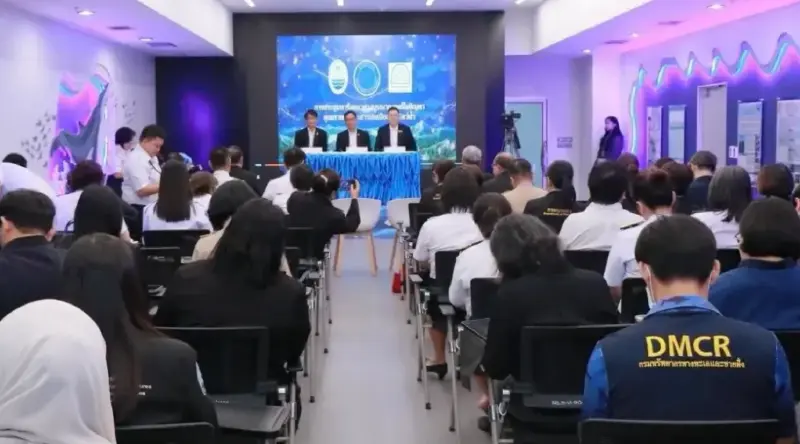
Officials met at the Department of Marine and Coastal Resources (DMCR) in the Government Complex on Chaeng Watthana Road in Bangkok on Monday (November 23, 2026) to discuss a joint response to water quality problems and toxic contamination in aquatic animals.
Phadet Laithong, deputy permanent secretary at the Ministry of Natural Resources and Environment and acting director-general of the DMCR, took part alongside Surin Worakijthamrong, director-general of the Pollution Control Department (PCD), and Pinsak Suraswadi, director-general of the Department of Fisheries.
The aim was to share information and test results and use them to draw up measures to tackle the problems and reduce their impact on the public.
Pinsak said the meeting was intended to share information, explain the nature of the problem and present the results of environmental monitoring, water quality tests and checks on aquatic animals in rivers.
The aim was to find ways to protect people who farm aquatic animals in rivers and to assess the environmental impact.
This work would help establish a system for monitoring conditions, carrying out checks and alerting coastal aquaculture farmers.
There were concerns about eating aquatic animals from stretches of the Kok River in northern Thailand where levels of toxic substances exceeded the limits.
Tests found relatively high levels of contamination in the sediment there, putting animals that live or feed on the riverbed at risk.
These include molluscs and bottom-dwelling fish.
The 10 aquatic species with levels of toxic substances above the limits
Tests on random samples from 300 aquatic species found that levels of toxic substances exceeded the limits in 10.
Those listed included freshwater shrimp, golden apple snails, river snails, freshwater mussels (hoi kap nam chuet) and freshwater bivalves known as hoi kraphong nam chuet.
The fish listed were pangasius catfish (pla pho), soldier river barbs, yellow mystus (pla kot lueang), northern black sheatfish (pla khao dam nuea) and sicklefin barbs.
Living organisms can naturally convert some arsenic into organic arsenic and excrete it within a short time.
Concerns remain about long-term exposure to contaminants and their build-up in the body.
People were advised to avoid eating aquatic animals from areas at risk of contamination.
The guidance said animals living in midwater or near the surface could be eaten, but their internal organs should be avoided because various substances accumulate there.
Further tests are planned on fish raised in cages, particularly along the Mekong River, and on fish from aquaculture ponds, to identify safe farms and areas at risk.
Under the plan, green, yellow and red flags would mark safe areas and areas at risk, based on the levels detected, to warn local residents.
If farms are found to have been affected by the use of river water with high pollution levels, they will receive help to change their farming methods or support for suitable livelihoods and forms of aquaculture.
Further research is needed into the effects of contaminants on the life cycles and reproduction of aquatic animals, including whether any effects pass to their offspring.
The available evidence does not yet establish whether contamination sets off a chain of effects.
Goonch catfish in the Mekong basin, including fish in the river’s tributaries, had shown skin abnormalities.
Pinsak confirmed that flukes had caused the inflammation and skin sores, and ruled out toxic substances in the water as the cause.
He said people needed to avoid eating these fish in any case because they live on the riverbed and carry parasites.
