
Chulalongkorn University hosts fourth Water Resilience Forum to address extreme rainfall


Connecting water-related risks with national preparedness
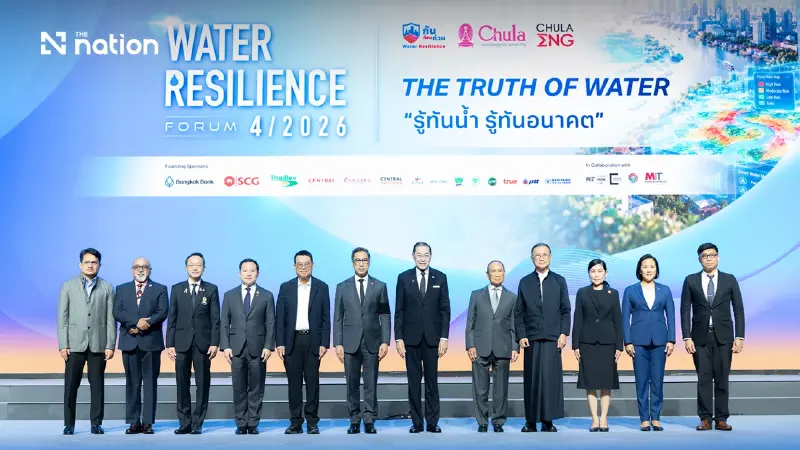
Chulalongkorn University, through the Water Resilience Center at its Faculty of Engineering, organised Water Resilience Forum 4/2026 under the theme “The Truth of Water: Understanding Water, Understanding the Future” and the concept “The World Is Adapting: As the World Must Live with Water, How Should We?”
The forum took place on 12 November 2026 at the SX Grand Plenary Hall, Queen Sirikit National Convention Center, with Professor (Special) Dr Surakiart Sathirathai, Chairman of the Chulalongkorn University Council, presiding over the opening ceremony.

The event brought together experts to exchange knowledge and explore ways to prepare for water-related risks arising from climate change, particularly extreme rainfall, which affects cities, economies and communities.
Surakiart noted that Thailand has long had a close relationship with water, but climate change, geographical conditions and urban expansion are altering the nature of water-related risks.
“Thailand has a long history of living with water. However, climate change, geographical conditions and urban development have changed the risks we face, including extreme rainfall, flash floods, high tides and droughts.
“Recent flooding in several areas has demonstrated that disaster relief is essential. Nevertheless, we must strengthen our preparations before disasters occur. This includes systematic water management, early warning systems, evacuation plans, support for vulnerable groups and improvements to drainage efficiency.”
He also called for a broader approach to water management that would create economic opportunities while strengthening national resilience.
“Thailand should move beyond viewing water management solely in terms of risks or disasters and towards an approach that creates security and economic opportunities. In other words, we need to shift from Water Risk to Water Economy.
“Data and knowledge should guide decision-making and investment so that they reflect actual risks. We can also learn from international approaches, including the Netherlands’ strategy of making room for rivers to accommodate floodwaters, Japan’s underground drainage tunnels and China’s Sponge City concept.
“Managing water-related disasters is not the responsibility of any single organisation. It requires cooperation among the government, businesses, the public and educational institutions to improve preparedness and reduce losses over the long term.”
TRUTH 1 – THE TRUTH WE CAN SEE
The session, “How Can Bangkok Prepare for Extreme Rainfall?”, featured Dr Sai Ravela, Principal Research Scientist in the Department of Earth, Atmospheric and Planetary Sciences at the Massachusetts Institute of Technology (MIT), and Assistant Professor Dr Pongsak Suttinon, Head of the Department of Water Resources Engineering at Chulalongkorn University’s Faculty of Engineering and a member of the Water Resilience Center’s academic committee.
The speakers examined how high-resolution climate data and modelling could help prepare for future water crises.
A key feature was a presentation showing possible future extreme rainfall conditions in Bangkok using the high-resolution extreme climate data system known as CEDoS, developed through joint research between the Water Resilience Center and MIT.
The system can simulate and project extreme climate hazards at a local level, with a spatial resolution of approximately 5 × 5 kilometres. The initial research focuses on Bangkok.
It combines climate data, scientific analysis, satellite information and artificial intelligence (AI) to assess future risks and support preparedness planning.
CEDoS is designed to model future climate conditions and risks. It is not a real-time weather forecasting or disaster warning system.
TRUTH 2 – THE RISK WE MUST FACE
The session, “When Water Risk Becomes Business Risk”, brought together Vikrom Kromadit, Chief Executive Officer of Amata Corporation Public Company Limited and Chairman of the Amata Foundation, and Tongjai Thanachanan, Executive Vice President – Chief Sustainability and Strategy at Thai Beverage Public Company Limited.

The two business leaders discussed how water-related risks could affect business operations and shared perspectives on how the private sector could strengthen its preparedness.

TRUTH 3 – THE ACTION WE CAN TAKE
The forum featured a video presentation entitled “The Khuan Santi Model: When Knowledge About Water Becomes Community Preparedness”, presented by Zakee Pitakumpol, an adviser to the committee of Khuan Santi Mosque in Hat Yai district, Songkhla province.

The presentation outlined a community-level approach to preparing for water-related disasters, covering the establishment of safe havens, evacuation procedures, communication, assistance for vulnerable groups, and preparedness measures and drills.
FROM TRUTH TO NATIONAL ACTION
The session, “Now That We Know the Facts, What Must Thailand Change?”, featured Bangkok Governor Chadchart Sittipunt and Danucha Pichayanan, Secretary-General of the National Economic and Social Development Council.

They exchanged policy perspectives on how knowledge and understanding of water-related risks could be translated into action at the national level.

CLOSING – THE TRUTH WE CHOOSE
The final session, “Understanding the Truth Today to Avoid a Heavy Price Tomorrow”, was delivered by Associate Professor Dr Witaya Wannasuphoprasit, Dean of Chulalongkorn University’s Faculty of Engineering and Chairman of the Water Resilience Center.
He summarised the forum’s key discussions, emphasising the importance of using data and knowledge to prepare for water-related risks before disasters occur.
The fourth Water Resilience Forum aimed to encourage a shift from responding to water-related disasters after they occur towards advance preparedness supported by data, research and technology.
The initiative seeks to help government agencies, businesses and communities assess risks, plan adaptation measures and work together systematically. Its longer-term goal is to reduce damage and strengthen society’s ability to live safely and sustainably with water.
