
Thailand’s oil price structure questioned as diesel rises


A fresh diesel price increase has renewed scrutiny over Thailand’s fuel pricing system, with critics arguing motorists are paying more despite ample stock and lower-cost supplies.
- Diesel prices in Thailand have risen despite the country possessing a three-month supply of crude oil purchased at a lower cost before the recent global price surge.
- The pricing structure is being questioned because it is based on international market benchmarks and allows components like refinery margins to increase, rather than reflecting the actual low cost of the oil currently in stock.
- This pricing system, which includes various taxes and fund contributions, has made Thai diesel more expensive than in neighboring countries like Malaysia and Indonesia, which use direct subsidies.
- Critics argue the structure benefits oil industry operators more than consumers, as it allows for upward price adjustments throughout the supply chain even when the underlying cost of oil reserves is low.
Whether Bangchak and PTT service stations are selling fuel at higher or lower prices than those in other ASEAN countries remains a matter of continuing public interest and frequent scrutiny.
This is especially the case at present, amid the Middle East war following the attacks launched by the United States and Israel on Iran.
This is because fuel prices are one of the key factors affecting people’s cost of living.
An examination by Thansettakij into Thai fuel prices compared with those in ASEAN countries, to determine whether Thailand is more expensive or cheaper, found that data from the Energy Policy and Planning Office (EPPO), Ministry of Energy, ranked ASEAN countries by the highest fuel prices for both gasoline and diesel as follows.
Gasoline
- Singapore: 86.01 baht per litre
- Laos: 62.43 baht per litre
- Cambodia: 50.59 baht per litre
- Myanmar: 45.42 baht per litre
- The Philippines: 37.85 baht per litre
- Vietnam: 31.05 baht per litre
- Thailand: 31.05 baht per litre
- Malaysia: 27.00 baht per litre
- Indonesia: 23.79 baht per litre
- Brunei: 13.43 baht per litre
Diesel
- Singapore: 88.28 baht per litre
- Cambodia: 51.80 baht per litre
- Myanmar: 49.68 baht per litre
- Laos: 48.98 baht per litre
- The Philippines: 42.98 baht per litre
- Vietnam: 33.62 baht per litre
- Malaysia: 32.37 baht per litre
- Thailand: 29.94 baht per litre
- Indonesia: 28.07 baht per litre
- Brunei: 7.85 baht per litre
Average oil prices in ASEAN as of March 16, 2026
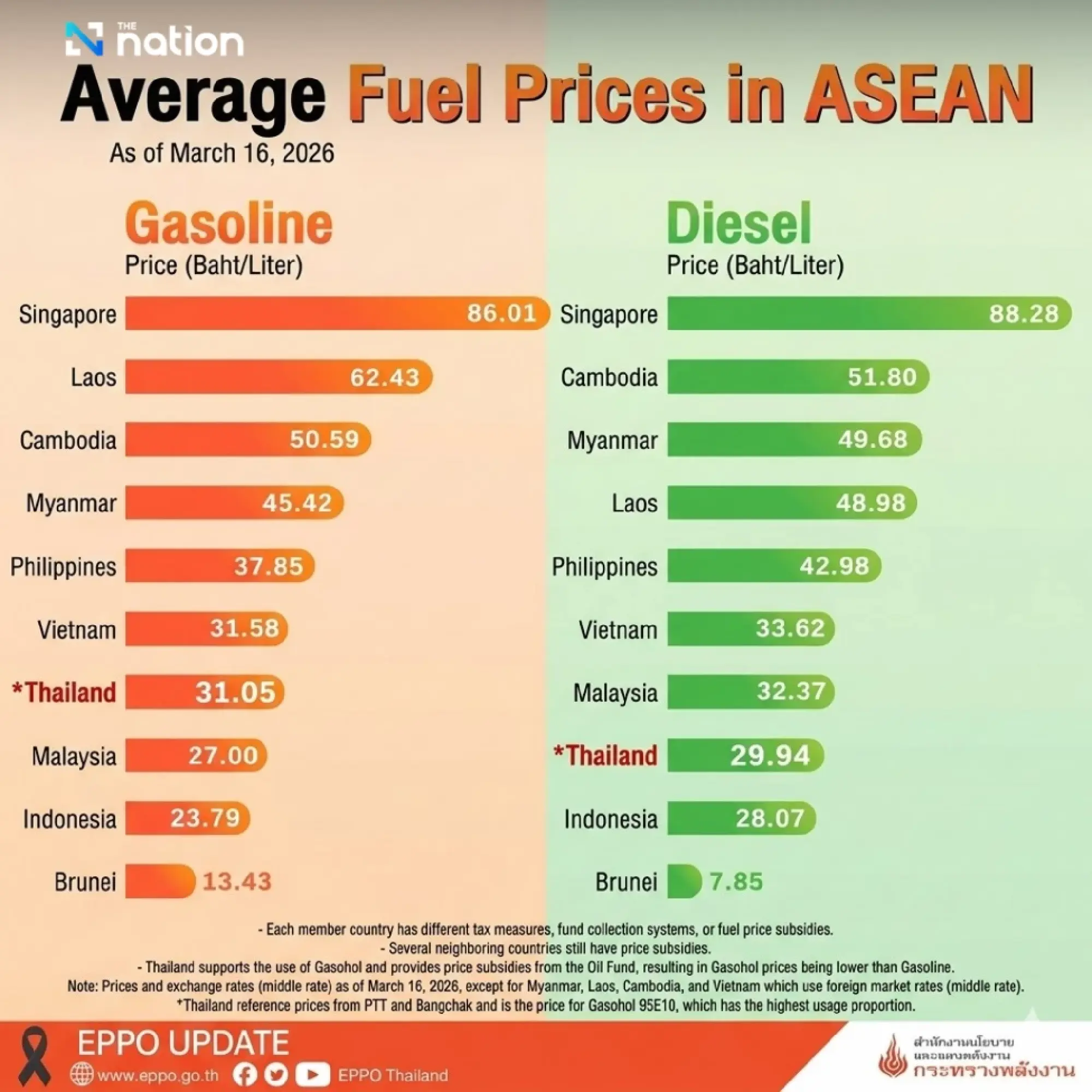
For retail oil prices in each country, the pricing factors are as follows:
- Each country has different tax measures, as well as different systems for collecting levies into funds or subsidising energy prices.
- Many neighbouring countries still subsidise fuel prices.
- Thailand supports the use of gasohol and subsidises prices through the Oil Fuel Fund, which is why gasohol is cheaper than gasoline.
Prices and exchange rates (mid-rates) are as of March 16, 2026, except for Myanmar, Laos, Cambodia and Vietnam, for which international market rates (mid-rates) are used.
Thailand’s reference prices are based on PTT and Bangchak, and refer to Gasohol 95 E10, which has the largest share of consumption.
Dissecting Thailand’s distorted oil price structure pushes diesel to 30 baht, making it pricier than in Malaysia and Indonesia
The government has gone ahead with another 0.50-baht-per-litre increase in diesel prices, effective March 18, 2026, from the previously capped 29.94 baht per litre to 30.44 baht per litre, while insisting that the ceiling will remain at no more than 33 baht per litre for some time to cushion living costs amid pressure from global energy costs and the still-strained Oil Fuel Fund.
This reflects an attempt to balance public relief with domestic energy stability, even though the government has insisted that the country has sufficient oil stocks for more than three months of use.

Assoc Prof Dr Aat Pisanwanich, an independent academic and expert in international and ASEAN economics, said the key fact is that the crude oil currently held in Thailand’s inventories was purchased before February 28, 2026, when Israel and the United States launched attacks on Iran, at a time when global oil prices had not yet surged because of the war.
That means the true cost is still low.
Therefore, in principle, “Thai people should continue to be able to use diesel at 29.94 baht per litre for three months”, from March 28, 2026, until late June, through June 28, 2026, and there should be no price increase during that period.
However, what has actually happened has moved in the opposite direction, as certain components of the price structure have been adjusted, especially the Gross Refinery Margin (GRM), from about 2 baht to 6 baht per litre in mid-March, even though the crude oil still in the system is older, lower-cost stock.
This has led to questions over whether there is sufficient justification for retail prices to rise.
Stock exists, but the price structure is problematic
Data indicate that Thailand has crude oil reserves of around 90 million barrels, or more than 14.31 billion litres, enough to support domestic use for about three months, in line with the government’s assurances.
The problem is not the quantity, but the pricing mechanism, which still relies on the Singapore market (MOPS) and allows some cost items to rise even though the actual underlying cost has not changed.
Thailand’s diesel price structure as of February 27, 2026, shows that:
- The ex-refinery price stood at 18.96 baht per litre
- The actual refining margin was about 5.2 baht per litre
- The crude oil cost was only 13.5 baht per litre
But after the global oil price crisis in March, as of March 17, 2026, the ex-refinery price surged to 38.67 baht per litre, forcing the state to use the Oil Fuel Fund to subsidise as much as 20.36 baht per litre in order to keep the retail price at 29.94 baht.
This reflects that the system is absorbing the shock from the price structure more than from the true cost of the stock on hand.
Thai people pay more than their neighbours
Compared with other ASEAN countries, Thailand still carries higher hidden cost burdens in its price structure than many countries, including excise tax, municipal tax and contributions to the Energy Conservation Promotion Fund, while Malaysia and Indonesia use direct budget subsidies and reduce tax burdens, resulting in significantly lower diesel prices than in Thailand, such as:
- Malaysia: around 23 baht per litre
- Indonesia: around 25 baht per litre
This reflects a clear policy difference between passing the burden on to the public and using the state to absorb costs.
The industry chain benefits
Another important issue is the structure of the oil industry chain, from upstream to downstream, which is seen as benefiting operators more than consumers when oil prices rise.
Every point in the chain, from refineries and oil traders to marketing margins, has an opportunity to adjust upwards, while consumers have no choice and must bear prices determined by the system.
Dr Aat said this is why “Thai people must bear the consequences” of expensive fuel prices, even though, in reality, the country still has low oil costs from old stock.
Accumulated policy problems
In addition to the price structure, there are long-accumulated policy factors, such as:
- The failure to seriously promote biodiesel, with Thailand still using only B7, while Indonesia uses B40 and Malaysia uses B20
- The use of multiple pricing systems, or a two-market structure, creates distortions, such as some traders turning to buy fuel at service stations where prices are lower than market prices
- The lack of clarity in the management of the Oil Fuel Fund, which has become more of a “price-delay” tool than a structural management mechanism
The result is a situation in which “there is enough oil, but shortages appear at the pump” because of panic buying in a distorted pricing system.
The questioned way out
The proposal is that the state must review the entire oil pricing structure, especially during periods when the country has low-cost stock.
If fuel has already been bought cheaply, the public should be allowed to use that low price, rather than letting a pricing mechanism tied to the world market be layered on top of it and push costs above the real level.
In addition, it is proposed that:
- Taxes and fund contributions should be reduced during the crisis
- The state budget should play a greater role in price management
- Alternative energy, such as biodiesel, should be accelerated
“This situation is therefore not merely the impact of the global energy war, but a test of Thailand’s energy management system as to who will be made to bear the burden, the public, or the structure that needs reform,” Aat said.
