
Thailand records a wider Middle East trade deficit as exports fall
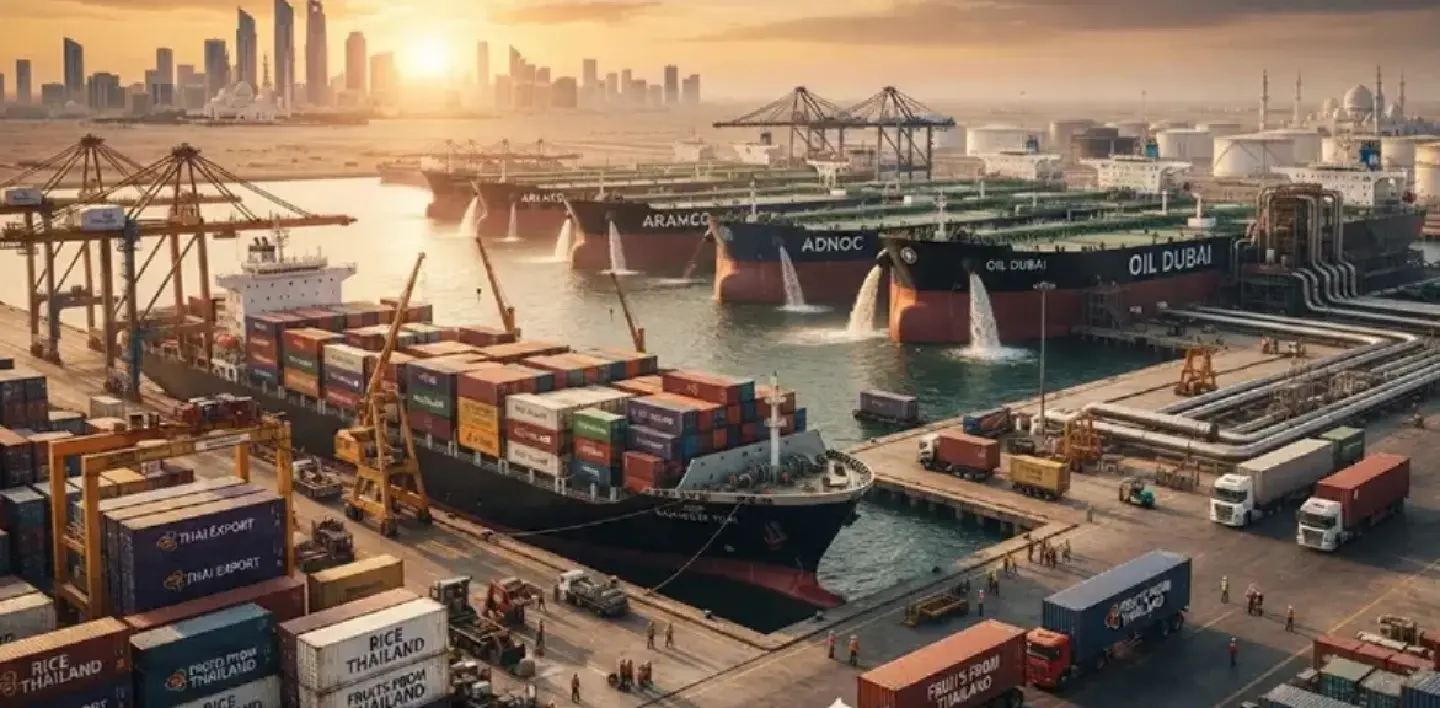


Thailand’s trade with 15 Middle Eastern countries rose 8.3% in the first half of 2026, but higher imports and weaker exports widened the deficit.
- In the first half of 2026, Thailand's trade deficit with the Middle East widened to THB 380.01 billion, as exports fell by 11.86% while imports grew by 16.95% compared to the same period last year.
- The drop in exports was driven by significant declines in key sectors like motor vehicles and parts (-40.09%), despite a large increase in gem and jewellery exports.
- The import surge was primarily caused by the value of crude oil and a 164.37% increase in imported jewellery, gemstones, and gold.
- Geopolitical conflict in the region is cited as a major cause, creating uncertainty for shipping routes and increasing transport costs, which impacts trade.
Geopolitical conflict involving the United States, Israel and Iran erupted in late February 2026.
Although negotiation efforts produced an agreement at one stage, fighting subsequently resumed, leaving shipping routes through the Strait of Hormuz and the Red Sea facing uncertainty.
This has significantly affected transport costs and international trade, including Thailand’s trade with the Middle East.
Trade grows, but Thai exports contract
Data from the Information and Communication Technology Centre of the Office of the Permanent Secretary, Ministry of Commerce, compiled in collaboration with the Customs Department, showed that Thailand’s trade with 15 Middle Eastern countries totalled THB741.95268 billion in the first six months of 2026, from January to June, up 8.3% from the same period a year earlier.
However, the composition of trade showed that the growth was not driven by Thai exports.
Exports were valued at THB180.97064 billion, down 11.86%, while imports rose 16.95% to THB560.98204 billion.
This resulted in Thailand recording a trade deficit of THB380.01141 billion with the Middle East, up from THB274.36397 billion in the same period last year.
UAE remains top trading partner as Israel ranks sixth
The United Arab Emirates (UAE) remained Thailand’s largest trading partner in the Middle East, with total trade of THB462.74258 billion, up 28.86% from the same period a year earlier.
It was followed by Saudi Arabia at THB134.71572 billion, up 7.96%; Türkiye at THB33.92422 billion, up 9.12%; Qatar at THB26.90893 billion, down 58.68%; and Oman at THB24.79072 billion, down 1.44%.
Among the countries involved in the conflict, Israel ranked sixth among Thailand’s Middle Eastern trading partners, with total trade of THB24.03895 billion, up 3.23%.
Trade with Iran stood at only THB1.19231 billion, down 48.03%, placing it among Thailand’s lowest-ranked trading partners in the region due to the impact of US trade sanctions.
Crude oil and gold drive import growth
Thailand’s main exports to the Middle East continued to be led by gems and jewellery, valued at THB49.72138 billion, up 253.42%.
This was followed by motor vehicles, equipment and parts at THB39.98227 billion, down 40.09%; air conditioners and parts at THB11.51296 billion, down 5.39%; rubber products at THB7.68126 billion, down 22.14%; and wood and wood products at THB6.35710 billion, down 35.29%.
On the import side, crude oil remained the largest category, valued at THB283.37920 billion, up 2.24%.
Jewellery, gemstones, silver bars and gold were valued at THB189.26279 billion, an increase of 164.37%.
These were followed by natural gas at THB26.78587 billion, refined petroleum products at THB20.93514 billion and chemicals at THB9.09057 billion, with all three categories declining from the same period last year.
Thai–Middle East trade risks remain under close watch
The outlook for Thailand’s trade with the Middle East in the second half of 2026 still requires close monitoring, particularly the impact of the continuing conflict, which could keep transport costs and Thailand’s energy import costs under pressure.
Although the Middle East remains an important market for Thai exporters, particularly for gems, motor vehicles, electrical appliances and processed agricultural products, Thailand’s trade structure with the region remains heavily dependent on crude oil and energy imports.
The overall increase in trade value therefore continued to be driven mainly by imports, while Thai exports remained under pressure and the trade deficit with the Middle East widened significantly in the first half of the year.
