
US transshipment crackdown puts eight Thai sectors on alert


Eight Thai sectors worth US$52.23bn could face closer US origin checks, but the estimated 172–345bn baht exposure is not a forecast of losses.
Eight Thai industrial groups responsible for US$52.23 billion in exports to the United States in 2025 could face more intensive checks on product origin and manufacturing processes as Washington steps up enforcement against illegal transshipment.
The sectors accounted for 72.33% of Thailand’s total exports to the US, according to an analysis by Associate Professor Dr Aat Pisanwanich, a lecturer at Rangsit University’s Faculty of Economics.
Under assumptions that 10–20% of exports in the identified sectors could be selected for stricter examination, the analysis estimated that goods worth US$5.2 billion to US$10.4 billion, or about 172.359 billion to 344.718 billion baht, could be exposed to additional scrutiny.
The figures represent trade potentially subject to checks, not projected damage or exports that would necessarily be lost. Products can still enter the US market if exporters provide complete evidence of their origin and manufacturing processes in Thailand.
Aat’s analysis followed the White House Office of Trade and Manufacturing Policy’s release on August 13 of The Great Transshipment Scam: Rise, Scope, and Costs.
The report examines cases in which Chinese manufacturers and exporters allegedly route, assemble or process products through third countries before declaring them as originating there to avoid US tariffs or other trade measures.
Tier 2 status does not impose new tariffs
Practices examined by the White House range from changing labels or documents and routing goods without genuine manufacturing to undertaking only limited assembly or processing.
The report also considers cases involving Chinese factories or investments in third countries that remain heavily dependent on raw materials, components, technology or corporate control from China.
The use of Chinese inputs or investment does not, however, automatically constitute illegal transshipment when the production process complies with applicable rules of origin and other laws.
The report places Thailand in Tier 2 alongside Brazil, Indonesia, Malaysia, Turkey and Vietnam. It describes this category as covering economies with substantial integration into China-linked sourcing, manufacturing, logistics and regional trade channels.
Aat emphasised that the tier system should be treated as a risk classification for analytical and enforcement purposes, rather than a determination that Thailand or individual Thai exporters have engaged in illegal transshipment.
The report is not a new tariff measure and does not automatically subject Thai goods to higher duties.
It could nevertheless inform risk screening by US Customs and Border Protection, potentially leading to closer examination of origin documents, supply chains and production processes, as well as requests for additional evidence where concerns arise.
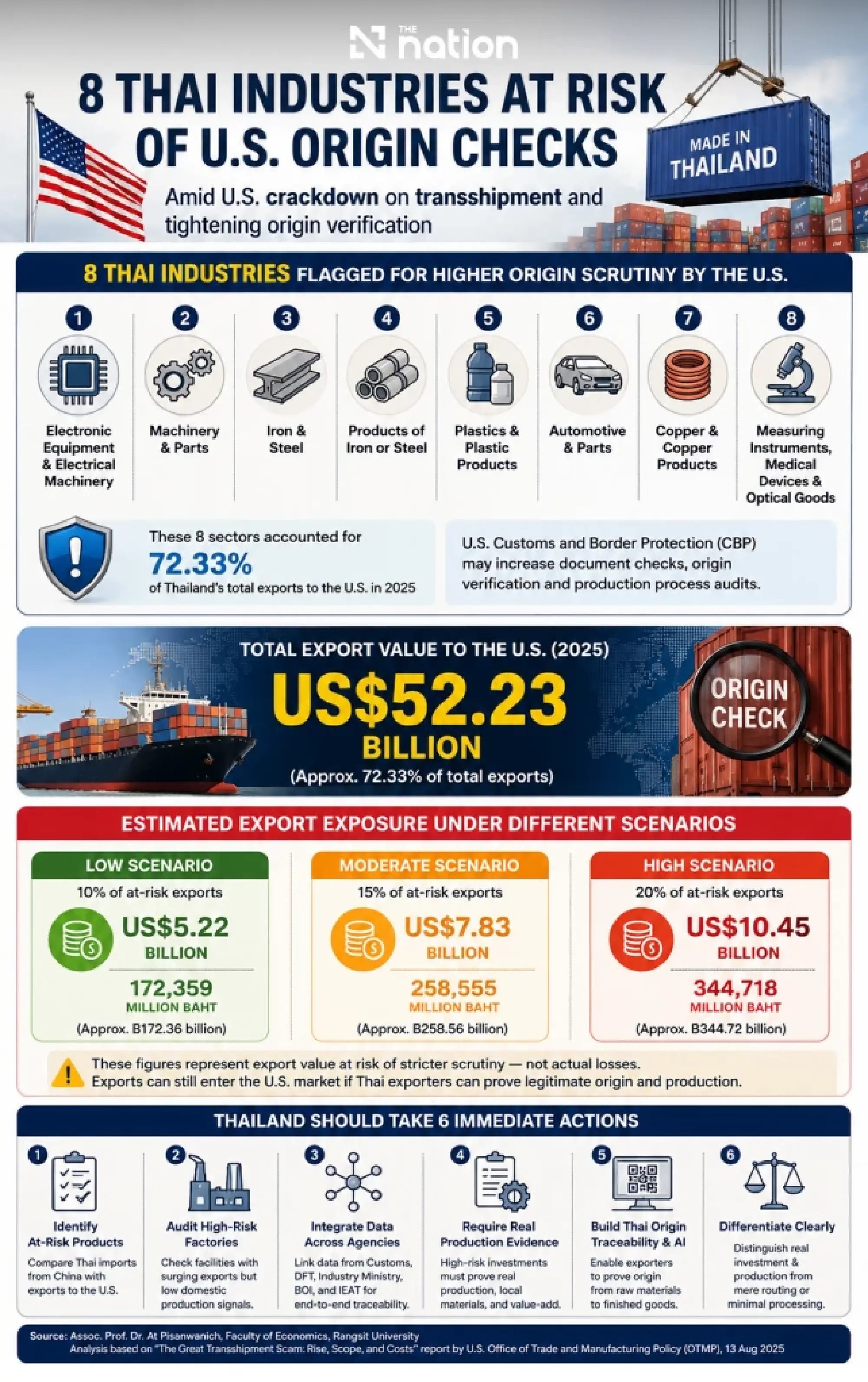
Eight sectors account for 72.33% of US exports
Aat compared Thailand’s growing imports from China with its exports to the United States and identified eight industrial groups that could face greater attention:
- electronic equipment and electrical machinery
- machinery and components
- iron and steel
- articles of iron or steel
- plastics and plastic products
- vehicles and components
- copper and copper products
- measuring, medical and optical instruments
The eight groups generated combined exports to the US of about US$52.23 billion in 2025, representing 72.33% of Thailand’s total exports to the market.
The analysis also highlighted declining capacity utilisation in several industries between 2021 and 2025, despite an increase in exports to the United States.
Capacity utilisation in electronic equipment and electrical machinery fell from 65.87% to 58.99%, a decline of 6.88 percentage points.
The rate for vehicles and components dropped by 16.66 percentage points, from 69.45% to 52.79%.
Plastics and plastic products recorded a decline of 5.70 percentage points, from 61.74% to 56.04%, while iron and steel fell by 3.89 percentage points, from 52.29% to 48.40%.
Aat described the divergence between lower factory utilisation and rising US-bound exports as a warning indicator rather than evidence of wrongdoing.
It could indicate greater use of Chinese raw materials and components or increased imports of semi-finished products for assembly or processing in Thailand, particularly in the automotive, electronics, plastics, steel and metal-product industries.
Up to B344.7bn could face closer checks
The analysis presented three scenarios based on the proportion of exports in the eight sectors that might become subject to stricter origin checks:
- Low scenario: 10%, equivalent to 172.359 billion baht
- Medium scenario: 15%, equivalent to 258.555 billion baht
- High scenario: 20%, equivalent to 344.718 billion baht
The calculations were based on an exchange rate of 33 baht to the US dollar.
Across the three scenarios, the value of potentially exposed exports would range from US$5.2 billion to US$10.4 billion.
Aat stressed that the amounts should not be interpreted as economic losses or exports certain to disappear. Goods selected for closer examination could still be admitted to the US if companies could verify the origin of their inputs and demonstrate that their production processes in Thailand met the required rules.
China imports grow faster than Thai exports
Thailand’s deepening trade links with China were identified as another factor that could attract US attention.
Thai exports to China increased from US$23.568 billion in 2016 to US$39.381 billion in 2025, representing growth of 67.1%.
Imports from China rose much faster, climbing 164.5% from US$41.044 billion to US$108.557 billion over the same period.
Imports therefore expanded at about 2.5 times the pace of exports, widening Thailand’s trade deficit with China from US$17.476 billion in 2016 to US$69.176 billion in 2025, an increase of 295.8%.
Thailand accumulated a trade deficit with China of US$286.879 billion, or approximately 9.61 trillion baht, over the 10 years from 2016 to 2025.
For 2026, the analysis forecast that Thailand would export US$41.495 billion of goods to China and import US$116.990 billion, producing a deficit of about US$75.495 billion, or 2.53 trillion baht.
That would lift the accumulated deficit between 2016 and 2026 to US$362.374 billion, or about 12.14 trillion baht.
Much of the import growth has involved industrial goods, raw materials and components used in manufacturing.
The 10 product groups recording the largest increases accounted for 69.08% of Thailand’s imports from China in 2016, rising to 76.86% in 2025.
Major categories included electronic equipment, electrical and mechanical machinery, vehicles and components, plastics, steel, copper, and measuring and medical instruments.
Heavy reliance on these imports does not by itself prove illegal transshipment, but it could prompt US authorities to seek more detailed evidence about input sources, value added and production undertaken in Thailand.
Six steps proposed to prove Thai origin
Aat proposed six measures to help Thailand protect legitimate manufacturers and strengthen evidence that exports genuinely originate in the country:
- Establish a watchlist of higher-risk products by comparing imports from China with exports to the United States.
- Inspect factories where exports have increased unusually quickly but electricity use, employment, machinery and domestic raw-material consumption do not correspond with reported production.
- Link information held by the Customs Department, Department of Foreign Trade, Industry Ministry, Board of Investment and Industrial Estate Authority of Thailand to allow checks throughout industrial supply chains.
- Require higher-risk investment projects to disclose their actual production processes, raw-material sources and the value added generated in Thailand.
- Develop an AI-supported Thai Origin Traceability system through which exporters can provide records covering every stage from raw materials to finished goods.
- Draw a clear distinction between genuine investment and manufacturing in Thailand and the simple routing or minimal processing of imported goods, preventing law-abiding Thai producers from being treated in the same way as suspected origin-circumvention operations.
