
Loy Krathong 2026: Fireworks, sky lanterns and gunfire rules
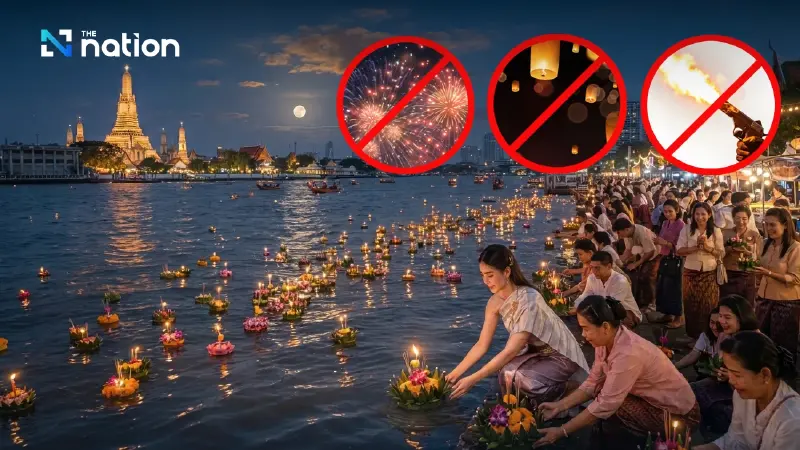


What are Thailand's Loy Krathong rules on November 24, 2026? Learn about fireworks permits, sky lanterns, airport drone restrictions and gunfire penalties.
- Setting off fireworks or releasing sky lanterns without permission is illegal, with penalties of up to three years in prison and a 60,000 baht fine.
- Firing a gun into the air without justification is a criminal offence, punishable by up to 10 years' imprisonment and the potential revocation of firearms licences.
- Strict restrictions are in place around six major airports, where releasing sky lanterns or setting off fireworks is forbidden to prevent endangering aircraft, which carries severe penalties.
Thailand’s Loy Krathong Festival is underway, with this year’s celebration falling on Tuesday (November 24).
People planning to attend celebrations at various venues are advised to check event locations, programmes and local restrictions in advance. Following these rules can help prevent accidents, injuries and property damage.

Key restrictions during the Loy Krathong Festival
Setting off fireworks and releasing sky lanterns without permission
Setting off fireworks or other pyrotechnics inside buildings, in enclosed areas or near entertainment venues, hotels and homes is particularly dangerous due to the risk of fire. Those who carry out these activities without permission face up to three years in prison, a fine of up to 60,000 baht, or both.
Firing guns into the air without justification in towns, villages or communities
The act constitutes a criminal offence punishable by up to 10 years in prison.
In addition, offenders may be required by the firearms registrar to post a bond or sign an undertaking, and could have their licences to possess and use firearms revoked. They may also be held liable for civil damages if falling bullets injure or kill other people.
Prior permission is required before setting off or launching fireworks or spinning firework rockets (talai), or releasing sky lanterns, including fire lanterns and smoke lanterns.
Why is permission required? The rules are designed to protect lives and property, safeguard air traffic and prevent interference with flight paths. Obtaining prior permission is also a legal requirement.
Why are the rules so strict? Fireworks injuries highlight the risks
According to injury surveillance data from the Department of Disease Control covering 2023 to 2025, a total of 3,314 people suffered fireworks-related injuries, averaging more than 1,000 cases annually.
Men and boys accounted for 86.9% of those injured, while school and university students accounted for 33.27%. Around 66% of the incidents occurred in homes.
The data also showed that January accounted for the highest proportion of injuries, at 20.3%, while 12.9% of incidents occurred around midnight.

AOT warns against sky lanterns and drone flights near six airports
Airports of Thailand Public Company Limited (AOT) has urged people living near its six airports to refrain from releasing sky lanterns, setting off fireworks or flying drones during the Loy Krathong Festival, from November 23 to November 25.
The six airports are Suvarnabhumi Airport, Don Mueang International Airport, Chiang Mai International Airport, Mae Fah Luang–Chiang Rai International Airport, Phuket International Airport and Hat Yai International Airport.
Restrictions and penalties for endangering aircraft
AOT has urged the public not to release sky lanterns, fire lanterns, smoke lanterns or balloons, or set off fireworks, spinning firework rockets (talai) or traditional rockets (bang fai) within aviation safety zones.
Drone flights are also prohibited within a nine-kilometre radius of airports unless prior permission has been granted.
These activities could endanger aircraft, obstruct pilots’ vision or distract them during flight. Airborne objects could also cause an aircraft to lose control or trigger a serious accident if they enter an engine or strike a fuel tank, potentially causing an explosion.
Anyone whose actions damage an aircraft in service so severely that it can no longer fly, or pose a danger to the safety of an aircraft in flight, could face the death penalty, life imprisonment, or a prison term of 15 to 20 years and a fine of 600,000 to 800,000 baht. Additional penalties under other relevant laws may also apply.
