
Rare-Earth Traceability Takes Point as Bangkok Presses Upstream Mine Accountability
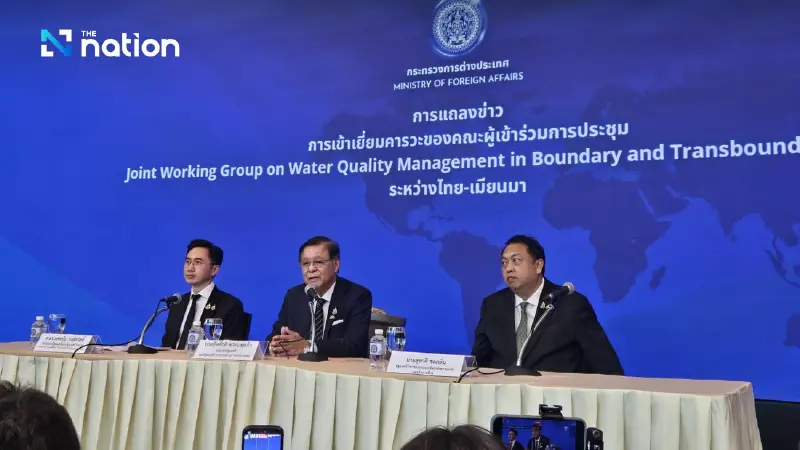


Yodchanan proposes Chinese supply-chain checks while Sihasak cites high-level backing ahead of Thailand–Myanmar water working group talks
- Thailand is proposing that China use its position as a major buyer of rare-earth minerals to implement supply-chain checks and verify the environmental standards of upstream mines in Myanmar.
- The initiative is backed by high-level Thai officials, including the Prime Minister, who have engaged with leaders from both China and Myanmar to address transboundary river pollution.
- Accountability measures being discussed include the potential suspension of non-compliant mines, using "chemical fingerprinting" to trace pollution sources, and establishing mechanisms for remediation costs.
Yodchanan proposes Chinese supply-chain checks while Sihasak cites high-level backing ahead of Thailand–Myanmar water working group talks.
Traceability has moved to the front of Bangkok’s push against transboundary river pollution, with Deputy Prime Minister and Minister of Higher Education, Science, Research and Innovation (MHESI) Yodchanan Wongsawat proposing that China use rare-earth supply-chain checks to verify whether upstream mines meet standards.
Speaking at a joint press conference at the Ministry of Foreign Affairs on Tuesday, November 24, 2026—following a courtesy call by delegates to the Thailand–Myanmar Joint Working Group on Water Quality Management in Boundary and Transboundary Rivers—Yodchanan framed upstream mining accountability as an international supply-chain question rather than a narrow bilateral water dispute.
While earlier coverage of Thailand’s transboundary river contamination has focused largely on downstream arsenic alerts, water-quality warnings along the Sai and Kok rivers, and initial diplomatic exchanges, Tuesday’s briefing sharpened the focus on commercial traceability, high-level political backing, and upstream enforcement.
High-Level Backing and Mekong–Lancang Links
Opening the briefing before departing early for the airport to attend a UNCLOS meeting, Deputy Prime Minister and Foreign Affairs Minister Sihasak Phuangketkeow stressed that river contamination affects both Thailand and Myanmar and requires coordinated upstream and downstream action backed by technical support.

Sihasak noted that the push carries leadership-level commitment, pointing to assurances from Myanmar as well as Prime Minister Anutin Charnvirakul’s talks with Chinese President Xi Jinping on the sidelines of APEC, following the Chinese premier’s recent visit to Thailand.
Given Beijing’s role in driving Lancang–Mekong Cooperation—where water management is a core pillar—Sihasak said China confirmed it does not support illegal or damaging mining activities in Shan State and underscored that commitment by sending its ambassador and specialists from Yunnan alongside Shan State delegates on the Myanmar side.
Supply-Chain Leverage and Remediation Costs
Building on that diplomatic framework during the question-and-answer session, Yodchanan pointed out that much of Myanmar’s rare-earth output moves onwards toward China, giving Beijing a practical entry point to verify provenance and environmental standards across downstream industrial supply chains.
Asked whether China had formally committed or whether Bangkok had proposed the mechanism, he said Thailand put the traceability proposal forward and shook hands on cooperation, adding that the Chinese ambassador engaged constructively and would join upcoming fieldwork.
He also argued that Thailand should not shoulder the financial burden of remediation alone, stressing that funding and compensation mechanisms—including potential external financing beyond initial design support under the Lancang–Mekong framework—must be weighed carefully rather than leaving Thai taxpayers to cover costs triggered upstream.

Shan State Mines, Bans and Lab Diagnostics
On enforcement, Yodchanan acknowledged that inspecting and regulating mines in Shan State or ethnic-controlled areas such as the Wa zone—especially private or non-state-controlled operations—will be difficult.
Still, Bangkok raised a six-month suspension or closure of problematic mines as an ultimate goal while the working group separates immediately actionable sites from areas with control constraints.
He added that authorities are reviewing import and export controls with the Ministries of Industry and Commerce, alongside precursor controls, to pursue bans where substances or practices harm Thai citizens, and saw no reason for Bangkok to conceal corporate ownership details of offending mines once established or disclosed.
Rather than relying on generic filters, he called for "chemical fingerprinting" and site sampling backed by joint Thai and Chinese laboratory work to design targeted filtration.

Working Group Schedule and Domestic Safeguards
The joint working group is set to meet on November 25–26, co-chaired on the Thai side by Permanent Secretary for Natural Resources and Environment Dr Jatuporn Buruspat alongside Myanmar and Chinese counterparts.
Sihasak, Yodchanan, and Deputy Prime Minister and Minister of Natural Resources and Environment Suchat Chomklin are also scheduled to conduct field visits in Chiang Rai on November 28–29 with Myanmar officials.
Suchat said coordination spans the Foreign Ministry, MHESI for scientific input, the Natural Resources and Environment Ministry—led operationally by the Pollution Control Department—and the Interior Ministry and provincial governors.
At home, Yodchanan said parallel safeguards are under way: agencies are testing agricultural soil and aquatic life for contaminants, adding 10 groundwater and community tap-water filtration points, preparing a "One Stop Service" data platform and risk map for official launch on November 27, and mapping irrigation and sedimentation traps ahead of next month’s irrigation water release.
