
Major issues could affect stability of Anutin's government: NIDA Poll
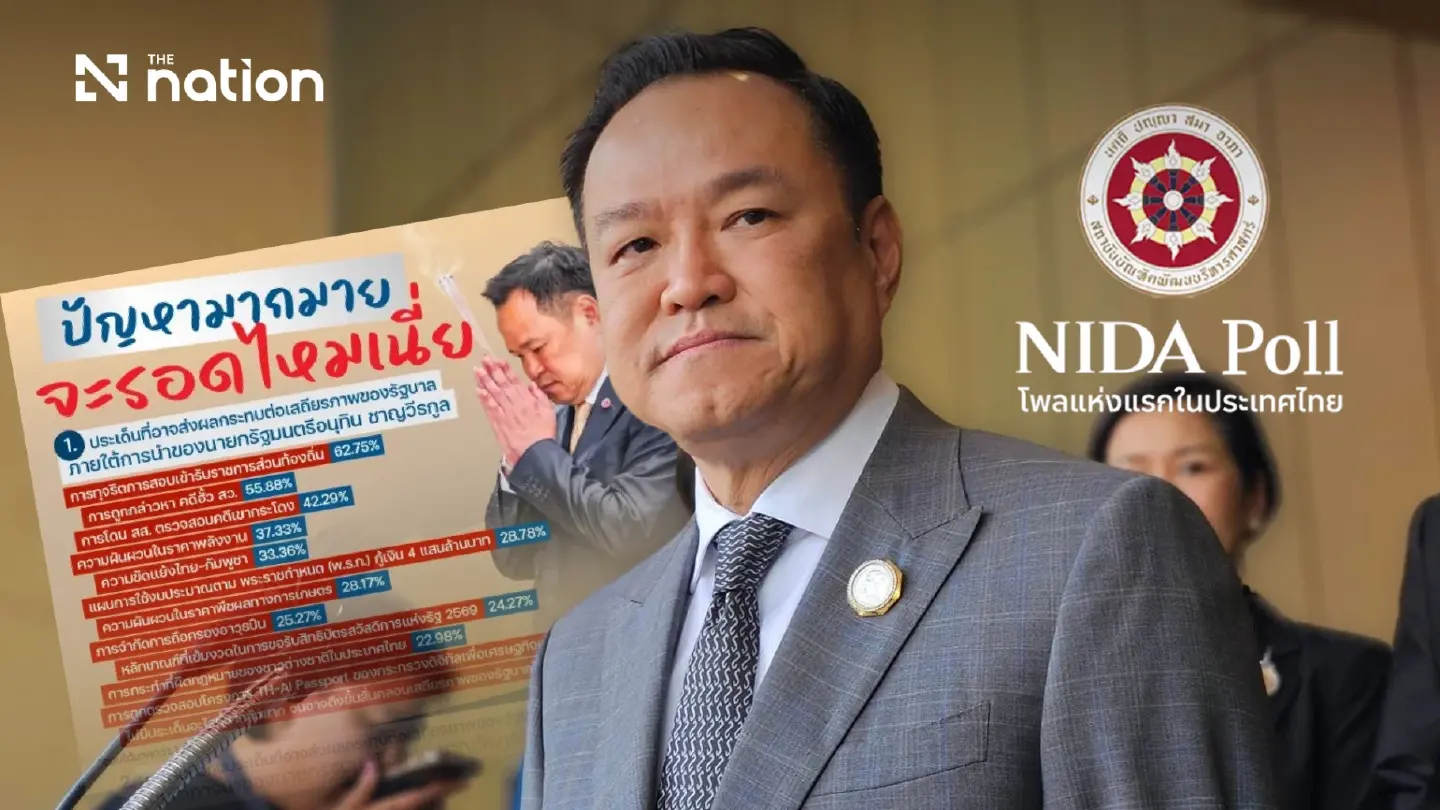


NIDA Poll found that 62.75% cited corruption in local government recruitment exams as a stability concern, while 31.99% said the government would be unable to cope at all.
- A NIDA poll identified corruption in local government recruitment exams (62.75%) and allegations of Senate election collusion (55.88%) as the top issues perceived as threats to the stability of Anutin's government.
- A plurality of respondents (37.86%) believe the government "definitely would not survive" these challenges, while another 26.03% think it would survive but be badly weakened.
- Confidence in the administration's ability to handle the problems is low, with nearly a third of those surveyed (31.99%) stating the government is "unable to cope at all."
NIDA Poll, the opinion survey centre at the National Institute of Development Administration (NIDA), released the findings of its survey, “So Many Problems — Will It Survive?”, conducted from August 18 to 20.
The nationwide sample comprised 1,310 people aged 18 and over from all regions and across different levels of education, occupations and incomes.
The survey examined issues that could affect the stability of the government led by Prime Minister Anutin Charnvirakul.
It used probability sampling based on the list in NIDA Poll’s Master Sample database, with multi-stage sampling, and collected data through telephone interviews.
The margin of error was set at no more than 0.05 at a 97.0% confidence level.
The issues identified as possible threats to the stability of the government under Anutin’s leadership were:
- 62.75%: corruption in recruitment examinations for local government service.
- 55.88%: allegations in the Senate election collusion case.
- 42.29%: scrutiny by Members of Parliament (MPs) over the Khao Kradong case.
- 37.33%: volatility in energy prices.
- 33.36%: the Thailand-Cambodia conflict.
- 28.78%: the spending plan under an emergency decree authorising THB400 billion in borrowing.
- 28.17%: volatility in agricultural crop prices.
- 25.27%: restrictions on firearm ownership.
- 24.27%: strict eligibility criteria for the 2026 State Welfare Card.
- 22.98%: unlawful activities by foreign nationals in Thailand.
- 18.17%: scrutiny of the Ministry of Digital Economy and Society’s TH-AI Passport project.
- 5.34%: no issue was considered worrying enough to threaten the government’s stability.
Assessments of the government’s ability to handle these issues were:
- 39.69%: able to handle some issues.
- 31.99%: unable to cope at all.
- 16.26%: able to handle all the issues.
- 11.68%: able to handle most of them.
- 0.38%: did not know or gave no answer.
Views on the government’s prospects of surviving the issues were:
- 37.86%: definitely would not survive.
- 26.03%: would survive but be badly weakened.
- 17.94%: would survive but be slightly weakened.
- 17.71%: would certainly survive with ease.
- 0.46%: did not know or gave no answer.
29.62% see Anutin’s bow to Thaksin as political drama
Public interpretations of Anutin’s act of bowing down at the lap of former prime minister Thaksin Shinawatra were:
- 41.45%: simply a gesture of respect from a junior to a senior.
- 29.62%: simply political drama.
- 21.60%: politics has no true friends and no permanent enemies.
- 17.48%: an attempt to seek support from Thaksin.
- 12.21%: a demonstration of Thaksin’s stature.
- 9.62%: a signal that the Pheu Thai Party would continue to support Anutin.
- 9.31%: disapproval of Anutin’s action.
- 4.73%: approval of Anutin’s action.
- 3.82%: no answer or no interest.
