
Thai opposition leader urges action on Myanmar mines polluting rivers
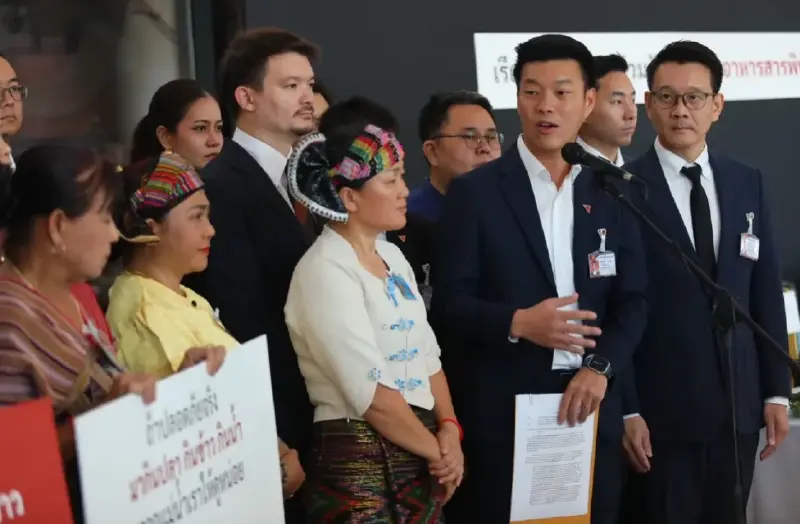


The opposition leader wants a map to show where farming can continue as usual and says Thai–Myanmar talks must cover all six rivers.
- Thai opposition leader Natthaphong Ruengpanyawut is demanding urgent government action on toxic river pollution from mines in Myanmar, citing a more than 50% rise in arsenic levels in local residents.
- He urges the government to use upcoming talks with Myanmar to address pollution in six cross-border rivers, calling for transparent water testing to trace pollution to its source.
- The pollution has damaged the reputation of agricultural produce from northern Thailand, leading to calls for a risk map to distinguish safe farming areas from those affected.
- Natthaphong proposes engaging China and Laos in regional talks and enacting new Thai laws to prevent the country from serving as a transit route for unverified, polluting rare earth ores.
Thailand’s opposition leader, Natthaphong Ruengpanyawut, called on Wednesday (November 25, 2026) for urgent action on toxic river pollution from mines in Myanmar after receiving a letter from a network of Tha Ton residents in Chiang Mai’s Mae Ai district.
To draw attention to toxic substances increasingly being detected in local people, residents cooked fish from the area, set out river water and invited government representatives to eat.
The People’s Party leader said uncertainty over which areas were affected had cast doubt on produce from across northern Thailand.
Middlemen had driven down prices, and consumers had lost confidence.
He urged the government to publish and use a risk map without delay to distinguish affected areas from those where farming could continue as usual.
A parliamentary subcommittee chaired by Phattarapong Leelaphat, a People’s Party MP for Chiang Mai, drew up the map with civil society groups and academics.
Citing tests by Thai authorities on the same 322 people in 2025 and 2026, Natthaphong said arsenic levels in their bodies had risen by more than 50%.
Drinking or coming into contact with contaminated river water, or handling or eating aquatic animals caught in those rivers, may have accounted for some of the residents’ exposure to toxic substances.
Natthaphong said the Thailand–Myanmar Joint Working Group’s talks, scheduled for November 25–26, must cover all six rivers – the Kok, Sai, Ruak, Mekong, Salween and Kra Buri – and all parts of Thailand affected by cross-border pollution.
He called for action beyond water testing and for the authorities to publish where and when tests take place and when results will be available.
Comparing water quality upstream and downstream of mines could help trace pollution to its source and target action at polluters, he said.
Myanmar’s military government might not fully control some mining areas in Shan State and elsewhere in Myanmar, the opposition leader said.
He proposed using December’s Mekong–Lancang Cooperation meeting with China and Laos to seek joint action on pollution at source.
Problems associated with rare earth mining could spread to Laos and affect the Mekong, a river many people in north-eastern Thailand depend on for their livelihoods and farming, he warned.
Natthaphong called for talks with China on oversight of the rare earth supply chain, saying some ore imported into Thailand from neighbouring countries was already being re-exported to China.
Thailand gained little added value while its people bore the environmental and health costs, he said.
He proposed secondary legislation under the Minerals Act and laws governing imports and exports to require checks on ore from mine to export.
The aim was to prevent Thailand from serving as a transit route for ore from mines where it could not be verified that production was non-polluting.
The People’s Party was ready to press for those measures through parliamentary committees and scrutiny of the government’s work.
