
Shenzhou-24 sends first Pakistani into orbit on November 25
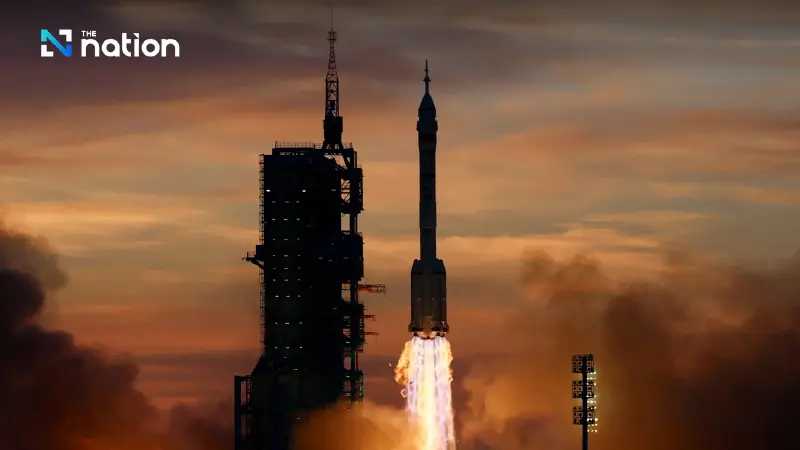


Muhammad Zeeshan Ali is due to spend five to 10 days running experiments on China’s Tiangong space station before returning with two Chinese astronauts.
- Pakistani pilot Muhammad Zeeshan Ali became the first person from his country to reach orbit on November 25.
- He was launched aboard China's Shenzhou-24 mission from the Jiuquan launch center, alongside two Chinese astronauts.
- Ali is set to become the first foreign astronaut to visit China’s Tiangong space station, where he will stay for 5-10 days.
- As a payload specialist, his mission includes conducting joint Chinese-Pakistani experiments in biotechnology and materials science.
Pakistani pilot Muhammad Zeeshan Ali became the first person from his country to reach orbit on Wednesday, November 25, when China launched Shenzhou-24 from Jiuquan in the country’s north-west. The 40-year-old is set to become the first foreign astronaut to visit China’s Tiangong space station.
A Long March-2F rocket lifted off at 8.18am Beijing time (7.18am in Thailand), carrying Ali, Chinese mission commander Tang Hongbo and flight engineer Wu Yi. The China Manned Space Agency said the spacecraft separated from the rocket about 10 minutes later and entered its planned orbit. All three astronauts were in good condition. Live pictures on Chinese state television showed the crew leafing through a manual after launch.

Pakistan’s first journey into space came in 2023, when Namira Salim took a suborbital flight with Virgin Galactic. Ali is the first Pakistani to go into orbit around Earth.
Ali learnt Mandarin for work aboard Tiangong
Ali spent seven months training in Beijing for his role as a payload specialist. The spacecraft and station both use Chinese for labels and operating instructions, Tang told reporters before launch. As Ali studied Mandarin, Tang and Wu worked on their English.
Ali’s language lessons extended to Chinese songs and poetry. He also practised calligraphy and played table tennis. Speaking to reporters on 24 November about what the flight meant to him, Ali said, “I carry the name of Pakistan on my shoulder.”

Ali is expected to spend five to 10 days on Tiangong, where a Chinese crew rotation usually lasts six months. His work includes an experiment on cyanobacteria, which use light to produce energy. The Chinese space agency said the mission includes four joint Chinese-Pakistani projects in biotechnology and materials science.
Zhu Yangzhu will stay on Tiangong for a full year
Shenzhou-23 commander Zhu Yangzhu, who arrived in May, will spend another six months aboard Tiangong. Ali is due to take Zhu’s place on the return flight, travelling home in the Shenzhou-23 capsule with Zhang Zhiyuan and Li Jiaying.

A full year in orbit would give Zhu the longest uninterrupted spaceflight by a Chinese astronaut. Researchers will study how his body adapts over that time, work that could help crews prepare for missions to the Moon and, eventually, Mars.
Tiangong, whose name means “Celestial Palace”, has been fully operational since late 2022. Built by China, the station can accommodate six people while two crews overlap. Beijing is opening it to overseas partners as the NASA-led International Space Station faces possible retirement around 2030.
China and Pakistan plan a lunar rover mission
China has launched satellites for Pakistan under a space partnership dating to the early 1990s. A Pakistani rover is due to fly on China’s Chang’e-8 lunar mission. Pakistan’s space agency has indicated a tentative 2028 launch, while the China National Space Administration gave an estimate of around 2029 in its 2025 announcement.

Pakistani Prime Minister Shehbaz Sharif thanked Chinese President Xi Jinping in a post on X before Ali’s flight, describing the launch as a milestone for both countries. Blaine Curcio, founder of Hong Kong-based Orbital Gateway Consulting, said the flight would give Pakistan practical scientific and technical experience as well as prestige and closer ties with China.

China still aims to land astronauts on the Moon by 2030. Its uncrewed Chang’e-7 mission missed its 2026 launch window amid adverse weather linked to a tropical storm. The US space agency NASA is targeting 2028 for its own crewed return to the lunar surface.
China and Russia plan to establish the first phase of a lunar research base by 2035. Washington has warned that Beijing could seek to control access to resource-rich parts of the Moon. Beijing rejects that suggestion and says it supports the peaceful use of space.
