
Scam Hubs Are Moving Deeper into Myanmar, and Thailand Remains The Gateway
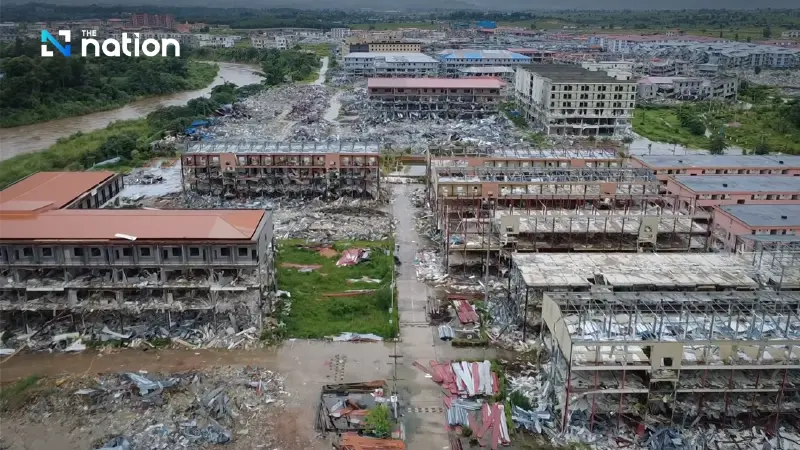


Operation Shamrock founder Erin West says syndicates are rebuilding inland and hiding in plain sight, demanding public vigilance and regional cooperation
- In response to crackdowns on visible border compounds, scam syndicates are relocating their operations deeper into remote, militia-controlled areas of Myanmar to evade surveillance.
- Thailand remains a critical gateway, with Bangkok serving as a central transit hub for trafficking victims lured by fraudulent job offers from around the world into Myanmar's scam centers.
- Beyond human trafficking, Thailand's role as a gateway includes providing supply chains for goods and internet infrastructure to the compounds, and serving as a key center for the financial networks that launder the stolen funds.
- The move into Myanmar follows pressure on syndicates in other countries like Cambodia, demonstrating a pattern of displacement that highlights the need for a coordinated regional response rather than isolated raids.
Operation Shamrock founder Erin West says syndicates are rebuilding inland and hiding in plain sight, demanding public vigilance and regional cooperation.
Thais are being urged to treat overseas job offers and unfamiliar online contacts with far greater suspicion, as a former US prosecutor warns that Southeast Asia's scam syndicates have survived the demolition of notorious compounds by simply moving on.
Erin West, founder of Operation Shamrock and a prosecutor of cybercrime and transnational organised crime for 26 years, recently travelled to the Thai-Myanmar border to see what happened after raids and demolitions at sites such as KK Park in Myawaddy.
Her findings are documented in "I Investigated the Scam Cities in Myanmar". The trip was funded by Sumsub, a global identity verification and fraud prevention firm.
"We are at crisis level," West told during an online interview with The Nation. "This isn't a small problem anymore."
She said the industry affects hundreds of thousands of trafficked workers and hundreds of thousands more people who have had their money stolen.

Moving inland
The dismantling of visible compounds has not ended the operations. West said syndicates realised that large complexes visible from the Thai side of the river made it easy to monitor them, so they are now relocating deeper into Myanmar, out of sight.
She described extensive deforestation and the construction of fully functional compounds within about six months. Criminals were operating from jungle settings while the buildings went up, she said, showing they can function without the infrastructure they later build.

The pattern, she said, follows pressure elsewhere. After the United States indicted Cambodian businessman Chen Zhi, the groups concluded Cambodia was no longer safe and shifted to Myanmar.
West said such displacement shows that action against single sites is not enough and that enforcement must reach the networks behind them.
Myanmar's instability is a major reason the crime flourishes there, she said. Land controlled by armed militias gives criminal enterprises room to settle, and the country's civil war complicates any response.
Thailand's role Thailand sits at the centre of this journey.
The documentary examines how Bangkok serves as a transit gateway for job seekers from South Asia, Africa and elsewhere, who are lured by apparently legitimate offers and then taken across the border into compounds where they are forced into running scams.

West praised recent Thai measures. She called tighter rules on opening bank accounts, which require stronger proof of identity, "absolutely a positive development".
She also noted that Thailand recently cut fibre-optic cable supplying compounds and that Thai telecoms were exploited in the past before authorities began to clamp down.
Criminals adapt, however. West said that compounds have built solar farms to cope with electricity cuts and that Thailand retains the ability to limit the supply chains flowing towards the compounds and make it harder for criminals to move goods and people where they want.
She also pointed to technology firms. Social media platforms that enable predators to reach victims, she said, could do much more to make their services safe.
"All of this is knowable," she said.

Following the money
Scam compounds depend on moving stolen funds quickly, and West said criminals avoid putting their own names on bank records. Instead they recruit real people with real identities to pass money through their accounts.
Verification at the moment an account opens is therefore not enough, she said. Banks and platforms must keep monitoring activity and look at the wider picture.
She gave the example of a rural nail salon suddenly handling millions of dollars, which should raise alarms.

Sumsub's Identity Fraud Report 2025-2026 supports this concern. It found that fraud complexity in Thailand rose 18% even though the overall fraud rate fell 17%, suggesting that fewer attempts are being made but by more sophisticated actors.
The report also found that the largest single fraud network detected in the Asia-Pacific was in Thailand, linking 3,018 users. The region accounted for a third (33%) of all fraud networks detected globally, more than any other.
Across Asia-Pacific, about one in 40 approved users (2.4%) is linked to a detected fraud network, and roughly a third of those links appear only after the person has passed identity verification.
West said money continues to flow despite the crackdowns. She cited a report from blockchain analytics firm TRM Labs showing more than a billion dollars passing through Cambodian casinos in 2026.
"They're going to find ways to move it," she said, so authorities must be as disruptive as possible.

Hiding in plain sight
Even the compound model itself is changing. West said that, as the world has taken notice, syndicates are pivoting away from huge, conspicuous sites.
They are now renting guesthouses in Vietnam and entire resorts in Uganda, she said, in order to be less obvious. That makes public vigilance essential.
She urged people to ask why a neighbouring building shows little coming and going yet appears to hold many people.

What the public can do
For job seekers, her advice was blunt. People should not accept work they cannot verify before travelling and should research the employer thoroughly. Criminals now use artificial intelligence to make fake companies and recruiters look convincing.
"We really need to be our own detectives," she said.
West does not expect the industry to be eliminated. She said it should be treated as a crisis to be "managed and disrupted", adding that criminals remain "a couple of steps ahead" and that catching them "will take all of us running".

The most effective pressure so far, she said, has come from global political attention, such as when China acted swiftly after one of its nationals was trafficked into a compound.
Her message to Thailand and its neighbours is that the crime is regional, so the response must be too. Thai authorities have shown they can act, and the public can add a vital layer of defence by staying alert to suspicious offers, unusual account requests and unexplained activity in their own communities.
