
PM Anutin orders new firearms bill and freeze on three gun licence types
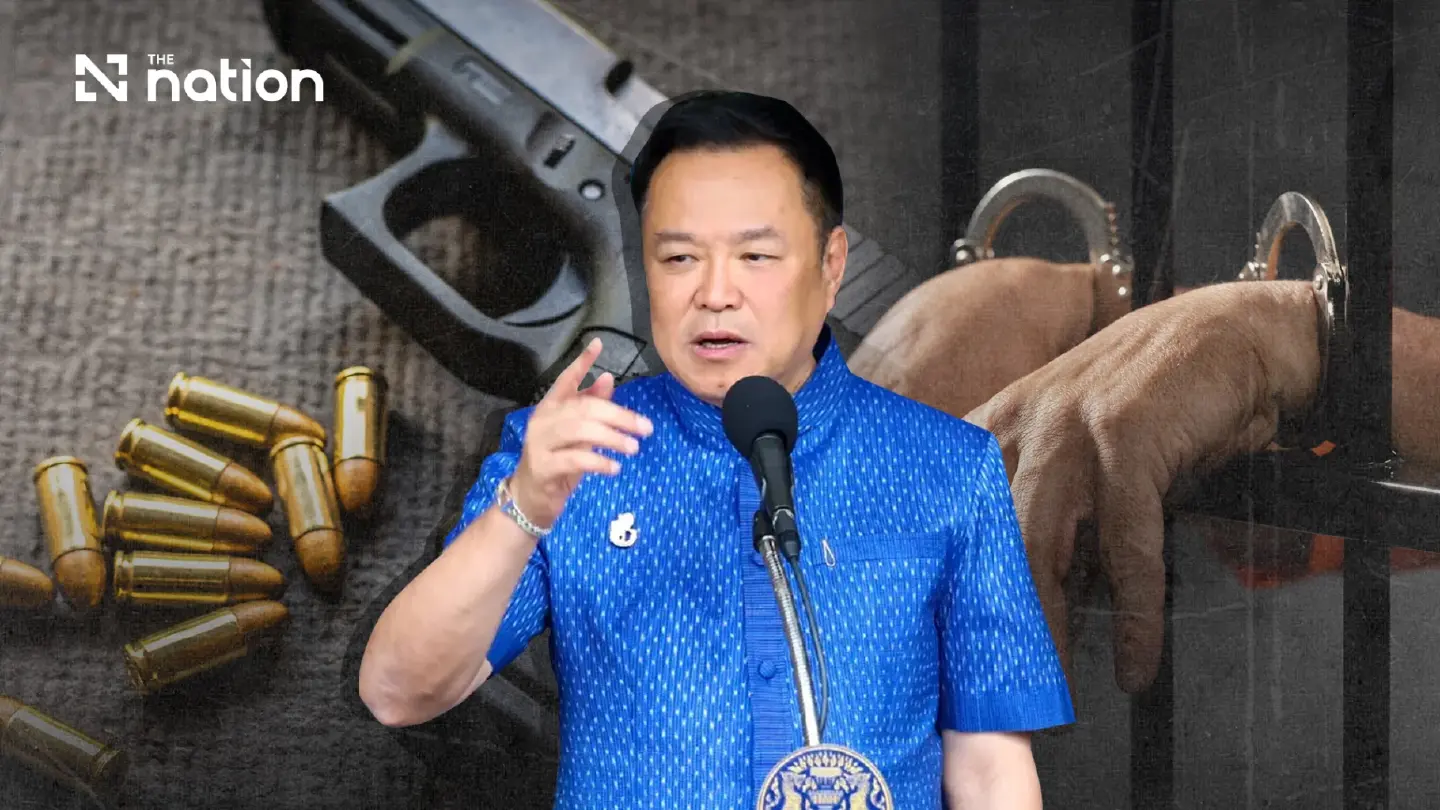


Police and administrative officials will intensify gun and drug checks while the government plans tougher penalties and considers a surrender window for illegal firearms.
- Prime Minister Anutin Charnvirakul has ordered the drafting of a new firearms bill aimed at tightening enforcement and increasing penalties for violations.
- The government has temporarily frozen the renewal of three specific gun licence types: Por 3 (to purchase), Por 4 (to possess and use), and Por 12 (to carry in public).
- A strict ban on carrying firearms in public is being enforced, requiring even legally licensed guns to be kept at home, with no exceptions for sport shooters.
- Authorities will increase enforcement with nationwide checkpoints, and suspects arrested for firearm offenses will be denied bail during the investigation.
Prime Minister Anutin Charnvirakul outlined the government’s firearms-control measures at Government House on Tuesday (August 11, 2026).
He explained that the government would accelerate action on firearms and had instructed Deputy Prime Minister Pakorn Nilprapunt at a Cabinet meeting to expedite the drafting of a new firearms bill.
He had also directed the Ministry of Interior and the Royal Thai Police (RTP) to halt renewals of three licence types for the time being: Por 3 (licence to purchase a firearm or ammunition), Por 4 (licence to possess and use a firearm) and Por 12 (licence to carry a firearm in public), unless the Cabinet decided otherwise.
Anutin added that enforcement procedures needed to be tightened and penalties made more severe and decisive.
He had instructed authorities nationwide to step up enforcement, with administrative and police officers setting up checkpoints focused primarily on firearms and drugs.
Several such cases had been detected during the night of Monday (August 10, 2026), he noted.
He maintained that bail would not be available in these cases and that police would oppose applications for bail during the investigation, meaning suspects would remain in custody.

Carrying firearms was not permitted during this period.
He therefore urged people not to believe anyone who advised them to carry a gun for self-defence.
In his view, people carrying guns generally placed themselves at risk because a firearm was a dangerous liability.
Ammunition could not be carried either, he added, and the new legislation would have to cover every aspect.
Online firearms trading, despite appearing difficult to control, would be subject to the same prohibition, Anutin stated.
Where there was no licence, he argued, it was beside the point whether control was difficult or easy.
Unlicensed possession would not be allowed, and anyone found with such a firearm would face imprisonment under strict enforcement.
Once the new law was in place, the government would consult prosecutors and the courts, seek their co-operation because the matter was important to the country, and request swift, decisive consideration, including opposition to bail at appropriate stages.
Legally licensed and registered firearms listed in the asset declarations of MPs and politicians could only be kept at home and could not be carried, Anutin stated.
For illegal firearms, the government would study legislation requiring them to be surrendered within a period to be specified by law.
Firearms that could not be transferred, such as those inherited from a partner when the recipient was not in a position to accept them, would also have to be handed in.
A temporary exemption from punishment would apply during the specified period.
Anutin was unsure whether this could be called an amnesty because he was not a lawyer, but explained that anyone surrendering a firearm within the deadline would face no penalty.
Anutin maintained that legally owned firearms could be completely barred from being taken outside the home. “Of course they can be banned,” he stated.
Anyone who was not a state officer performing official duties and carried a firearm without a carrying licence would be breaking the law.
He described the current rule as a 100% ban on carrying firearms and warned that violations were offences punishable by imprisonment.
No exemption would be granted to sport shooters taking firearms to practise at a shooting range, he stated.
The amount of practice ammunition at each range would have to be checked, and guns would have to be deposited with the range.
Shooters would be required to buy practice ammunition there, with the recorded quantities required to match.
After practice, guns would have to remain at the range and could not be carried away.
No justification would be accepted, he insisted, adding that other countries already followed such rules and that penalties for carrying firearms could extend to capital punishment.
Regarding guns kept at home by owners displaying threatening or violent behaviour, the Prime Minister maintained that carrying licences were no longer available.
Household or family members should monitor gun owners whose behaviour appeared suspicious, he added.
Taking a firearm out of the home was illegal, and ignorance of the law was no defence.
There were no exceptions.
Anutin also noted that existing law already clearly prohibited firearms from being taken outside the home and that anyone doing so was breaking it.
He would later check whether anyone at Government House was carrying one.
He also planned to instruct close aides and members of ministerial entourages that, if they carried firearms without being police officers on duty, they would have to face the consequences themselves.
Anutin stressed that firearms enforcement must not become a short-lived campaign or turn lax after public attention faded.
Authorities must not allow that to happen, he stated.
The country had officials responsible for enforcement because the matter was already governed by law, while both state officers and administrative authorities had a duty to supervise it strictly.
Firearms kept at home could not be discharged there for self-defence, according to Anutin, who maintained that shooting an intruder would still be unlawful because, in his view, the law offered no protection in that situation.
He did not know how such cases had been handled previously, but considered firearms harmful.
Keeping a gun nearby could make people feel more powerful than others, and pressure or anger might lead them to cause trouble for themselves and others.
The policy could not please everyone, he added, but it had to ensure safety, particularly for innocent victims, ordinary law-abiding citizens and children.
He advised that guns be kept only as display items, with ammunition discarded, magazines removed and the firearms secured in display cases.
Anutin added that he had once owned a gun but had lost it, after which he reported the loss to police.
He no longer owned any firearms.
Anutin stated that he did not know whether his wife owned the firearm listed in the asset declaration filed with the National Anti-Corruption Commission (NACC), adding that it could no longer be taken anywhere.
