
B106.8bn southern double-track plan heads to Cabinet



The Transport Ministry will seek Cabinet approval on September 1 for a 504km, 106.8-billion-baht southern double-track railway to Padang Besar.
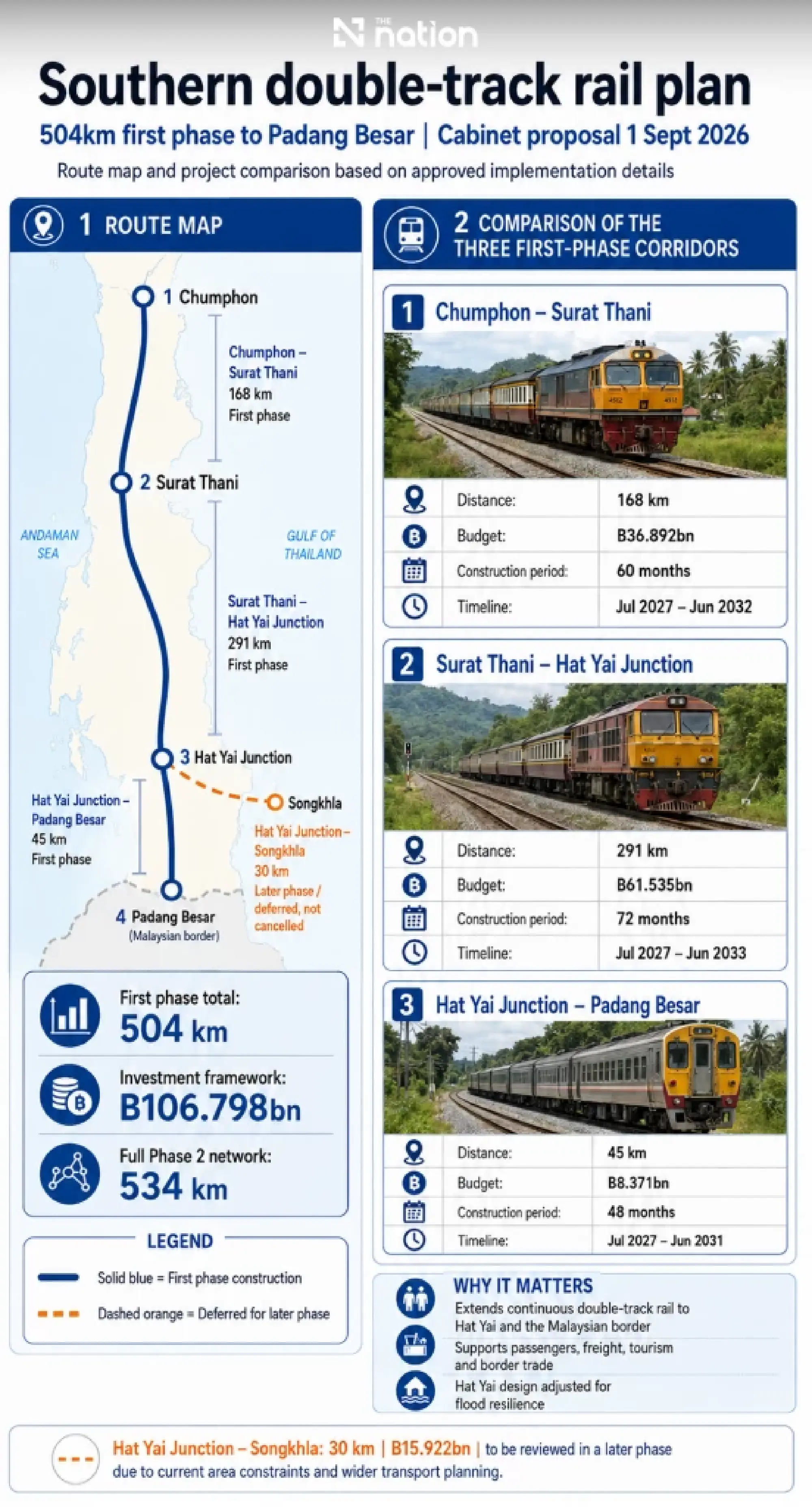
The Transport Ministry is preparing to seek Cabinet approval on September 1 for a 504-kilometre first phase of its southern double-track railway programme, involving an investment framework of about 106.8 billion baht and extending the network to Padang Besar on the Malaysian border.
The proposal is expected to be considered at the mobile Cabinet meeting in Songkhla after the State Railway of Thailand (SRT) board approved the implementation approach for three Phase 2 southern routes covering a combined 534km.
Deputy Transport Minister Sanphet Bunyamanee said on Sunday (August 16) that the SRT was finalising the project details for submission to the Transport Ministry within the week before proceeding through the remaining approval process.
The initial construction programme would cover 504km, while the remaining 30km between Hat Yai Junction and Songkhla would be considered in a later phase rather than removed from the plan.
First phase covers three southern corridors
The full Phase 2 programme comprises three routes totalling 534km:
- Chumphon–Surat Thani, covering 168km
- Surat Thani–Hat Yai Junction–Songkhla, covering 321km
- Hat Yai Junction–Padang Besar, covering 45km
Construction would begin with the entire 168km Chumphon–Surat Thani section, the 291km Surat Thani–Hat Yai Junction section and the 45km Hat Yai Junction–Padang Besar section.
These three corridors would form the 504km first phase, with a combined investment framework of approximately 106.798 billion baht.
The project would extend continuous double-track operations from the upper South through Hat Yai to Padang Besar, a key gateway connecting Thailand’s railway system with Malaysia.
The expanded network is intended to support passenger journeys, tourism, border trade and international freight while easing the operational constraints of the existing single-track railway.
“Once the double-track network extends from the upper South to Hat Yai and Padang Besar, it will increase capacity for passenger and freight services, reduce single-track limitations, improve transport efficiency and connect the southern economy more effectively with neighbouring countries,” Sanphet said.
Hat Yai alignment redesigned after floods
Parts of the railway around Hat Yai have been redesigned following flooding in November 2025 that disrupted the southern line.
Around 3km of railway previously planned at ground level would instead be built as an elevated viaduct, while a further 2km would use an embankment structure.
The revised design is intended to improve flood resilience, reduce obstruction to natural waterways and lower the risk of the southern rail network being damaged or cut off during future floods.
Sanphet said the investment should address long-term local conditions as well as increase rail capacity.
Hat Yai is a major economic, commercial, tourism and transport centre for southern Thailand, making it necessary to incorporate lessons from previous flooding into the new infrastructure design, he added.
Construction planned from July 2027
The 168km Chumphon–Surat Thani section has a revised investment framework of 36.89232 billion baht.
Construction is expected to take about 60 months, or five years, from July 2027 to June 2032.
The wider 321km Surat Thani–Hat Yai Junction–Songkhla corridor has a revised investment framework of 77.45697 billion baht. However, only the 291km Surat Thani–Hat Yai Junction section would proceed in the first phase.
That section has a budget framework of 61.53455 billion baht and an estimated construction period of 72 months, or six years, from July 2027 to June 2033.
The 45km Hat Yai Junction–Padang Besar section has a revised budget of 8.37145 billion baht. Construction is expected to take 48 months, or four years, from July 2027 to June 2031.
The Padang Besar section would complete the connection between Thailand’s southern railway and the Malaysian rail network, supporting cross-border passenger and freight services.
Hat Yai-Songkhla section remains under review
The 30km Hat Yai Junction–Songkhla section, carrying an investment framework of 15.92242 billion baht, will not be built alongside the initial 504km programme.
Sanphet stressed that the section had not been cancelled but would require further consideration because conditions along the proposed corridor had changed.
Community expansion and dense residential development have created constraints involving available land, the railway right of way and possible effects on residents.
Other transport systems are also being developed to serve journeys between Hat Yai and Songkhla.
Authorities will therefore assess passenger demand, urban development, connections between transport modes and value for money to ensure that projects complement one another rather than create overlapping services.
“Hat Yai–Songkhla has not been removed from the plan, but it must be considered in line with the realities of the area today,” Sanphet said.
“We need to determine which option can best meet public travel needs, connect efficiently with other systems and minimise the impact on communities.”
Transport development in Hat Yai and Songkhla would be considered as an integrated network incorporating the double-track railway, mass transit, airport connections and roads to support long-term urban, economic, trade and tourism growth.
Four civil-work contracts planned
If Cabinet approves the project, the SRT will begin drafting the terms of reference for procurement.
The civil works are provisionally expected to be divided into four contracts:
- one contract for Chumphon–Surat Thani
- two contracts for Surat Thani–Hat Yai Junction
- one contract for Hat Yai Junction–Padang Besar
The Transport Ministry will monitor each stage of implementation to keep the programme on schedule.
The railway is intended to expand passenger and freight capacity, lower transport and logistics costs, provide more travel options and connect southern Thailand more closely with Malaysia and the wider regional rail network.
